
What is the source of the Sun's energy ? Explain with proper nuclear reaction.
ifos-2018-subject-07-002
What is the source of the Sun's energy ? Explain with proper nuclear reaction.
What do you mean by nuclear reactors ? With a neat diagram, describe the essential parts of a nuclear reactor and discuss about its applications.
The nuclear radius of {}_8\text{O}^{16} is 3 fermi. What will be the nuclear radius of \text{U}^{235} ?
Write the semi-empirical mass formula for nuclei and on its basis draw mass parabolas for odd and even isobars. What would be the most stable isobar in each case?
Which of the following elementary particle reactions/decays are allowed under various conservation laws? If allowed, write down the type of interaction and the characteristic time by which it would proceed:
(i) p + n \to \Lambda^0 + \Sigma^+
(ii) \pi^+ + n \to \Lambda^0 + K^+
(iii) p+n\to K^{+}+\Sigma^{+}
(iv) \pi^{0}\to\gamma+
(v) \bar{n}\to\bar{p}+e^{+}+\nu_e
A \pi^--meson at rest decays into a \mu^--meson: \pi^-\to\mu^-+\bar{\nu}_{\mu} Calculate the kinetic energy of the \mu^--meson emitted in the reaction.
Obtain an expression for the magnetic moment of a nucleus having one nucleon outside the closed core. Use this to calculate the magnetic moment of \,{}_{8}^{17}\mathrm{O} nucleus.
Assuming that the neutron-proton interaction has a square well form V(r)=-V_0\quad\text{for }r\leq b =0\quad\text{for }r>b, the ground state wave function of deuteron nucleus is given as \psi(r)=A\sin kr\quad\text{for }r\leq b =Ce^{-\gamma r}\quad\text{for }r>b where k=\sqrt{\frac{M}{\hbar^2}(V_0+W)} and \gamma=\sqrt{\frac{MW}{\hbar^2}}. Here M is the nucleon mass, W is the binding energy of deuteron and A and C are constants.
(i) Show that for a just bound state of deuteron V_0b^2=\frac{\pi^2\hbar^2}{4M}.
(ii) Explain why deuteron is a loosely bound extended structure.
Nuclear forces are mediated by exchange of \pi-mesons of rest mass 140\,\mathrm{MeV}. Estimate the range of nuclear forces.
The maximum energy of a positron (e^+) released in the decay of \,{}_{6}^{13}\mathrm{C} atom into a \,{}_{7}^{13}\mathrm{N} atom is 1.202\,\mathrm{MeV}. If the mass of the \,{}_{6}^{13}\mathrm{C} atom is 13.003354\,\mathrm{u}, calculate the mass of the \,{}_{7}^{13}\mathrm{N} atom.
Draw the baryon octet according to Murray Gell-Mann.
An atomic power reactor can deliver 300\text{ MW}. If due to fission of each atom of {}_{92}\text{U}^{235}, the energy released is 200\text{ MeV}, calculate the mass of uranium fissioned per hour.
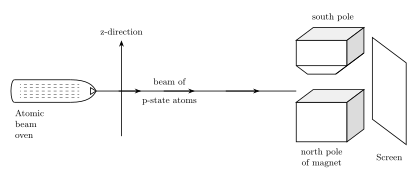
In an atomic physics experiment a beam of p-state atoms is passed through a non-uniform magnetic field. After passing through the magnetic field the atomic beam strikes at the screen and is detected as shown in the given figure. Obtain an expression of the force acting on the p-atoms beam due to gradient in the magnetic field acting along z-axis as shown. Also comment on the number of spots that are found on the screen as an outcome and explain.
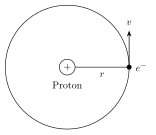
Consider an electron circulating around a proton (as shown in figure) in a circular orbit of radius, r. Assuming the motion of orbiting electron equivalent to an electrical current loop, find the expression for the ratio of magnetic moment to the angular momentum of the system and estimate the numerical value of this ratio.
How many different wavelengths may be observed in the spectrum from a hydrogen sample, if the atoms are excited to states with principle quantum number n ?
Show that for pure rotational spectrum of a diatomic molecule the wave number difference between the consecutive lines \Delta \bar{\nu} = \frac{\hbar}{2\pi Ic}, where I is the moment of interia.
If \Delta \bar{\nu} = 4050\text{ m}^{-1} for the HF molecule, what is the interatomic distance of this molecule ? [Given \hbar = 1\cdot 05 \times 10^{-34}\text{ Js}]
The most intense vibrational bands of CO and HCl molecules have the wave numbers 2\cdot 143 \times 10^5\text{ m}^{-1} and 2\cdot 886 \times 10^5\text{ m}^{-1} respectively. Calculate the force constants of these molecules.
What is nuclear precession? How is it used in the principle of working of an NMR?
Discuss the theory of rotational and vibrational spectra of diatomic molecules. What is the difference between fluorescence and phosphorescence?