
Comment Done
Navigation
HomePYQs Question BankCSE Physics OptionalIFoS Physics OptionalBlog & InsightsCourses & ProgrammesFree materialsMy Courses (Candidate Portal)
Account
/
20 questions visible on this page

Consider an electron circulating around a proton (as shown in figure) in a circular orbit of radius, r. Assuming the motion of orbiting electron equivalent to an electrical current loop, find the expression for the ratio of magnetic moment to the angular momentum of the system and estimate the numerical value of this ratio.
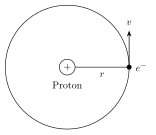
Physics Diagram ifos-q-6-019-fig-1
IFoS 2018Paper II8 marksifos-2018-subject-06-001

The most intense vibrational bands of CO and HCl molecules have the wave numbers 2\cdot 143 \times 10^5\text{ m}^{-1} and 2\cdot 886 \times 10^5\text{ m}^{-1} respectively. Calculate the force constants of these molecules.

IFoS 2018Paper II10 marksifos-2018-subject-06-006

The radial part of Schrödinger wave function for hydrogen atom for spherical symmetric potential V(r) = -\frac{e^2}{4\pi \varepsilon_0 r} is given as : \frac{1}{r^2}\frac{d}{dr}\left(r^2 \frac{dR}{dr}\right) + \frac{2\mu}{\hbar^2}\left[ E - V(r) - \frac{\hbar^2}{2\mu}\frac{l(l+1)}{r^2}\right] R = 0, where \mu = \frac{mM}{m+M} is reduced mass and m and M are mass of electron and proton respectively. (i) Obtain the form of the above equation for ground state electron of hydrogen atom. (ii) Also starting with a trial wave function for the radial equation, R = A e^{-r/a_0}, for the l = 0 state, find the expressions of energy E and orbital radius for the ground state of hydrogen atom.

IFoS 2018Paper II5+15=20 marksifos-2018-subject-05-005

Consider a particle trapped in a box of width L and its \text{n}^{\text{th}} state wave function is given by \psi_n (n) = \sqrt{\frac{2}{L}} \sin\left(\frac{n\pi x}{L}\right). Calculate the expectation value of the position <x> of the particle. How is this result different from classical consideration of finding the particle inside the box ?

IFoS 2018Paper II10 marksifos-2018-subject-05-007

Electrons with energies of 1\cdot 0\text{ eV} and 2\cdot 0\text{ eV} are incident on a barrier 10\cdot 00\text{ eV} high and 0\cdot 50\text{ nm} (nanometer) wide. Calculate the ratio of their respective transmission probabilities across the barrier.

IFoS 2018Paper II8 marksifos-2018-subject-05-003

The quantum theory describes the angular momentum (\vec{J}) as a linear operator with three components J_x, J_y and J_z in three dimensions. For the angular momentum operator prove that [J^2, J_i] = 0, where i = x, y, and z and comment on the measurability of J^2 and its components as operators.

IFoS 2018Paper II15 marksifos-2018-subject-05-008

Given the time dependent one-dimensional Schrödinger wave equation as H\psi(t) = i\hbar \frac{\partial \psi(t)}{\partial t}, \text{ with } H = \frac{\vec{p}\cdot \vec{p}}{2m} + V(\vec{x}) as Hermitian operator for a particle of momentum \vec{p} under the influence of a potential V(\vec{x}). Find the value of \frac{d}{dt}\left(\int \psi^*(t) \psi(t) \, dx\right).

IFoS 2018Paper II8 marksifos-2018-subject-05-004

Consider an experiment in which a beam of electrons is directed at a plate containing two slits, labelled as A and B. Beyond the plate is a screen, where electrons hit the screen and are detected. For each of the following cases sketch the variation of the relative number of incident electrons as a function of position along the screen and also provide brief explanation about each observation : (i) Slit A open, slit B closed, (ii) Both A and B are open.

IFoS 2018Paper II10 marksifos-2018-subject-05-002

Write down the Schrödinger wave equation for a one-dimensional harmonic oscillator in which a particle of mass m and frequency \omega is subject to a parabolic potential V(x) = m\omega^2 x^2/2. Let one of the possible energy eigen states be given by \psi(x) = Ax e^{-x^2/x_0^2}. Find the energy E corresponding to the eigen state given by \psi(x). Is it a ground state energy or one of the excited state energies ? Comment.

IFoS 2018Paper II20 marksifos-2018-subject-05-006

Prove the following identities:

(i) [\hat{p}_x,\hat{L}_y]=i\hbar\hat{p}_z

(ii) e^{i(\hat{\sigma}\cdot\hat{n})\theta}=\cos\theta+i(\hat{\sigma}\cdot\hat{n})\sin\theta

CSE 2018Paper II7+8=15 markscse-2018-subject-05-009

Show that for free electron gas, the density of states in three dimensions (3D) varies as E^{1/2}, and this dependence changes to E^0 for 2D (quantum well), E^{-1/2} for 1D (quantum wire) and \delta function for 0D (quantum dot).

CSE 2018Paper II15 markscse-2018-subject-05-010

The ground state wave function for hydrogen atom is \psi(r)=\frac{1}{\sqrt{\pi a_0^3}}e^{-r/a_0} where a_0 is the Bohr radius. Sketch the wave function and the probability density as a function of the separation distance r. Calculate the probability that the electron in the ground state is found beyond the Bohr radius.

CSE 2018Paper II20 markscse-2018-subject-05-008

Calculate the zero-point energy of a system consisting of a mass of 10^{-3}\,\mathrm{kg} connected to a fixed point by a spring which is stretched by 10^{-2}\,\mathrm{m} by a force of 10^{-1}\,\mathrm{N}. The system is constrained to move only in one direction.

CSE 2018Paper II10 markscse-2018-subject-05-004

Which of the following functions is/are acceptable solution(s) of the Schrodinger equation?

(i) \psi(x)=Ae^{-ikx}+Be^{ikx}

(ii) \psi(x)=Ae^{-kx}+Be^{kx}

(iii) \psi(x)=A\sin 3kx+B\cos 5kx

(iv) \psi(x)=A\sin 3kx+B\sin 5kx

(v) \psi(x)=A\tan kx Explain your answer.

CSE 2018Paper II15 markscse-2018-subject-05-006

A beam of particles of energy 9\,\mathrm{eV} is incident on a potential step 8\,\mathrm{eV} high from the left. What percentage of particles will reflect back?

CSE 2018Paper II15 markscse-2018-subject-05-007

Calculate the radius of electron orbit for \mathrm{Li}^{++} in ground state.

CSE 2018Paper II10 markscse-2018-subject-05-001

What is Zeeman effect? Discuss the factors on which Larmor frequency is dependent.

CSE 2018Paper II15 markscse-2018-subject-05-002

The wave function of a particle is given as \psi(x)=\frac{1}{\sqrt{a}}e^{-\lvert x\rvert/a}. Find the probability of locating the particle in the range -a\leq x\leq a.

CSE 2018Paper II10 markscse-2018-subject-05-003

The general wave function of harmonic oscillator (one-dimensional) are of the form u_n(x)=\sum_{k=0}^{\infty}a_k y^k e^{-y^2/2} With y=\sqrt{\frac{m\omega}{\hbar}}x, and coefficients a_k are determined by recurrence relations a_{k+2}=\frac{2(k-n)}{(k+1)(k+2)}a_k Corresponding energy levels are E_n=\left(n+\frac{1}{2}\right)\hbar\omega. Discuss the parity of these wave functions. What happens, if the potential for x\leq 0 is infinite (half harmonic oscillator)?

CSE 2018Paper II10 markscse-2018-subject-05-005

Use uncertainty principle to estimate the ground state energy of a linear harmonic oscillator.

IFoS 2018Paper II8 marksifos-2018-subject-05-001

Document & Diagram Scanner

Clean whiteboard & high-contrast scan with automatic image enhancement

Filter:
-- × -- pxCompressed: -- KB--% saved