
(i) What is central force? Give two examples of the central force.
(ii) Show that the angular momentum \vec{L} of the particle in a central force field is a constant of motion.
cse-2019-subject-01-001
(i) What is central force? Give two examples of the central force.
(ii) Show that the angular momentum \vec{L} of the particle in a central force field is a constant of motion.
Show that the cross-section for elastic scattering of a point particle from an infinitely massive sphere of radius R is \dfrac{R^2}{4}. What is the inference of this result?
Two \beta-particles A and B emitted by a radioactive source R travel in opposite directions, each with a velocity of 0.9c with respect to the source. Find the velocity of B with respect to A (Here c is the velocity of light).
Consider a light beam passing through a horizontal column of water moving with a velocity 'v'. Determine the speed u of the light measured in the lab frame when the beam travels in the same direction as the flow of the water. (Speed of water = v (lab frame), and refractive index = n)
How fast and in what direction must galaxy A be moving if an absorption line found at wavelength 550\text{ nm} (green) for a stationary galaxy is shifted to 450\text{ nm} for galaxy A and how fast and in what direction is galaxy B moving if the same line is shifted to 700\text{ nm} for it ?
Estimate the current gain of an n-p-n transistor if only 0\cdot 3\% of the conduction electrons that enter the base from the emitter recombine in the base region.
A small magnet is placed on the surface of a disc of normal material. Explain what happens when the disc is cooled down so that it becomes superconducting. Can this be explained from classical viewpoint if we simply treat the superconductor as a material which has zero resistivity ?
Describe the working of a microprocessor system in block diagram. How is its performance affected in a pipelined processor?
Derive an expression for lattice specific heat in Debye model. Find its low temperature limit (Debye T^3 law).
What are type I and type II superconductors? Give examples. Discuss and compare Meissner effect and perfect diamagnetic behaviour for type I and type II superconductors.
What are intrinsic and extrinsic semiconductors? Show that in the intrinsic semiconductors, Fermi level lies exactly in the middle of bottom of conduction band and top of valence band.
Derive Bragg diffraction law for X-ray diffraction. Compare Laue and Debye-Scherrer methods for crystal structure determination.
What are operational amplifiers? How can it be used as an inductor? Prove it mathematically.
Calculate Atomic Packing Fraction (APF) for FCC and HCP structures, and show that these are the most closely packed structures.
Calculate the total conductivity in an intrinsic semiconductor. How does this conductivity change with temperature ?
Draw the circuit of a phase shift oscillator using transistor. Obtain the expression for the frequency of oscillations and condition for sustained oscillations. Give necessary equivalent circuit while deriving the expression of frequency of oscillations and condition for sustained oscillations.
A pair of transistors operates in a class B push-pull circuit with a power supply of voltage V_{\text{cc}} = 12\text{ V}. If the turns ratio of the output transformer is 2 and the load resistance R_{\text{L}} is 6\ \Omega, calculate the maximum output power and maximum dc power supplied. Hence find efficiency of the circuit. Neglect transformer winding resistance.
Derive the expression for electron concentration in the conduction band of an intrinsic semiconductor.
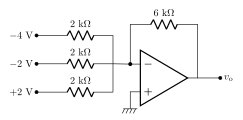
Find the output voltage of the three-input adder circuit shown below.
Explain drift velocity, mobility and conductivity of an intrinsic semiconductor.