Two particles each of rest mass 1\text{ gm} collide head-on with the speed 0\cdot 8\text{c} to stick together at rest. Find the mass of the final composite.
ifos-2025-subject-01-005
Two particles each of rest mass 1\text{ gm} collide head-on with the speed 0\cdot 8\text{c} to stick together at rest. Find the mass of the final composite.
(i) Define cyclic coordinates and find their connections with the symmetries of the system.
(ii) A system with two degrees of freedom is described by the Lagrangian \text{L} = \frac{1}{2}\text{m}_1 \dot{\text{q}}_1^2 + \frac{1}{2}\text{m}_2 \text{q}_1^2 \dot{\text{q}}_2^2 - \frac{\alpha}{\text{q}_1}, \alpha is constant. Find the cyclic coordinates, conserved quantities and symmetries for this system, if any.
Calculate the effective gravitational acceleration at the equator due to the Earth's rotation. [\text{R}_{\text{earth}} = 6400\text{ km}]
A particle of mass \text{m} moves under the attractive central force \text{F} = -\frac{\text{C}}{\text{r}^{\text{n}+1}}. Find the condition for which the particle will have stable circular orbit. (\text{C} > 0, a constant).
Write down the Euler equations for torque-free motion of a rigid body. Solve these equations to find precessing motion for a symmetric top.
Consider two inertial frames \text{S} and \text{S}'. \text{S}' is moving along \text{y}-direction with a constant speed \text{v}_0. Find how the first order partial derivatives with respect to \text{x}, \text{y}, \text{z} and \text{ct} are connected in these two inertial frames. Show that the D'Alembertian, \nabla^2 - \frac{1}{\text{c}^2}\frac{\partial^2}{\partial \text{t}^2} is invariant under the Lorentz transformation.
Find the equation of orbit for a particle of mass m, moving in the influence of central force F(r) in terms of u \left(\equiv \frac{1}{r}\right).
Define Coriolis force. A particle is dropped from a height h vertically at the northern hemisphere at latitude \theta. Find its deflection from the vertical line due to Coriolis force.
Consider two inertial frames S and S'. S is at rest and S' is moving along x - x' direction with constant speed v. (i) Find how different components of momentum four-vector in S and S' frames are related. (ii) Show that p^\mu p_\mu is Lorentz invariant.
The moment of inertia tensor of a cube of mass M and side a is given by the matrix I = \frac{M a^2}{12} \begin{bmatrix} 8 & -3 & -3 \\ -3 & 8 & -3 \\ -3 & -3 & 8 \end{bmatrix}. Calculate the principal moments of inertia of the cube.
The Lagrangian of a system is given by L (\vec{r}, \vec{v}) = \frac{1}{2} m (\vec{v} + \vec{a})^2 + \vec{b} \cdot \vec{v} - \vec{c} \cdot \vec{r} where, \vec{a}, \vec{b} and \vec{c} are constant vectors. Construct the Hamiltonian of the system and find the canonical equations of motion.
Define generalized coordinates. How many generalized coordinates are required to describe the dynamics of (i) a free rigid body in 3 dimension ? (ii) a solid cylinder rolling in an inclined plane without slipping ?
Write down the expression for kinetic energy of a relativistic particle with rest mass m_0, moving with a speed v. (i) Show that the kinetic energy reduces to \frac{1}{2} m_0 v^2 in the non-relativistic limit. (ii) Find the first relativistic correction to the non-relativistic kinetic energy.
Construct the Lagrangian of a simple pendulum whose string is replaced by a spring with spring constant k and rest length l_0 oscillating in a vertical x - y plane. Find the equations of motion.
Calculate the velocity of a particle having kinetic energy four times the rest mass energy.
A particle of mass m moves under the action of a central force whose potential is V(r) = Kmr^4 (K > 0). Calculate the kinetic energy for which the orbit will be circle of radius R, about the origin.
Why can Electron-Positron pair production through a high energy photon not take place in vacuum?
Calculate the inertia tensor for a rigid body consisting of three particles of masses 3\text{ gm}, 1\text{ gm}, 2\text{ gm} located at (1, -1, 2)\text{ cm}, (1, 0, 2)\text{ cm}, (-2, 1, 0)\text{ cm} respectively.
Calculate the inertia tensor for a rigid body consisting of three particles of masses 3 gm, 1 gm, 2 gm located at (1, -1, 2)\text{ cm}, (1, 0, 2)\text{ cm}, (-2, 1, 0)\text{ cm} respectively.
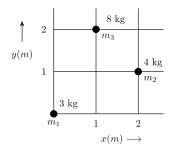
What are the coordinates of the centre of mass of the system of masses shown in the figure?