
Explain an experiment for determination of the refractive index of a gas using Michelson interferometer.
ifos-2023-subject-02-005
Explain an experiment for determination of the refractive index of a gas using Michelson interferometer.
Find an expression for the average energy of a forced oscillator in the steady-state motion.
An achromatic doublet of focal length 25\text{ cm} is to be made by placing a convex lens of borosilicate crown glass in contact with a diverging lens of dense flint glass. Assuming n_r = 1 \cdot 61864, n_b = 1 \cdot 62468, n_r' = 1 \cdot 71426 and n_b' = 1 \cdot 72906, calculate the focal length of each lens. Here, the unprimed and the primed quantities refer to the borosilicate crown glass and dense flint glass respectively.
Explain with proper examples the techniques of obtaining interference by 'division of wavefront' and 'division of amplitude'.
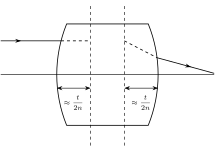
Consider a thick equiconvex lens of refractive index 1 \cdot 5 as shown in the figure. The magnitude of the radii of curvatures of the two surfaces is 5\text{ cm}. The thickness of the lens is 1\text{ cm} and the lens is placed in the air. Obtain the system matrix and determine the focal length and the position of unit planes :
A length of 25 cm of a solution containing 50 gm of solute per litre causes a rotation of the plane of polarization of light by 5^\circ. Find the rotation of the plane of polarization by a length of 75 cm of the solution containing 100 gm of solute per litre.
A length of 25\text{ cm} of a solution containing 50\text{ gm} of solute per litre causes a rotation of the plane of polarization of light by 5^\circ. Find the rotation of the plane of polarization by a length of 75\text{ cm} of the solution containing 100\text{ gm} of solute per litre.
Define Einstein's coefficients A and B for spontaneous and stimulated emissions, and write the relation between them. If the Einstein's coefficient of spontaneous emission is 10^7/\text{s}, determine the Einstein's coefficients for the stimulated emission for the emission wavelength of 5800\text{ \AA}.
Why can Electron-Positron pair production through a high energy photon not take place in vacuum?
In a reference frame S, an event 1 occurs at the origin at t = 0 and another event 2 occurs at x = 4000\text{ m} and time t = 5 \times 10^{-6}\text{ s}. Find the time interval between the events as registered by clock in a frame S' moving with speed v = 0 \cdot 6 \, c relative to S along the common X-X' axis, the origin coinciding at t = t' = 0\,.
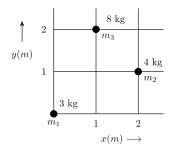
What are the coordinates of the centre of mass of the system of masses shown in the figure?
Calculate the inertia tensor for a rigid body consisting of three particles of masses 3\text{ gm}, 1\text{ gm}, 2\text{ gm} located at (1, -1, 2)\text{ cm}, (1, 0, 2)\text{ cm}, (-2, 1, 0)\text{ cm} respectively.
A particle of mass m moves under the action of a central force whose potential is V(r) = Kmr^4 (K > 0). Calculate the kinetic energy for which the orbit will be circle of radius R, about the origin.
A hoop is rolling down on an inclined plane without slipping. Find its velocity at the bottom of the inclined plane.
Calculate the velocity of a particle having kinetic energy four times the rest mass energy.
Calculate the inertia tensor for a rigid body consisting of three particles of masses 3 gm, 1 gm, 2 gm located at (1, -1, 2)\text{ cm}, (1, 0, 2)\text{ cm}, (-2, 1, 0)\text{ cm} respectively.
A particle of mass m moves under the action of a central force whose potential is V(r) = Kmr^4 (K > 0). Calculate the kinetic energy for which the orbit will be circle of radius R, about the origin.
State the basic conditions for oscillations in a feedback amplifier. What are the primary requirements to obtain steady oscillations at a fixed frequency?
(i) Prove the following using De Morgan's theorems : A \cdot B + C \cdot D = \overline{\overline{A \cdot B} \cdot \overline{C \cdot D}} (ii) Simplify the following expression : Y = A \cdot B \cdot \bar{C} \cdot D + \bar{A} \cdot B \cdot \bar{C} \cdot \bar{D} + B \cdot \bar{C} \cdot D
Describe briefly the functions of the basic segments of a microprocessor. Draw a block diagram of the registers in the 8085 microprocessor.