Show that the square of the orbital angular momentum operator (L^2) commutes with any of the components of angular momentum operator L. Is it possible to measure L^2, L_x, L_y and L_z simultaneously ? Give reasons for your answer.
(i) Assuming the potential seen by a neutron in a nucleus to be schematically represented by a one-dimensional, infinite rigid wall potential of length 10^{-15}\text{ m}, estimate the minimum kinetic energy of the electron. (ii) Estimate the minimum kinetic energy of neutron bound within the nucleus as described above. Can an electron be confined in a nucleus ? Explain.
Calculate the Fermi energy in electron-volt for sodium assuming that it has one free electron per atom. The density of sodium = 0.97\text{ gm/cc} and the atomic weight of sodium is 23.
Prove that the work done by a perfect gas during a quasi-static adiabatic expansion is given by W = \frac{P_i V_i}{\gamma - 1} \left[ 1 - \left( \frac{P_f}{P_i} \right)^{\frac{\gamma - 1}{\gamma}} \right] where \gamma is the ratio of specific heats.
Define internal energy U, Helmholtz's function F, enthalpy H, Gibbs' potential G and hence obtain the four Maxwell's thermodynamic relations.
Explain the T-s diagram for the reversible Carnot cycle and hence obtain the expression for the efficiency of the Carnot engine.
The specific heat of a solid at low temperatures is given by the relation C_V = AT^3, where A is a constant and T is the absolute temperature. How much heat will be required to raise the temperature of m\text{ gm} of the solid from 300\text{ K} to 500\text{ K}?
What do you understand by macrostates and microstates? Briefly explain.
What is anomalous dispersion? How does the phenomenon of dispersion lead to the separation of white light into its constituent colours?
Consider a uniformly magnetized sphere of radius a and magnetization \vec{M} = M_0 \hat{z} surrounded by a vacuum region. Obtain an expression for scalar magnetic potential for r < a.
How does Planck's law resolve the ultraviolet catastrophe predicted by classical physics? Calculate the average energy \bar{\varepsilon} of an oscillator of frequency 0.60 \times 10^{14}\text{ s}^{-1} at T = 1800\text{ K}, treating it as (i) classical oscillator and (ii) Planck's oscillator.
Using Maxwell's equations, obtain Poisson's equation and Laplace's equation. The region -\frac{\pi}{2} < \frac{z}{z_0} < \frac{\pi}{2} has a charge density \rho = 10^{-8} \cos \left( \frac{z}{z_0} \right) (\text{C/m}^3). Elsewhere the charge density is zero. Find the electric potential V and electric field E from the Poisson's equation.
In spherical coordinates, V = -25\text{ V} on a conductor at r = 2\text{ cm} and V = 150\text{ V} on another conductor at r = 35\text{ cm}. The space between the conductors is a dielectric for which \varepsilon_r = 3.12. Find the surface charge densities on the conductors.
Obtain the general boundary conditions for fields E, B, D and H at a boundary between two different media carrying charge density \sigma or a current density K.
The magnitude of the average electric field normally present in the Earth's atmosphere just above the surface of the Earth is about 150\text{ N/C}, directed radially inward, toward the centre of the Earth. What is the total net surface charge carried by the Earth? Assume the Earth to be a conductor. (The radius of the Earth is 6.37 \times 10^6\text{ m})
Find the magnetic field strength (H) at the centre of a square current loop of side L.
A uniform plane wave with \vec{E} = E_x \hat{a}_x propagates in a lossless medium (\varepsilon_r = 4, \mu_r = 1, \sigma = 0) in the z-direction. Assume that E_x is sinusoidal with a frequency 100\text{ MHz} and has a maximum value of 10^{-4}\text{ (V/m)} at t = 0 and z = \frac{1}{8}\text{ (m)}. (i) Write the expression for instantaneous E for any t and z. (ii) Write the expression for instantaneous H. (iii) Determine the locations where E_x is a positive maximum, when t = 10^{-8}\text{ (s)}.
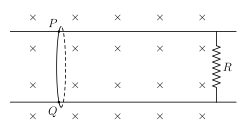
Consider a situation shown in the figure below. The wire PQ has mass m, resistance r and can slide on the smooth, horizontal parallel rails separated by a distance l. The resistance of rails is negligible. A uniform magnetic field B exists in the rectangular region and a resistance R connects the rails outside the field region. At t = 0, the wire PQ is pushed towards right with a speed V_0. Find (i) the current in the loop at an instant when the speed of the wire PQ is V and (ii) the acceleration of the wire at this instant :
A weakly damped harmonic oscillator consisting of spring-mass system has the following parameters : Mass m = 0.25\text{ kg}, Spring constant k = 100\text{ N m}^{-1}, Damping coefficient \gamma = 1\text{ N s m}^{-1} A periodic force F = 5 \cos \omega t (newton) is applied to the system. Determine (i) the amplitude of the oscillator at resonance and (ii) the Q-value of the oscillator.
Explain the phenomenon of double refraction. What are positive and negative crystals? Give their examples.