
Derive an expression for intermodal dispersion for a multimodal step-index fibre.
cse-2012-subject-02-007
Derive an expression for intermodal dispersion for a multimodal step-index fibre.
A diffraction grating of width 5 cm with slits of width 10^{-4} cm separated by a distance of 2\times10^{-4} cm is illuminated by light of wavelength 550 nm. What will be the width of the principal maximum in the diffraction pattern? Would there be any missing orders?
Distinguish between Fresnel and Fraunhofer classes of diffraction. Show that the area of each Fresnel half-period zone is same.
Two identical relativistic particles of rest mass m and kinetic energy T collide head-on. What is the relative kinetic energy, i.e., the kinetic energy T' of one in the rest frame of the other?
Define a conservative field. Determine if the field given below is conservative in nature: \vec{E}=c\left[y^2\hat{i}+(2xy+z^2)\hat{j}+2yz\hat{k}\right]\,\mathrm{V/m} where c is a constant.
Consider a uniform half-sphere of radius R and mass M. The half-sphere is supported by a frictionless horizontal plane as shown in the figure. The half-sphere lies in the region z<0.
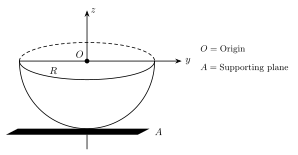
Find the centre of mass of the half-sphere.
A particle is moving in a central force field on an orbit given by r = ke^{\alpha\theta}, where k and \alpha are positive constants, r is the radial distance and \theta is the polar angle.
(i) Find the force law for the central force field.
(ii) Find \theta(t).
(iii) Find the total energy.
A rigid body is spinning with an angular velocity of 4\ \mathrm{rad\,s^{-1}} about an axis parallel to the direction (4\hat{\jmath}-3\hat{k}) passing through the point A with \overrightarrow{OA}=2\hat{\imath}+3\hat{\jmath}-\hat{k}, where O is the origin of the coordinate system. Find the magnitude and direction of the linear velocity of the body at point P with \overrightarrow{OP}=4\hat{\imath}-2\hat{\jmath}+\hat{k}.
Calculate the moment of inertia of a solid cone of mass M, height h, vertical half-angle \alpha and radius of its base R, about an axis passing through its vertex and parallel to its base.
A projectile of mass M explodes, while in flight, into three fragments. One fragment of mass m_1=M/2 travels in the original direction of the projectile. Another fragment of mass m_2=M/6 travels in the opposite direction and the third fragment of mass m_3=M/3 comes to rest. The energy E, released in the explosion, is 5 times the kinetic energy of the projectile at explosion. What are the velocities of the fragments?
A man has a mass of 100\text{ kg} on earth. When he is on the space craft an observer from the earth registers his mass as 102\text{ kg}. Determine the speed of the space craft.
Using the concept of the operator equation for a given vector quantity of a rotating body, show that \vec{v}_s = \vec{v}_r + \vec{\omega} \times \vec{r} where \vec{v}_s and \vec{v}_r are the velocities of the particle relative to space and rotating sets of axes while \vec{\omega} is the angular velocity of the earth relative to the inertial system. Obtain the expression for the Coriolis force for such a moving system of mass m.
State Hamilton's principle for the motion of a monogenic system. Use the calculus of variation to deduce Lagrange's equation that follows from Hamilton's principle. Explain carefully all the terms used in the derivation.
Using D'Alembert's principle, show that the following relation can be obtained for a system of particles under generalized coordinates \sum_i \vec{F}_i \cdot \delta \vec{r}_i = \sum_j Q_j \delta q_j with Q_j = \sum_i \vec{F}_i \cdot \frac{\partial \vec{r}_i}{\partial q_j}. What is the significance of Q_j ?
Starting with Newton's second law of motion, establish D'Alembert's principle and discuss its significance.
Express Lagrange's equation of motion for the cyclic coordinate q_j and show that the result leads to the general conservation theorem for the generalized momentum coordinates.
Draw the common-base amplifier circuit, using an n-p-n transistor and briefly discuss its working.
An electron beam of 4 Kev is diffracted through a Bragg angle of 16^\circ for the first maxima. If the energy is increased to 16 keV, find the corresponding Bragg angle for diffraction.
Using band theory of solids, explain whether the effective mass of an electron can be positive, negative as well as infinity. Explain the significance of negative mass.
(i) What are intrinsic and extrinsic semiconductors ? Explain. (ii) How are n-type and p-type semiconductors obtained ?