The motion of a damped mechanical oscillator is represented by m\ddot{x}+\alpha\dot{x}+\beta x=0 where m, \alpha and \beta are constants. The oscillator is critically damped. The system is given an impulse at x=0 and t=0, resulting in an initial velocity v. After how much time the system experiences maximum displacement?
The separation between the slits is 0.5\,\text{mm} in Young's double-slit experiment. The interference pattern observed on a screen placed 5\,\text{m} away reveals the location of the first maximum which is 6\,\text{mm} from the centre of the pattern. Calculate the wavelength of light and separation between second and third bright fringes.
Distinguish between Fresnel and Fraunhofer classes of diffraction. Show that the area of each Fresnel half-period zone is same.
Two identical relativistic particles of rest mass m and kinetic energy T collide head-on. What is the relative kinetic energy, i.e., the kinetic energy T' of one in the rest frame of the other?
A projectile of mass M explodes, while in flight, into three fragments. One fragment of mass m_1=M/2 travels in the original direction of the projectile. Another fragment of mass m_2=M/6 travels in the opposite direction and the third fragment of mass m_3=M/3 comes to rest. The energy E, released in the explosion, is 5 times the kinetic energy of the projectile at explosion. What are the velocities of the fragments?
Define a conservative field. Determine if the field given below is conservative in nature: \vec{E}=c\left[y^2\hat{i}+(2xy+z^2)\hat{j}+2yz\hat{k}\right]\,\mathrm{V/m} where c is a constant.
A rigid body is spinning with an angular velocity of 4\ \mathrm{rad\,s^{-1}} about an axis parallel to the direction (4\hat{\jmath}-3\hat{k}) passing through the point A with \overrightarrow{OA}=2\hat{\imath}+3\hat{\jmath}-\hat{k}, where O is the origin of the coordinate system. Find the magnitude and direction of the linear velocity of the body at point P with \overrightarrow{OP}=4\hat{\imath}-2\hat{\jmath}+\hat{k}.
Calculate the moment of inertia of a solid cone of mass M, height h, vertical half-angle \alpha and radius of its base R, about an axis passing through its vertex and parallel to its base.
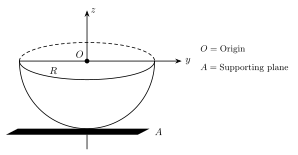
Consider a uniform half-sphere of radius R and mass M. The half-sphere is supported by a frictionless horizontal plane as shown in the figure. The half-sphere lies in the region z<0.
Find the centre of mass of the half-sphere.
A particle is moving in a central force field on an orbit given by r = ke^{\alpha\theta}, where k and \alpha are positive constants, r is the radial distance and \theta is the polar angle.
(i) Find the force law for the central force field.
(ii) Find \theta(t).
(iii) Find the total energy.
Simplify the logical expression AB + \bar{A}\bar{B} + ABC using a Karnaugh map.
Simplify the logical expression \overline{(A+B)}B(A+\bar{C}) and draw the logical circuit to implement it.
Draw the common-base amplifier circuit, using an n-p-n transistor and briefly discuss its working.
Describe the characteristic properties of a superconductor. Derive London equation for a superconductor and hence explain Meissner effect.
Distinguish between intrinsic and extrinsic semiconductors. Show that in a semiconductor, the product of concentrations of the two types of charge carriers is constant at a given temperature.
Derive Bragg diffraction condition in vectorial form using incident and diffracted wave vectors and reciprocal lattice vector.
An electron beam of 4 Kev is diffracted through a Bragg angle of 16^\circ for the first maxima. If the energy is increased to 16 keV, find the corresponding Bragg angle for diffraction.
Explain the origin of energy band formation in solids. Show that in nearly free electron approximation, the energy band gap is 2|V_G|, where V_G is Fourier transform of periodic potential seen by the valence electrons.
Find an expression for lattice specific heat of solids, and its low and high temperature limits. What is Debye temperature?
{}^{235}\mathrm{U} yields two fragments of A=95 and A=140. Obtain the energy distribution of the fission products. Assume that the two fragments are ejected with equal and opposite momentum.