A particle of rest mass M=4\times10^{-27}\ \mathrm{kg}, disintegrates into two particles of rest masses M_1=3\times10^{-27}\ \mathrm{kg} and M_2=1\times10^{-27}\ \mathrm{kg}. Show that the energies E_1 and E_2 of these two parts after disintegration satisfy the condition E_1=3E_2 while moving in opposite directions with equal linear momenta. Give necessary mathematical derivation.
Show that the operator \left(\nabla^2-\frac{1}{c^2}\frac{\partial^2}{\partial t^2}\right) is invariant under Lorentz transformations.
Show that a particle of rest mass m_0, total energy E and linear momentum \vec{p} satisfies the relation E^2=c^2p^2+m_0^2c^4 where c is the velocity of light in free space.
Show that the kinetic energy and angular momentum of torque free motion of a rigid body is constant.
Derive the relativistic length contraction using Lorentz transformation.
Calculate the horizontal component of the Coriolis force acting on a body of mass 0.1\ \mathrm{kg} moving northward with a horizontal velocity of 100\ \mathrm{ms^{-1}} at 30^{\circ}\mathrm{N} latitude on the Earth.
If the forces acting on a particle are conservative, show that the total energy of the particle which is the sum of the kinetic and potential energies is conserved.
Prove that as a result of an elastic collision of two particles under non-relativistic regime with equal masses, the scattering angle will be 90^\circ. Illustrate your answer with a vector diagram.
A particle describes a circular orbit under the influence of an attractive central force directed towards a point on the circle. Show that the force varies as the inverse fifth power of distance.
Suppose that an S'-frame is rotating with respect to a fixed frame having the same origin. Assume that the angular velocity \vec{\omega} of the S'-frame is given by \vec{\omega}=2t\hat{\imath}-t^{2}\hat{\jmath}+(2t+4)\hat{k} where t is time and the position vector \vec{r} of a typical particle at time t as assumed in S'-frame is given by \vec{r}=(t^{2}+1)\hat{\imath}-6t\hat{\jmath}+4t^{3}\hat{k}. Calculate the Coriolis acceleration at t=1 second.
Two identical relativistic particles of rest mass m and kinetic energy T collide head-on. What is the relative kinetic energy, i.e., the kinetic energy T' of one in the rest frame of the other?
A projectile of mass M explodes, while in flight, into three fragments. One fragment of mass m_1=M/2 travels in the original direction of the projectile. Another fragment of mass m_2=M/6 travels in the opposite direction and the third fragment of mass m_3=M/3 comes to rest. The energy E, released in the explosion, is 5 times the kinetic energy of the projectile at explosion. What are the velocities of the fragments?
Calculate the moment of inertia of a solid cone of mass M, height h, vertical half-angle \alpha and radius of its base R, about an axis passing through its vertex and parallel to its base.
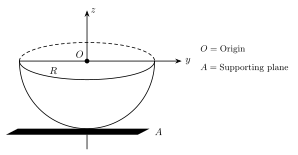
Consider a uniform half-sphere of radius R and mass M. The half-sphere is supported by a frictionless horizontal plane as shown in the figure. The half-sphere lies in the region z<0.
Find the centre of mass of the half-sphere.
A particle is moving in a central force field on an orbit given by r = ke^{\alpha\theta}, where k and \alpha are positive constants, r is the radial distance and \theta is the polar angle.
(i) Find the force law for the central force field.
(ii) Find \theta(t).
(iii) Find the total energy.
A rigid body is spinning with an angular velocity of 4\ \mathrm{rad\,s^{-1}} about an axis parallel to the direction (4\hat{\jmath}-3\hat{k}) passing through the point A with \overrightarrow{OA}=2\hat{\imath}+3\hat{\jmath}-\hat{k}, where O is the origin of the coordinate system. Find the magnitude and direction of the linear velocity of the body at point P with \overrightarrow{OP}=4\hat{\imath}-2\hat{\jmath}+\hat{k}.
Define a conservative field. Determine if the field given below is conservative in nature: \vec{E}=c\left[y^2\hat{i}+(2xy+z^2)\hat{j}+2yz\hat{k}\right]\,\mathrm{V/m} where c is a constant.
On the basis of three principal moments of inertia I_A, I_B and I_C each about X, Y and Z axes respectively, how can you classify molecules?
With an appropriate diagram, deduce the velocity profile for streamline flow of a liquid through a capillary of circular cross-section. Deduce also the fraction of liquid which flows through the section up to a distance a/2 from the axis, where a is the radius of the capillary.
A spaceship measures 50 m in length on ground and it measured a length of 49.7 m in space as observed from the ground. Find out the speed of the spaceship.