
N particles are distributed among three states having energies E = 0, E = kT and E = 2kT. If the total equilibrium energy of the system is 1000 kT, what is the value of N?
ifos-2010-subject-04-001
N particles are distributed among three states having energies E = 0, E = kT and E = 2kT. If the total equilibrium energy of the system is 1000 kT, what is the value of N?
Explain why the distribution of speeds of molecules emerging through a small hole in an effusive molecular beam source is not a Maxwellian distribution.
Let f be the Fermi-Dirac distribution function, then show that— (i) -\left(\dfrac{\partial f}{\partial E}\right) is a maximum at the Fermi level;
What is meant by a dielectric? Define polarization vector P and relate it with the average molecular dipole moment. Obtain expression for the potential due to a polarized dielectric in terms of the polarization vector.
Obtain Poisson's equation in electrostatics from Gauss' law. What form does it take when the charge density is zero?
Consider the L\text{-}C\text{-}R circuit shown below :
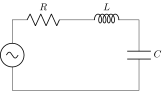
\begin{align*} R &= 0\cdot 1\ \Omega \\ L &= 1\text{ nH} \\ C &= 1\text{ nF} \end{align*}
(i) Determine its resonance frequency f_0.
A radiation gas of temperature T fills a cavity of volume V. The system expands adiabatically and reversibly to a volume equal to 8V. By what factor does the temperature change?
Consider a long, line charge with charge density \rho_l = 10^{-6}\text{ coulomb/m}. Find the force acting on a dust particle carrying -10^{-9}\text{ coulomb}, 1\text{ metre} away from the line charge in free space.
A spherical capacitor is made of concentric conductors of radii a and b (b > a). The total charge on the inner sphere of radius a is Q. (i) Derive an expression for the capacitance C.
(ii) The earth may be modeled as a spherical capacitor with a = 6\cdot 5 \times 10^6\text{ m} and b \rightarrow \infty. Determine C, if the medium surrounding the earth is free space.
A point charge +q is located near the corner of a horizontal and a vertical plate as shown below :
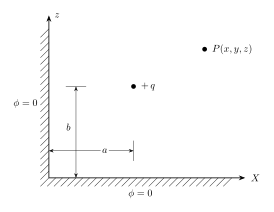
Obtain an expression for the electrostatic potential \phi_P using the image method.
The electromagnetic field inside a device is given by \vec{E} = \hat{y} E_0 \sin(k_x x) e^{-j k_z z}, \quad\text{where } k_x = \frac{n\pi}{a} \vec{H} = E_0 [\hat{x} \frac{-k_z}{\omega\mu} \sin(k_x x) + \hat{z} \frac{j k_x}{\omega\mu} \cos(k_x x)] e^{-j k_z z} Obtain an expression for the z-component of time-averaged Poynting vector \vec{S}.
A long wire of radius a carries I amperes of current. The magnetic field surrounding it is given by H_\phi = \dfrac{I}{2\pi\rho} for \rho > a. Obtain expressions for (i) the magnetic energy stored per unit length in the region b \ge \rho \ge a and (ii) the equivalent inductance L per unit length.
Show that when the temperature T of a radiating object is not too different from the surrounding temperature T_0, the object obeys Newton's law of cooling.
The following inputs are given :
\begin{align*} T_0 &= 5500\text{ K} && \text{(Sun surface temperature)}, \\ R &= 7 \times 10^{10}\text{ cm} && \text{(Sun radius)}, \\ r &= 6\cdot 4 \times 10^8\text{ cm} && \text{(Earth radius)}, \\ D &= 1\cdot 5 \times 10^{13}\text{ cm} && \text{(Sun--Earth distance)}. \end{align*}
Assume that the earth and the sun both absorb all electromagnetic radiations incident on them, and that the earth is at a constant temperature T over the day-night cycle. Calculate T.
Calculate, giving necessary steps, the radio frequency at which nuclear magnetic resonance occurs in water kept in a uniform magnetic field of 2.4\ \mathrm{T}. The magnetic moment of proton is 2.793\mu_N.
A wire of length 2 m is perpendicular to X-Y plane. It is moved with a velocity \vec{V}=(2\hat{i}+3\hat{j}+\hat{k})\,\mathrm{ms}^{-1} through a region of uniform induction \vec{B}=(\hat{i}+2\hat{j})\mathrm{Wm}^{-2}. Compute the potential difference between the ends of the wire.
If the magnetic moment of proton is 2.793\ \mu_N calculate, giving necessary steps, the radio frequency at which nuclear magnetic resonance occurs in water kept in a uniform magnetic field of 2.4\text{ T}.
Using Maxwell's field equations for a homogeneous non-conducting medium, derive the wave equation for the electric field. Calculate the velocity of EM wave in free space.
Explain the term 'Poynting vector' and state the significance of Poynting theorem.