
On the basis of three principal moments of inertia I_A, I_B and I_C each about X, Y and Z axes respectively, how can you classify molecules?
cse-2011-subject-01-006
On the basis of three principal moments of inertia I_A, I_B and I_C each about X, Y and Z axes respectively, how can you classify molecules?
A rigid body rotates with the angular velocity '\omega' about an axis through the origin O and having direction cosines l, m, n. Show that the moment of inertia of the rigid body about the axis is I = I_{xx} l^2 + I_{yy} m^2 + I_{zz} n^2 + 2 I_{xy} l . m + 2 I_{yz} m . n + 2 I_{zx} n . l where the symbols have their usual meanings.
With an appropriate diagram, deduce the velocity profile for streamline flow of a liquid through a capillary of circular cross-section. Deduce also the fraction of liquid which flows through the section up to a distance a/2 from the axis, where a is the radius of the capillary.
A spaceship measures 50 m in length on ground and it measured a length of 49.7 m in space as observed from the ground. Find out the speed of the spaceship.
The principal moments of inertia of a body at a point are given as 200, 300 and 450\text{ gm.cm}^2. Write down the equation of the ellipsoid of inertia at that point.
A particle of rest mass 'M' moving at a velocity 'u' collides with a stationary particle of rest mass 'm'. If the particles stick together, show that the speed of the composite ball is equal to v = \frac{u \gamma M}{(\gamma M + m)}, \quad \text{where } \gamma = \frac{1}{\sqrt{1 - \frac{u^2}{c^2}}}
What is nearly free electron approximation? On the basis of this approximation explain the formation of energy bands in solids.
Distinguish between Einstein and Debye models of specific heats of solids. Obtain an expression for the specific heat of a solid on the basis of Debye model. Discuss the results for low and high temperature ranges.
Distinguish between classical and quantum theory of paramagnetism. Explain the paramagnetism of free electrons on the basis of F.D. distribution.
What is Josephson tunnelling? Distinguish between a.c. and d.c. Josephson effects.
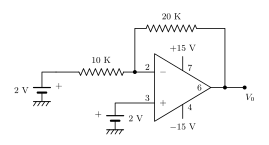
Identify the above op-amp circuit. Estimate the net output voltage V_0.
Employing NAND gates, design a half adder circuit which can add two bits A and B and provide a sum S and a carry C as its output.
Describe the essential parts of an oscillator circuit using a block diagram. Design a Colpitts oscillator set to a frequency of 1500\text{ Hz} and explain how your design incorporates the essential parts of the oscillator circuit.
What are the advantages of MOSFET over JFET ? Draw and explain the structure and working of a MOSFET which can function both in enhancement and depletion modes.
Using the collector characteristics of a bipolar junction transistor, show how you can use it as a switch with one ON and one OFF state. Plot and describe the operation of this circuit for a sinusoidal input.
Show the variation of magnetization with applied magnetic field for type I and type II superconductors. Describe their behaviour. Discuss their potential for various applications.
What is a Josephson junction ? Explain the phenomenon of tunneling of charge carriers across such a junction. Discuss DC and AC Josephson effects. Mention some applications of this device.
Draw a two stage RC coupled transistor amplifier. Plot the frequency response and indicate the lower and upper cut off frequencies and the bandwidth.
In one experiment, a perfect conductor and a superconductor are cooled to below 1\text{ K} and then a magnetic field is applied. In another experiment, they are cooled to below 1\text{ K} in magnetic field. Describe their responses in these two experiments and explain.
Discuss the motion of an electron in an allowed energy band under the influence of an external electric field. Obtain an expression for the effective mass of the electron and discuss its variation in the band.