Explain the fine structure of H_\alpha line of H-atom arising due to LS coupling.
cse-1996-subject-06-003
Explain the fine structure of H_\alpha line of H-atom arising due to LS coupling.
Describe Frank Hertz experiment to establish the quantization of energy levels.
An electron moving with energy E encounters one dimensional potential step as given below: V(x) = 0 \quad x < 0 \qquad V(x) = V_0 \quad x > 0 (a) Suppose the electron has the energy E > V_0 and is incident from (-x) direction, find the normalized wave function so corresponds to unit incident flux. (b) Solve the above problem for the case E < V_0 and discuss the significance of the result with the help of a suitable example.
Calculate the velocity and direction of recoil electron for back scattered X-ray photon of \text{Mo } K_\alpha of 0.707\ \text{\AA} in Compton effect.
A vacuum of the order of 10^{-11}\text{ cm of Hg} is obtained in the laboratory. Estimate the number of molecules of gas per cobic centimeter at 27^\circ \text{C} in that vacuum.
How is absolute scale of temperature obtained with the help of Carnol cycle? Hence define absolute zero
State the principle of equipartition of energy. What are its limitations? Show that it is applicable only when the energy is a quadratic function of the associated variable.
What is Brownian motion? Deduce Einstein's formula for translatory Brownian motion of particles suspended in a liquid and hence determine the avogadro's number.
Write a short note on Specific heat of solids.
Explain the concept of entropy The specific heat C_p of a material depends on temperature T according to the relation: C_p = a + bT + cT^2 \text{ where a, b and c are constants,} Derive an expression for the change in its entropy when the temperature changes from T_1 to T_2.
Using Maxwell's thermodynamic relations show that the internal energy of an ideal gas at a constant temperature is independent of its volume while for a real gas it is a function of Volume also.
To what extent the pressure in a cathode ray tube must be reduced so that 90\% of the electrons emitted by the cathode reach the anode which is at a distance of 20\text{ cm} from the cathode? The mean molecular radius of main constituent gases of atmosphere is 2\text{\AA} and the number of molecules at standard pressure (760\text{ mm of Hg}) is 3 \times 10^{25} per \text{m}^3.
Write a short note on Solar constant.
Show that electromagnetic propagating in a homogeneous isotropic medium, arc transverse in nature.
An electric dipole moment, \vec{p}_2, is placed at (r, \theta) in he electric field of another dipole moment \vec{p}_1, placed at he origin. Assuming that the electric potential, V, at (r, \theta) due to \vec{p}_1 is V(r, \theta) = \frac{p_1 \cos \theta}{4 \pi \epsilon_0 r^2} find the dipole-dipole interaction energy.
Show that attenuation constant \alpha and phase factor \beta for an electromagnetic wave, propagating in a perfectly conducting medium, are equal. At what frequency the skin depth in silver is 1\ \mu\text{m} when the conductivity of silver is 30 \times 10^6\text{ Siemens/meter} and relative permeability is 1.0?
Self inductance of two coils, A and B, connected in series is 25\text{ mH} or 10\text{ mH}, depending on the relative current directions in the coils. Self inductance of the isolated coil. A, is 10\text{ mH}. Calculate mutual inductance M of the pair of coils coupling factor and leakage factor. If the current in coils is changing at the rate of 1000\text{ A/s}, find the induced electromotive forces across the coil A.
A relay has a coil resistance of 10\ \Omega and inductance of 1\text{ H}. It is energized by a single voltage pulse of 10\text{ V} which remains constant for 250\text{ ms} and then falls to 0\text{ V}. Relay contact closes when the increasing current reaches 200\text{ mA} and opens when the decreasing current is at 100\text{ mA}. Calculate the time for which the relay contact is closed.
Starting from Biot Savart's law, find the vector potential at a distance r, from a current carrying wire.
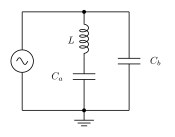
An alternating voltage is applied to the circuit shown in Fig. 1. Show that it has two resonant frequencies, f_p and f_s interrelated as f_p = f_s \sqrt{\left(1 + \frac{1}{r}\right)} Where r = \left(\frac{C_b}{C_a}\right)