Comment Done
Navigation
HomePYQs Question BankCSE Physics OptionalIFoS Physics OptionalBlog & InsightsCourses & ProgrammesMy Courses (Candidate Portal)
Account
/
20 questions visible on this page

A uniform rope of mass M and length L is hanging from a rigid support. A transverse wave travels along the rope. Calculate the speed of the wave at a distance x from the free end the time taken by the wave to travel the whole length.

CSE 1997Paper I20 markscse-1997-subject-02-003

The amplitude of damped oscillator of frequency 300\text{ Hz} reduces one-tenth of its initial amplitude after 3000 oscillations. Calculate the damping constant and the time in which its energy will reduce to one-tenth of its initial energy.

CSE 1997Paper I20 markscse-1997-subject-02-002

In a hydrogen atom for the 2\text{p} \to 1\text{ s} transition the probability per unit time is 6 \times 10^8\text{ s}^{-1}. Calculate the angular frequency of the emitted photons and the order of Einstein's coefficient \text{B}_{21}.

CSE 1997Paper I20 markscse-1997-subject-02-001

Write a short note on Coriolis force and its effects.

CSE 1997Paper I20 markscse-1997-subject-01-006

Moving in a closed elliptical orbit, Halley's comet goes round the Sun once every 75 years. At its point of closest approach its distance from the Sun is 8.9 \times 10^7\text{ km}. If mass of the Sun is 2 \times 10^{30}\text{ kg}, what will be the greatest distance of the comet from the Sun ?

CSE 1997Paper I20 markscse-1997-subject-01-005

In the ammonia molecule the three hydrogen atoms form an equilateral triangle. The distance between the centre of this triangle from each hydrogen atom is 0.939\text{ \AA}. The nitrogen atom is at the apex of the pyramid with the three hydrogen atoms forming the base. The distance between the hydrogen and nitrogen atoms is 1.014\text{ \AA}. Find the position of the centre of mass relative to the nitrogen atom.

CSE 1997Paper I20 markscse-1997-subject-01-001

The tides in oceans on Earth are produced by gravitational pull of the Sun and the Moon. The pull due to Sun is much greater than the pull due to Moon. Explain, why tides due to Sun are only about 0.4 times as high as that due to Moon. The mass of the Sun is 2 \times 10^7 times the mass of the Moon and the distance between Sun and Earth is 400 times the distance between Moon and Earth. The radius of the Earth is 6.4 \times 10^6\text{ m}.

CSE 1997Paper I20 markscse-1997-subject-01-003

Write a short note on Motion of rocket.

CSE 1997Paper I20 markscse-1997-subject-01-002

A particle is moving under a central force field. Obtain the equations of motion and prove that in such a field the areal velocity of the particle remains constant.

CSE 1997Paper I20 markscse-1997-subject-01-004

Obtain the relativistic transformation relation for density in inertial frames. Why is the equivalent energy corresponding to 1 amu of mass?

CSE 1997Paper I20 markscse-1997-subject-01-009

Distinguish between streamline and turbulent motion. Define Reynolds number. When a sphere of radius 1.2\text{ mm} moves in glycerine, the laminar flow observed if the velocity of sphere does not exceed 0.23\text{ ms}^{-1}. At that minimum velocity of sphere of radius 5.5\text{ cm} will the flow in water become turbulent? The viscosities of glycerine and water are 11.9\text{ P} and 0.011\text{ P} respectively. The density of glycerine is 1.2 \times 10^{-3}\text{ Kg/m}^3.

CSE 1997Paper I20 markscse-1997-subject-01-008

Explain processional motion of a top. A solid sphere of radius 2\text{ cm} and mass 50\text{ gm} has a thin nail of length 5\text{ mm} fixed perpendicular to its surface. When this sphere spins like a top with a speed of 20 rev./second what will be its processional speed?

CSE 1997Paper I20 markscse-1997-subject-01-007

Define ex-OR. Give its truth table and draw the possible logic blocks.

CSE 1996Paper II30 markscse-1996-subject-08-003

Derive the expression for the frequency spectrum of a carrier wave of frequency f_c which is amplitude modulated by a frequency f_m. A certain transmitted radiates 9\text{ kW} of power when the carrier wave is unmodulated and 10.12\text{ kW} power when the carrier wave is sinusoidally modulated. Calculate the modulation index.

CSE 1996Paper II20 markscse-1996-subject-08-001

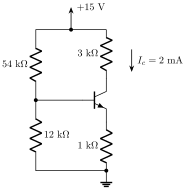
A Si BJT is connected as shown Fig . Show that it is in active region and works as an amplifier Calculate its mid frequency gain, given that BJT has h_{ie} = 1\text{ k}\Omega, h_{oe} = h_{re} = 0, I_{co} = 20\text{ nA}.

Physics Diagram cse-q-8-166-fig-2
CSE 1996Paper II30 markscse-1996-subject-08-002

Write a comparative account of the following four processes: (i) \beta - decay (ii) positron emission (iii) electron capture (iv) inverse \beta- decay

CSE 1996Paper II20 markscse-1996-subject-07-001

Define parity for a quantum mechanical system. Describe an appropriate experiment proving the parity violation in weak interaction. How can the parity violation in weak interaction be understood ? Explain.

CSE 1996Paper II60 markscse-1996-subject-07-003

Taking only the spin motion of electron, proton and neutron and assuming them as point particles, obtain their magnetic moments. How far the values thus obtained agree with experimental values? If not, why? Explain.

CSE 1996Paper II20 markscse-1996-subject-07-002

Calculate the bond length and force constant of the bond of {}^{12}\text{C}\ {}^{16}\text{O} molecule; given 0 \rightarrow 1 rotational line in v = 0 state is at 115.3\text{ GHz} and the wavelength of the vibrational frequency is 14.7\ \mu\text{m}.

CSE 1996Paper II30 markscse-1996-subject-06-004

Write a short note on Stellar spectra.

CSE 1996Paper II20 markscse-1996-subject-06-001

Document & Diagram Scanner

Clean whiteboard & high-contrast scan with automatic image enhancement

Filter:
-- × -- pxCompressed: -- KB--% saved