Show that the angular momentum of a particle located at position \vec{r} relative to the origin of co-ordinates is given by \vec{l} = \vec{r} \times \vec{p} where \vec{p} is the linear momentum of the particle. Using this result prove that the angular momentum of a system of particles can be expressed as the sum of their angular momentum around the centre of mass and the angular momentum around the origin of a single particle of mass equal to the total mass of the system located at the centre of mass.
A smooth sphere A of mass m and speed u impinges obliquely on a sphere B of mass (M>m) at rest. The velocity of A before collision makes an angle \theta with the line of centres at the time of impact. Show that A is deflected through a right angle if \tan^2\theta=e\frac{M-m}{M+m} where e is the coefficient of restitution.
A \mu meson travels towards the earth's surface from high up in atmosphere with a speed of 0.99\text{ C}. It decays after travelling a distance of 6\text{ km}. In what time does the \mu meson decay as measured by observers in reference frames (i) bound to the earth and (ii) bound to the meson itself.
Simplify the following logic function and draw the corresponding logic gates: Y = A.B + B.\overline{C} + \overline{A}.B + \overline{A}.C + \overline{B}.\overline{C} + \overline{A}.\overline{B}.\overline{C} + A.B.C
Assuming that for a paramagnetic material, the magnetic susceptibility is inversely proportional to temperature in Kelvin, obtain Curie-Weiss law for the paramagnetic phase of a ferro-magnetic material.
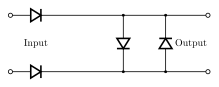
Four silicon diodes are connected as shown in Fig. 1. A sinusoidal voltage of amplitude 2\text{ V} is applied in the input. What is the waveshape of the output and its amplitude? If the amplitude of the input voltage is reduced to 1\text{ V}, what will be the waveshape of the output and its amplitude ? Threshold voltage of each diode is 0.6\text{ V}.
Draw the circuit of an emitter-follower and find its voltage gain.
Explain the basic distinction between a perfect conductor and a superconductor.
Explain the phenomenon of nuclear fission and obtain the expression for fissionability parameter. Show that the critical value of the fissionability parameter is 50.
Mention the conservation law violated in the following elementary particle reactions:
(i) \mu^- \rightarrow e^- + u_o
(ii) n \rightarrow p + e^-
(iii) k \rightarrow \pi^o + \pi^o
(iv) e^- + e^- \rightarrow \gamma
Explain the physical meaning of each term, write semiempirical mass formula for a nucleus. Find the value of atomic number of most stable nucleus for a given mass number A.
Draw the energy level diagram and show the allowed transitions for Zeeman pattern for n = 3_1 \rightarrow 2_0 transition line of a hydrogen atom placed in a uniform magnetic field of 1\text{ kg}. Calculate the doublet splittings.
Explain the origin of continuous X-rays. Compare the phenomenon with photoelectric effect.
Draw the expression for Lande's g-factor for LS coupled state.
Write in brief the differences between the IR active and Raman active bands.
Using Heisenberg Uncertainty principle, find the ground state energy and Bohar radius of hydrogen atom.
Write down the time independent Schrodinger equation for the x < 0 and x > 0 in case of a step potential V(x) = \begin{cases} 0, & x < 0 \\ V_o, & x > 0 \end{cases} Discuss the solutions thus obtained for the case E > V_o. Obtain the following relations. |R|^2 = \left(\frac{1-\mu}{1+\mu}\right)^2 \quad \text{and} \quad \frac{k}{k_o}|T|^2 = \mu \left(\frac{2}{1+\mu}\right)^2 There \mu = \sqrt{1 - \frac{V_o}{E}}, R and T are reflection and transmission coefficients respectively. Other symbols have their usual meaning. Plot the behaviour of |R|^2 and k/k_o |T|^2 with \mu.
Write a short note on Law of equipartition of energy.
What is population inversion ? Mention the methods of achieving population inversion. Explain the concept of negative temperature.
Show the distribution of velocities for temperatures \text{T}_1, \text{T}_2 and \text{T}_3 (\text{T}_1 > \text{T}_2 > \text{T}_3) of gas molecules according to the Maxwell-Boltzmann law. Using this law prove that the most probable velocity is \sqrt{2/3} times the root-mean-square velocity.