The time independent wave function of a system is \psi(x) = A \exp(ikx), where k is a constant. (i) Is this wave function normalizable in the domain -\infty < x < \infty? (ii) Calculate the probability current density for this function.
The components of arbitrary vectors \vec{A} and \vec{B} commute with those of \vec{\sigma}. Show that (\vec{\sigma} \cdot \vec{A})(\vec{\sigma} \cdot \vec{B}) = \vec{A} \cdot \vec{B} + i\vec{\sigma} \cdot (\vec{A} \times \vec{B}).
(i) Derive an expression for the period of Bloch oscillation for a one-dimensional crystal having lattice period a and electric field \varepsilon. (ii) Consider an electron in a perfectly periodic lattice, wherein the energy-wavenumber relationship in the first Brillouin zone is expressed as E = \frac{\hbar^2 k^2}{5\mathrm{m}_e} where \mathrm{m}_e is the mass of an electron in free space. Find the effective mass of the electron and hence write down the time-independent Schrodinger equation for the electron. Also determine the velocity of the electron. Ignore all interactions except between the electron and the lattice.
Find the condition at which de Broglie wavelength equals the Compton wavelength for a particle.
The raising (J_+) and lowering (J_-) operators of total angular momentum are defined by J_+ = J_x + iJ_y and J_- = J_x - iJ_y. Find the values of the following : (i) [J_x, J_+] (ii) [J_y, J_+] (iii) J_- J_+
What is the concept of negative temperature in statistical mechanics? Explain in brief.
Explain how we can produce refrigeration without using a compressor.
Explain how the state of ionization of any particular element in a star changes with varying temperatures and pressures.
Distinguish between a perfect gas and a real gas. Derive van der Waals' equation of state and use it to obtain the expressions for the critical constants in terms of the constants of the van der Waals' equation.
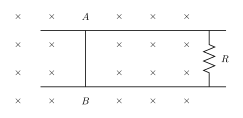
The wire AB shown in the figure below has mass m, resistance r and it can slide on the smooth horizontal parallel rails separated by a distance l. A uniform magnetic field B exists in the rectangular region and a resistance R connects the rails outside the field region. At t = 0, the wire AB is pushed towards right with a speed v_0.
Find out the current in the loop at an instant when the speed of the wire is v. Find out the velocity v as a function of x. (Assume that the resistance of the rails is negligible)
Explain Ampere's circuital law of magnetic field. What modifications Maxwell made in this equation to derive Maxwell's fourth equation?
A material has \sigma = 10^{-2}\text{ S/m} and \varepsilon = 2\varepsilon_0. At what frequency, the conduction current would be equal to the displacement current?
What is Lenz's law? Is Lenz's law the same as Faraday's law? What happens if Lenz's law is reversed? Explain.
Write down Stefan-Boltzmann law of radiation and derive it from Planck's law of radiation.
Assuming that the Sun radiates like a perfect blackbody, at what wavelength does the peak of the solar spectrum occur? Given that the surface temperature of the Sun is about 6000\text{ K}.
If the electrostatic potential in spherical polar coordinate is \phi(r) = \phi_0 e^{-r/r_0} where \phi_0 and r_0 are constants, what will be the charge density at a distance r = r_0?
Write down the electromagnetic wave equation in non-conducting dielectric medium. Hence, show that the velocity of wave propagation is given by v = \sqrt{\frac{1}{\mu \epsilon}}, where the symbols have their usual meanings.
An infinitely long coaxial cylinder structure has an inner conductor of radius a and an outer conductor of radius b. The inner conductor is attached to V_0, while the outer one is grounded. Calculate the field \vec{E} in between a and b.
Explain with proper examples the techniques of obtaining interference by 'division of wavefront' and 'division of amplitude'.
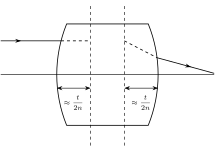
Consider a thick equiconvex lens of refractive index 1 \cdot 5 as shown in the figure. The magnitude of the radii of curvatures of the two surfaces is 5\text{ cm}. The thickness of the lens is 1\text{ cm} and the lens is placed in the air. Obtain the system matrix and determine the focal length and the position of unit planes :