The specific heat of a substance is found to vary with temperature in the following way c(T) = aT + bT^2 where c(T) is the specific heat at the temperature T and 'a' and 'b' are constants. Compare the average specific heat of the substance in the temperature range 0-T to the specific heat at the mid-temperature T/2.
Explain the concept of internal energy of a system. Formulate mathematically the first law of thermodynamics. Calculate the work done in an isothermal compression of a gas.
Write a short note on Carnot cycle.
Write a short note on Thermodynamic potentials.
In a series L–C–R circuit connected to an alternating constant voltage source the current amplitude is (1/n) times the amplitude at resonance at frequencies w_1 and w_2. Obtain an expression for its quality factor at resonant frequency.
An L–C–R circuit has a resistance of 100 ohms, a capacitance of 0.2 \mu\text{F} and an inductance of 5 H. An ac source E = 50 \sin (1000 t)\text{ volt} is connected in the circuit. Calculate the average power dissipated.
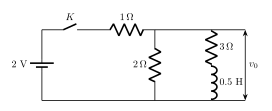
In the given circuit the output voltage v_0 at time t second after closing the key K is 1 volt. Calculate the rate of change of current in the inductance coil at this moment.
The frequency of applied voltage in a cyclotron is 1.2 \times 10^7\text{ Hz}. Find the magnetic field strength when protons are to be accelerated. If the radius of dees is 0.5 m, what is the energy of the accelerated protons ?
Two inductance coils hang inductances L_1 and L_2 and negligible resistances are connected in parallel. The coils have a mutual inductance M. Obtain an expression for the effective inductance of the combination.
The electric field vector of a plane electromagnetic wave is given by: \vec{E} = E_0 \cos(kz - \omega t + \delta)\hat{x} Write the magnetic field vector. Calculate the average energy per unit volume stored in electromagnetic field and the average energy flux density.
A potential field is given by: \phi = (x^2 + y^2 + z^2)\text{ volt.} Find the electric field at a point (x, y, z) and the charge density in the region.
Differentiate between Fresnel and Fraunhoffer diffractions. How can one explain the Fresnel diffraction pattern due to a straight edge?
Explain why a two-level system is not adequate for laser operation. Draw the essential parts of a ruby laser and explain the working principle with the help of an energy level diagram.
Sodium light is incident normally upon a plane transmission grating having 5000 lines/cm. Calculate the angular separation of the D_1 and D_2 lines in the first order spectrum. As this angular separation is very sexy small, how can one magnify it 10 times ? (Given : \lambda_{v1} = 5690\text{ \AA} and \lambda_{v2} = 5896\text{ \AA})
Give Rayleigh's criterion for resolution. Why telescopes with larger objectives are better? The objective of the telescope at St. Palomer has a diameter of 5.08 m. What is the least distance on Moon which could be resolved by it? (Given distance of moon from the Earth = 3,84,000 km and \lambda = 5890\text{ \AA}).
Why an extended source is necessary to see colours in a soap-film ? Non-reflecting surfaces are made by coating very thin films of a transparent material. Find the maximum thickness of such thin coatings given that \lambda = 5.5 \times 10^{-5}\text{ cm} and \mu = 5/4.
What are the essential conditions for observing the interference of light? Two coherent sources with intensity ratio 4 : 1 interfere. Find I_{\text{max}} / I_{\text{min}}.
Calculate the peak values of \vec{E} and \vec{B} for a laser beam of power 2 \times 10^{10}\text{ W} and radius 0.1 mm.
A short-focus lens is used to focus a laser beam of wavelength 6328 Å. If the beam width is comparable to the focal length of the lens, calculate the area of cross-section of the region of focus.
The equation of a one-dimensional propagating harmonic transverse wave is given by: y = 8 \sin 30\pi \left(t - \frac{x}{240}\right) \text{meter} Find the resultant wave formed by the superposition of the incident and the reflected waves from a rigid end. Also determine the amplitude of stationary waves formed at x = 2\text{ meter}. What will be the distance between consecutive nodes ?