
What are the vector and scalar potentials ? Derive Maxwell's wave equations in terms of these potentials.
cse-2004-subject-03-006
What are the vector and scalar potentials ? Derive Maxwell's wave equations in terms of these potentials.
Find out the magnetic field inside a long solenoid carrying current i and having n turns per unit length.
A point charge q is held at a distance d in front of an infinite grounded conducting plane. What is the electric potential in front of the plane ?
What is the volume density of the charge in a region of space, where the electrostatic potential is given by V = a - b (x^2 + y^2) - c \ln (x^2 + y^2), where a, b, c are constants ?
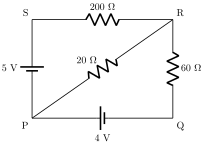
A network PQRS is connected as shown in the figure below. Apply Kirchhoff's law and show that the current flowing through the 20\ \Omega resistor PR is 0.029 A.
Define the strength of a magnetic shell and calculate the magnetic potential at any neighbouring point due to this shell. Does the potential depend on the shape of the shell ?
What do you understand by a perfect black body? Can it be realised in practice ? Show that the ratio of the emissive power to the absorptive power for all bodies at a given temperature is equal to the emissive power of a perfectly black body.
Given the temperature of the Sun's surface T = 5755\text{ K}, radius of the Sun 6.9 \times 10^5\text{ km}, distance between the Earth and the Sun 1.5 \times 10^8\text{ km}. Estimate the solar constant (i.e. the energy received per sec per unit area of the Eath's surface). Assume \sigma = 5.7 \times 10^{-8}\text{ W/m}^2\text{-K}^4.
Show that the Poynting vector \bar{S} = (\bar{E} \times \bar{H}) represents the energy flow per unit area per unit time both in magnitude and direction in case of a plane electromagnetic wave.
Show that the ratio of the focal lengths of the two lenses in an achromatic doublet is given by \frac{f_1}{f_2} = - \frac{w_1}{w_2} where w_1 and w_2 are the dispersive powers of the lenses of focal lengths f_1 and f_2 respectively.
Write down the equation of motion for a damped harmonic oscillator assuming the damping force proportional to the velocity of the particle. Obtain the general solution for its displacement as a function of time. Discuss the cases of 'overdamping', 'under-damping' and 'critical damping'.
Differentiates between Rayleigh and Raman scatterings. Why is Raman scattering considered to be a breakthrough in molecular spectroscopy ? What are the advantages of using laser light in Raman spectroscopy ?
Water vapor shows Infrared absorption bands at 1595\text{ cm}^{-1}, 3652\text{ cm}^{-1} and at 3756\text{ cm}^{-1}. If the Raman spectrum is observed with the Argon Ion Laser 514.5\text{ nm}, at what wavelengths would you expect to find the Raman Stokes lines ?
A quartz quarter wave plate is to be used with the sodium light (\lambda = 5896\text{ \AA}). What should be its thickness ?
A narrow slit illuminated by monochromatic light of \lambda = 6400\text{ \AA} is placed at a distance of 3 metres from a straight edge. If the distance between the straight edge and the screen is 6 metres, calculate the distance between the first and the fourth dark bands.
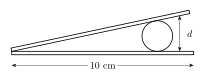
Two microscope slides of length 10 cm each form a wedge. At one end they are in contact and at the other end they are separated by a thin wire of diameter d (see the diagram below). Interference fringes are obtained when illuminated vertically by a monochromatic light of \lambda = 500\text{ nanometers}. The fringe spacing is found to be 1.25 cm. Estimate the diameter of the wire.
A thin converging lens and a thin diverging lens are placed coaxially at a distance of 5 cm. If the focal length of each lens is 10 cm, find for the combination (i) the focal length, (ii) the power, (iii) the positions of the principal points.
A siren of frequency 900 Hz is going towards a wall away from an observer at a speed 10 m/sec. Determine : (i) Frequency of sound directly heard from the siren. (ii) Frequency of sound reflected from the wall. (iii) Number of beats per second heard by the observer. (Velocity of sound = 330 m/sec)
A particle moves in space with the Lagrangian L = \frac{1}{2} m (\dot{x}^2 + \dot{y}^2 + \dot{z}^2) - V + A \dot{x} + B \dot{y} + C \dot{z} where A, B, C are given functions of x, y, z. Find the corresponding Hamiltonian in terms of coordinates and momenta.
Write down the expression for the relativistic mass of a particle moving with a velocity v in terms of its rest mass. Establish from the above expression Einstein's mass-energy relation E = mc^2.