(b) Derive approximate expressions for the potential and the radial as well as the azimuthal components of the field due to an electric dipole at points far away from it. Also derive expression and hence describe the effect of a unifrom electric field on a dipole which can rotate freely.
- (a) Consider two long and straight current carrying wires placed parallel to each other a certain distance apart. Derive an expression for the force per unit length experienced by these wires. Discuss that the attractive (repulsive) nature of this force is related to the directions of flow of currents in the two wires.
(a) Prove the relation \nabla^2 \left( \frac{1}{|\vec{r} - \vec{r}'|} \right) = - 4 \pi \delta \left(|\vec{r} - \vec{r}'|\right) and hence show that \phi(\vec{r}) = \int \frac{\rho(\vec{r}')}{|\vec{r} - \vec{r}'|} \, d\vec{r}' is a solution of the Poisson equation \nabla^2 \phi(\vec{r}) = - 4 \pi \rho(\vec{r}).
(c) What do you understand by paraxial rays ? Show that the effect of translation of a paraxial ray while travelling along a homogeneous medium is represented by a 2 \times 2 matrix if the ray is initially defined by a 2 \times 1 matrix.
(b) For a transverse sinusoidal wave of wavelength \lambda propagating along negative x direction through a string fixed at a point, show that the nodes are located at x = 0, \lambda/2, \lambda, 3\lambda/2, \dots while the kinetic energy / unit length at the antinodes is given by E = 2 \rho A^2 \omega^2 \cos^2 \omega t where \rho, A and \omega, are the mass density / unit length, amplitude of transverse displacement and angular frequency of the wave, respectively.
(c) Why does one see two image points for a single object point while viewed through a calcite crystal ? What is this property of the crystal known as ? What is an optic axis of a crystal ? Explain the meanings of positive and negative crystals with one example for each kind.
Differentiates between Rayleigh and Raman scatterings. Why is Raman scattering considered to be a breakthrough in molecular spectroscopy ? What are the advantages of using laser light in Raman spectroscopy ?
- (a) Why does one get three-dimensional image in holography ? Explain with appropriate figures how can one construct and read a hologram.
(d) Drawing a neat diagram, discuss how light travels through an optical fibre. Show that the numerical aperture of a commercially available optical fibre is around 0.25. Explain its physical significance.
(c) Explain how Einstein's A and B coefficients are related to the phenomena of spontaneous and stimulated emission of radiation, respectively. Derive the relation between A and B. Establish that at very high frequency around X-ray wavelength regime, lasers cannot be made as easily as at low frequencies, e.g. far infra-red regime.
(b) What is the essential difference between interference and diffraction of light ? How can you achieve Fraunhofer diffraction in the laboratory ? Using the concept of Fraunhofer diffraction at a single slit, find out the intensity distribution produced by two slits of equal width.
(b) What are constraints of motion ? Explain with examples the holonomic and non-holonomic constraints. Discuss critically how can one overcome the limits of constraints by introducing generalised coordinates.
(b) Show that the mass-energy relationship in relativistic kinematics can lead to the equation E^2 = c^2 p^2 + m_0^2 c^4 where E is the total energy of the particle of rest mass m_0, linear momentum p and moving with a velocity v; c is the velocity of light in free space.
(a) How are linear and angular momenta related to each other ? Considering a system of mass points under the influence of forces derived from potentials only, prove that the generalised linear momentum is conserved. Establish further that the angular momentum of the above system is also conserved if the potential is centrally symmetric.
- (a) Show that the length L of an object moving with a velocity v is given in the direction of motion by L = L_0 \left(1 - \frac{v^2}{c^2}\right)^{1/2} where L_0 is the proper length and c is the velocity of light in free space. What will be the shape of a spherical ball while moving under relativistic regime ?
- (a) Considering the scattering of \alpha-particles by the atomic nuclei, find out the Rutherford scattering cross-section. Explain the physical significance of the final expression.
Draw a circuit diagram of an R-C phase shift oscillator. Explain its working. Derive an expression for its frequency.
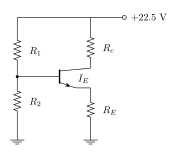
A transistor with \beta = 50, V_{BE} = 0.7\text{ V}, V_{CC} = 22.5\text{ V} and R_c = 5.6\text{ k}\Omega is used in biasing circuit as shown in the figure. It is designed to establish the quiescent potential at V_{CE} = 12\text{ V}, I_C = 1.5\text{ mA} and stability factor S \le 3. Find the values of resistors R_E, R_1 and R_2, where symbols have their usual meanings.
Show that the condition of periodicity of lattice leads to the Bloch theorem. What is a Bloch function ?
What is the principle used in 'half-adder' ? Give the truth table for it.