
The X and Y co-ordinates of Cornu's spiral can be expressed quantitatively by two integrals. Derive the expressions of these integrals.
cse-2006-subject-02-005
The X and Y co-ordinates of Cornu's spiral can be expressed quantitatively by two integrals. Derive the expressions of these integrals.
Obtain the relation to find radii of the rings and the wavelength of light in Newton's circular ring. Calculate the radius of curvature of the convex glass surface where diameter of 5^{th} and 15^{th} bright rings formed by sodium yellow light are measured to be 2.303\text{ mm} and 4.134\text{ mm}. Given \mu = 1.5 and \lambda_{yellow} = 5282 \text{\AA}.
In the steady state forced vibration a point particle of mass 'm' moves under the influence of an external force (F \sin pt) \hat{i} in addition to the restoring force - (kx) \hat{i} and damping force - (\beta x) \hat{i} . Show that (i) the amplitude is maximum when p = \sqrt{\omega^2 - 2b^2} , where k/m = \omega^2 and (ii) the value of the maximum amplitude is \frac{f}{2b \sqrt{\omega^2 - 2b^2}} . What do you mean by the sharpness of resonance ?
Derive Snell's law of refraction from fermat's principle. How is the refractive index related to the velocity of light ? Light of wavelength 600 nanometre (in vacuum) enters a glass slab of refractive index 1.5. What are the values of wavelength, frequency and velocity of light in glass ? [Velocity of light in vacuum = 3 \times 10^8\text{ ms}^{-1}]
What is centre of mass ? Show that the total linear momentum of a system of particles about the centre of mass is zero.
The source S' moves along the x'-axis at a speed v, and emits light at an angle \theta' to the x'-axis of its own frame. In the S-frame the emitting angle with the x-axis is \theta. Here x and x'-axes are coincident. Show that the exact relativistic aberration formula \tan \theta = \frac{\sin \theta' \sqrt{1 - v^2 / c^2}}{\cos \theta' + v} can be derived from the velocity transformation relations.
Derive an equation of motion for a variable mass. Explain how it is applied in the motion of a rocket.
What is Hamilton's principle ? Obtain Lagrange's equations of motion with its help for a conservative system.
Prove that two successive Lorentz transformations are equivalent to another Lorentz transformation. Hence write down the Einstein's velocity addition relation.
Derive Euler's equations of motion for a rigid body rotating about a fixed point under the action of a torque. When a rigid body is not subjected to any net torque, write down Euler's equations of motion of the body with one point fixed.
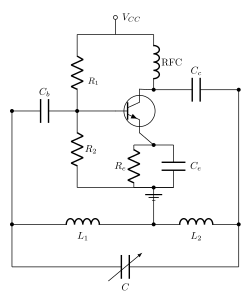
Discuss the functioning of the above oscillator circuit. Obtain the condition for maintenance of oscillations and the expression for the frequency assuming that the resistances of the inductors are negligible.
Define (i) input bias current, (ii) input offset current, (iii) input offset voltage, (iv) output offset voltage, (v) power supply rejection ratio and (vi) slew rate for an OPAMP.
Draw the logic circuit for the following Boolean expression : Y = \overline{A + B} + \overline{C} What are the 'Y' values for the input combinations : (1) 1, 1, 0; (2) 1, 0, 1; (3) 0, 0, 1 ? (ii)
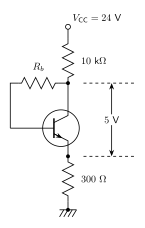
Define \alpha and \beta parameters of a transistor. A germanium transistor with \beta = 45 is biased as shown above. Calculate the value of R_b.
Discuss the motion of an electron in one-dimensional periodic potential and show that it leads to formation of bands of allowed and forbidden states in the electron energy spectrum. How are the insulators, semi-conductors and conductors discriminated on the basis of band structure ?
(i) Discuss briefly the concept of effective mass in semiconductors and explain the significance of negative effective mass. (ii) In isolated atoms, the electrons have discrete and definite energies but in solids they have bands of energies. Explain why. (iii) A proton, deuteron and \alpha-particle accelerated through the same potential difference, on entering a region of uniform magnetic field applied normal to their plane of motion, move in circular orbits. Compare the radii of the orbits described by them.
(ii)
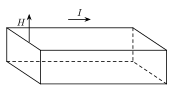
An In As semiconductor sample is cut in the form of a small bar of size 1 \cdot 0 \text{ cm} \times 1 \cdot 0 \text{ cm} \times 2 \cdot 0 \text{ mm}. Its lengthwise resistance is 1 \cdot 25 \ \Omega. A Hall field of 1 \cdot 7 \text{ V/m} develops when a current of 0 \cdot 12 \text{ A} is passed lengthwise and a magnetic field of 0 \cdot 05 \text{ T} is applied normal to its length as shown above. Calculate the carrier density. (iii) Determines the reciprocal lattice vectors of an fcc lattice.
Calculate the spin and parities of the ground states of {}_2^4\text{He} and {}_{30}^{67}\text{Zn} nuclei.
(i) Write the Weizacker mass formula and explain the significance of various terms. (ii) Determine the amount of {}_{84}^{210}\text{Po} necessary to provide a source of \alpha-particles of strength 5 \text{ mC}_i. The half-life of {}_{84}^{210}\text{Po} is 138 \text{ d}.
(i) Differentiate between K-capture and inverse \beta-decay. (ii) Explain what is internal conversion and how it differs from \beta-decay.
(i) What are the basic interactions in nature ? Give one example for each. Compare their relative strengths and ranges. (ii) What are the conservation laws for strong, electromagnetic and weak interactions ? (iii) Distinguish between particle and anti-particle. How was positron discovered ?