Comment Done
Navigation
HomePYQs Question BankCSE Physics OptionalIFoS Physics OptionalBlog & InsightsCourses & ProgrammesFree materialsMy Courses (Candidate Portal)
Account
/
20 questions visible on this page

The refractive indices of core and cladding in a step index optical fiber are 1.52 and 1.48 respectively. The diameter of the core is 30\,\mu\mathrm{m}. If the operating wavelength is 1.3\,\mu\mathrm{m}, calculate the V parameter and the maximum number of modes supported by the fiber.

CSE 2016Paper I10 markscse-2016-subject-02-006

The equation of a progressive wave moving on a string is y = 5\sin \pi(0.01x - 2t). In this equation, y and x are in centimetres and t is in seconds. Calculate amplitude, frequency and velocity of the wave. If two particles at any instant are situated 200\,\mathrm{cm} apart, what will be the phase difference between these particles?

CSE 2016Paper I10 markscse-2016-subject-02-001

Explain the principle of (i) induced absorption, (ii) spontaneous emission and (iii) stimulated emission. Show that the ratio of Einstein's coefficients is given by \frac{A}{B}=\frac{8\pi h\nu^{3}}{c^{3}}

CSE 2016Paper I20 markscse-2016-subject-02-007

Discuss the principles of Fresnel's half period zone and explain how these are used in the construction of a zone plate. Show how the zone plate has several foci.

IFoS 2016Paper I20 marksifos-2016-subject-02-005

Plane polarized light of wavelength 6000\text{ \AA} is incident on a thin quartz plate cut with faces parallel to the optic axis. Given, \mu_0 = 1.544 and \mu_e = 1.553, calculate the following quantities : (i) The ratio of the intensities of the ordinary and the extraordinary light if the planes of vibration of two incident lights make an angle of 30^\circ with the optic axis. (ii) The minimum thickness of the plate for which ordinary and the extraordinary waves will combine to produce plane polarized light.

IFoS 2016Paper I10+10=20 marksifos-2016-subject-02-006

A diffraction grating has 5000\text{ lines per cm}. For illumination at normal incidence, determine the dispersive power of the grating in the second order spectrum in the range of wavelengths around 500\text{ n.m.}

IFoS 2016Paper I8 marksifos-2016-subject-02-004

State Huygen's principle. Using this principle and suitable diagram, show that this principle could lead to Snell's law of refraction.

IFoS 2016Paper I20 marksifos-2016-subject-02-003

The vibrations of a string fixed at both ends is represented by the equation y = 2\sin\frac{\pi x}{3}\cos 50\pi t\ (m) If the above stationary wave is produced due to the superposition of two component waves of the same frequency, velocity and amplitude travelling in opposite directions, find (i) the exact equations of the displacements associated with the vibrations of the component waves and (ii) the distance between two consecutive nodes of the stationary wave.

IFoS 2016Paper I5+3=8 marksifos-2016-subject-02-002

Prove that the group velocity V_g of electromagnetic waves in a dispersive medium is given by V_g = \frac{c}{n + \omega\ dn/d\omega} where c is the velocity of light in vacuum and n is the refractive index of the medium for the angular frequency \omega of the waves.

IFoS 2016Paper I8 marksifos-2016-subject-02-001

Explain the principle of producing polarized light by the method of reflection, refraction and double refraction with the help of neat diagrams.

CSE 2016Paper I15 markscse-2016-subject-02-008

Calculate the percentage contraction in the length of a rod in a frame of reference, moving with velocity 0.8c in a direction

(i) parallel to its length and

(ii) at an angle of 30^\circ with its length. What is the orientation of the rod in the moving frame of reference in case (ii)?

CSE 2016Paper I20 markscse-2016-subject-01-008

Given a proton for which \beta=0.995 measured in the laboratory. What are the corresponding relativistic energy and momentum? Take, m_p=1\cdot67\times10^{-24}\,\mathrm{g}.

CSE 2016Paper I10 markscse-2016-subject-01-009

Show that the Young's modulus Y, modulus of rigidity n and Poisson's ratio \sigma are related by the equation Y = 2n(1 + \sigma).

CSE 2016Paper I10 markscse-2016-subject-01-006

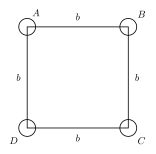
Four solid spheres A, B, C, and D each of mass m and radius a, are placed with their centres on the four corners of square of side b as shown in the figure below:

Physics Diagram q-1-050-fig-1

Calculate the moment of inertia of the system about one side of the square, Also, calculate the moment of inertia of the system about a diagonal of the square.

CSE 2016Paper I20 markscse-2016-subject-01-005

Derive the expression for Coriolis force and show that this force is perpendicular to the velocity and to the axis of rotation. What is the nature of this force?

CSE 2016Paper I10 markscse-2016-subject-01-004

A body moving in an inverse square attractive field traverses on elliptical orbit with eccentricity e and period \gamma. Find the time taken by the body to traverse the half of the orbit that is nearer the centre of force. Explain briefly why a comet spends only 18\% of its time on the half of its orbit that is nearer the sun.

CSE 2016Paper I10 markscse-2016-subject-01-003

A force field is given by \vec{F} = (2xy + z^3)\hat{i} + x^2\hat{j} + 3xz^2\hat{k} Is it a conservative field ? If so, what is the scalar potential ?

IFoS 2016Paper I2+6=8 marksifos-2016-subject-01-001

A horizontal pipe of non-uniform bore has water flowing through it such that the velocity of flow is 40\ \mathrm{cm/s} at a point where the pressure is 2\ \mathrm{cm} of mercury column. What is the pressure at a point where the velocity of flow is 60\ \mathrm{cm/s}? (Take, g = 980\ \mathrm{cm/s^2} and density of water = 1\ \mathrm{g/c.c.})

CSE 2016Paper I10 markscse-2016-subject-01-007

(i) The distance between the centres of the carbon and oxygen atoms in the carbon monoxide (CO) gas molecule is 1.130\times10^{-10}\ \mathrm{m}. Locate the centre of mass of the molecule relative to the carbon atom.

(ii) Find the centre of mass of a homogeneous semicircular plate of radius a.

CSE 2016Paper I10 markscse-2016-subject-01-001

A student is working in a physics laboratory, which is at temperature 27^{\circ}\mathrm{C}, on a sonometer to study formation of stationary waves. The cross-sectional area of the sonometer wire is 0.85\times10^{-6}\ \mathrm{m^2} and a tension of 20\ \mathrm{N} is applied on it. If the rigid supports are 1.2\ \mathrm{m} apart and the temperature of the wire drops by 7^{\circ}\mathrm{C}, calculate the (i) final tension and (ii) fundamental frequency of vibration of the wire. Take, coefficient of linear expansion and isothermal Young's modulus as 1.5 \times 10^{-5}\ \mathrm{K}^{-1} and 2.0 \times 10^{11}\ \mathrm{N\,m}^{-2} respectively.

CSE 2016Paper I10 markscse-2016-subject-01-002

Document & Diagram Scanner

Clean whiteboard & high-contrast scan with automatic image enhancement

Filter:
-- × -- pxCompressed: -- KB--% saved