g(E) = \frac{V}{\pi^2 \hbar^3 c^3} E^2 What is the density of states? For a relativistic particle of rest mass \mu, prove that the density of states in the extreme relativistic limit (E \gg \mu c^2) g(E) = \frac{V}{\pi^2 \hbar^3 c^3} E^2 where g(E) = density of states, V = volume of the system containing the particle, E = total energy, c = velocity of light and \hbar = Planck's constant.
Explain how the uncertainty in position is different from the uncertainty or inaccuracy of the measuring instruments.
Obtain the expressions for reflection coefficient (R) and transmission coefficient (T) for reflected waves and transmitted waves from an infinite thin barrier.
Determine the ground state energy of an electron in an infinite potential well of width of 2\text{ \AA}.
A ternary system consists of three components (A, B and C) in equilibrium with two phases. Determine the number of degrees of freedom using the Gibb's phase rule and discuss the effect of pressure and temperature variations on the phase equilibrium.
Discuss briefly the considerations which led Van der Waals to modify the gas equation. What are the critical constants of a gas ? Calculate the values of these constants in terms of the constants of the Van der Waals equation.
A reversible heat engine operates with three reservoirs at 300\text{ K}, 400\text{ K} and 1200\text{ K}. It absorbs 1200\text{ kJ} energy as heat from the reservoir at 1200\text{ K} and delivers 400\text{ kJ} work. Determine the heat interactions with the other two reservoirs.
Consider a mixture of N_A molecules of a monatomic gas A and N_B molecules of a monatomic gas B. For this mixture, obtain the Helmholtz free energy and pressure. (The particle partition function for a monatomic gas is q = \left(\frac{2\pi m k T}{h^2}\right)^{\frac{3}{2}} V).
Explain why, at equilibrium, the chemical potential of a component must be the same in all coexisting phases. Derive the equilibrium condition for a binary liquid-vapour system in terms of chemical potential.
\vec{E} = 10 \cos (\omega t - 100 x) \hat{j}\text{ V/m} In free space, an electric field (\vec{E}) is given by the following expression : \vec{E} = 10 \cos (\omega t - 100 x) \hat{j}\text{ V/m} Find the angular frequency \omega and the displacement current.
Consider a long straight wire of length L carrying a current I. Determine the magnetic vector potential \vec{A} at a point P located at distance x from the wire.
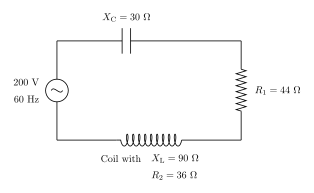
As shown in the figure, a series circuit connected across a 200\text{ V}, 60\text{ Hz} line consists of a capacitor of capacitive reactance of 30\ \Omega, a non-inductive resistor of 44\ \Omega and a coil of inductive reactance 90\ \Omega and resistance 36\ \Omega.
Determine : (i) Power factor of the circuit (ii) Power absorbed by the circuit (iii) Power dissipated in the coil
Show that the electromagnetic wave equation is invariant under Lorentz transformations.
Consider a conducting sphere of radius ‘a’ in a uniform electric field \vec{E}. Find the induced surface charge density on the sphere and determine the electric field \vec{E} at a point P characterized by radius vector \vec{r}.
An electromagnetic wave has its magnetic field |\vec{B}| = 55 \times 10^{-8}\text{ T}. Determine the magnitude of the Poynting vector.
Consider a point charge of 5\text{ nC} placed at a distance of 1\text{ m} from a perfect conducting plane (z = 0) of infinite extent. Find the electric field at a point (2, 2, 0)\text{ m} and show that it is normal to the plane.
A rectangular coil consists of 50 closely wrapped turns and has dimensions of 0\cdot 5\text{ m} \times 0\cdot 4\text{ m}. It carries a current of 1\cdot 5\text{ A}. If a uniform magnetic field B = 0\cdot 1\text{ T} is applied such that the direction of the magnetic field makes an angle of 60^\circ with respect to the plane of the coil, what is the torque exerted on the coil by the magnetic field?
State and explain Kirchhoff's current law and Kirchhoff's voltage law. Derive these laws from the principles of charge conservation and energy conservation.
A parallel plate capacitor having circular plates of radius 10\text{ cm} is being charged. If the electric field at any instant within the capacitor changes at the rate 5\cdot 0\text{ V m}^{-1}\text{ s}^{-1}, calculate the magnetic intensity |\vec{H}| inside the capacitor.
Derive the Planck's radiation law for blackbody radiation using the Bose-Einstein distribution function. Explain how results from quantum statistics differ from classical results derived from the Rayleigh-Jeans law.