Comment Done
Navigation
HomePYQs Question BankCSE Physics OptionalIFoS Physics OptionalBlog & InsightsCourses & ProgrammesFree materialsMy Courses (Candidate Portal)
Account
/
20 questions visible on this page

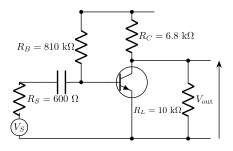
The following common-emitter amplifier is required to have a signal voltage gain V_{\text{out}} / V_S of at least 100. The transistor has \beta = 63, early voltage V_A = 100\text{ V} and I_{SE} = 1.5 \times 10^{-14}\text{ A} :
Physics Diagram cse-q-8-191-fig-1

Assuming that the operating collector voltage is supposed to be + 6\text{ V}, perform related calculations to check whether the circuit satisfies the operating point and voltage gain criteria. The reactance of the capacitors can be neglected at all frequencies.

CSE 2006Paper II20 markscse-2006-subject-08-002

What are Brillouin zones ? How are they related to the energy levels of an electron in a metal ? Draw the Brillouin zone for a rectangular lattice of sides \pi and 2\pi. Also compute the energy at the corner and midpoints of the adjacent sides of the first Brillouin zone.

CSE 2006Paper II30 markscse-2006-subject-08-001

What is a microprocessor ? Explain the internal architecture of an 8085 \mu\text{P}.

CSE 2006Paper II20 markscse-2006-subject-08-005

Explain the working and applications of a FET.

CSE 2006Paper II20 markscse-2006-subject-08-004

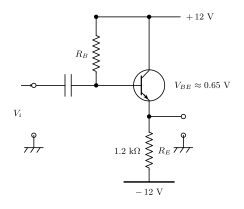
(i) Simplify the logical expression f = ABC + B \overline{C} D + \overline{A} BC by using Karnaugh map and realise f using NAND gates only. 10 (ii) The transistor in the following circuit has \beta = 100 and V_A = 90\text{ V}. What value of R_B will give 0 volt d.c. output 10

Physics Diagram cse-q-8-221-fig-1
CSE 2006Paper II20 markscse-2006-subject-08-003

Illustrate the Geiger-Nuttall law in a plot between the decay constant and energy of various nuclides for any radioactive series.

CSE 2006Paper II20 markscse-2006-subject-07-003

(i) Exlain the quark structure of hadrons. Identify the field of quark of electro-weak and electro-strong interactions. Also verify the conservation of strangeness in the following reactions : 10 \pi^- + p \rightarrow \Lambda^\circ + K^\circ K^+ \rightarrow \pi^+ + \pi^+ + \pi^- (ii) Drawing necessary diagrams, explain diamond structure and CsCl structures. 10

CSE 2006Paper II20 markscse-2006-subject-07-007

(i) Discuss in detail the classification of elementary particles. 10 (ii) On the basis of band theory, explain the classification of solids by considering their electrical properties. 10

CSE 2006Paper II20 markscse-2006-subject-07-006

In the following reactions indicate with an explanation, whether they proceed by strong, electromagnetic or weak interaction or they are forbidden : \pi^+ \rightarrow \mu^+ + u_\mu p \rightarrow n + e^+ + u_e p + \pi^- \rightarrow K^+ + \Sigma^-

CSE 2006Paper II15 markscse-2006-subject-07-008

What is the role of neutrino in the weak interaction of radioactive nuclides ? Explain the experimental detection of neutrino.

CSE 2006Paper II15 markscse-2006-subject-07-005

Name the various classifications of the gamma rays based on electric, magnetic and order. How does parity affect these radiations ?

CSE 2006Paper II20 markscse-2006-subject-07-004

Describe briefly the different types of physical processes with which gamma rays are absorbed by matter as they are emitted.

CSE 2006Paper II20 markscse-2006-subject-07-002

Based on physical calculations, explain why deuteron is stable.

CSE 2006Paper II20 markscse-2006-subject-07-001

What are the gyromagnetic factors of the three cases, viz., a spinning electron, an orbiting electron and a free proton ?

CSE 2006Paper II15 markscse-2006-subject-06-002

Determine the order of magnitude of the energy involved in the spin-orbit interaction of 2p state of an atom with an electron. Given the magnetic field due to the state is 0.28 T.

CSE 2006Paper II20 markscse-2006-subject-06-001

Explain and discuss the basic principle of nuclear magnetic resonance (NMR).

CSE 2006Paper II15 markscse-2006-subject-06-005

State and discuss the Franck-Condon principle giving special reference to its applications.

CSE 2006Paper II20 markscse-2006-subject-06-004

Examine whether the molecule {}^{11}\text{B}^{16}\text{O} can show – (i) a pure rotation spectrum ; (ii) a vibration-rotation spectrum. Give reasons.

CSE 2006Paper II20 markscse-2006-subject-06-003

(i) Using Pauli matrices \sigma_x, \sigma_y and \sigma_z, show that \left(\vec{\sigma} \cdot \vec{r}\right) \left(\vec{\sigma} \cdot \vec{p}\right) = \vec{r} \cdot \vec{p} + i \vec{\sigma} \cdot \vec{L} \quad 10 (ii) For the radiation of wavelength 6000~\text{\AA}, determine the wavelength separation between its two component lines which are observed in the normal Zeeman effect. The magnetic field used is \frac{\pi}{4}~\text{weber}/\text{m}^2 and the specific charge of the electron = 1.76 \times 10^{11}~\text{C}~\text{kg}^{-1}. 10

CSE 2006Paper II20 markscse-2006-subject-05-003

(i) Calculate the de Broglie wavelength of a thermal neutron at 27~^\circ\text{C} temperature. 10 (ii) Considering one-dimensional case for free particle, show that the plane wave function is the eigenfunction of a linear momentum operator and kinetic energy operator. 10

CSE 2006Paper II20 markscse-2006-subject-05-001

Document & Diagram Scanner

Clean whiteboard & high-contrast scan with automatic image enhancement

Filter:
-- × -- pxCompressed: -- KB--% saved