
Explain why the square of the angular momentum (L^2) and only one of the components (L_x,L_y,L_z) of L are regarded as constants of motion.
cse-2017-subject-05-008
Explain why the square of the angular momentum (L^2) and only one of the components (L_x,L_y,L_z) of L are regarded as constants of motion.
Evaluate the most probable distance of the electron from nucleus of a hydrogen atom in its 2p state. What is the probability of finding the electron at this distance?
Using Schrodinger equation, obtain the eigenfunctions and eigenvalues of energy for a 1- dimensional harmonic oscillator. Sketch the profiles of eigenfunctions for first three energy states.
Calculate the probability of transmission of an electron of 1.0\,\mathrm{eV} energy through a potential barrier of 4.0\,\mathrm{eV} and 0.1\,\mathrm{nm} width.
A beam 4.0 keV electrons from a source is incident on a target 50.0 cm away. Find the radius of the electron beam spot due to Heisenberg’s uncertainty principle.
Estimate the de Broglie wavelength of the electron orbiting in the first excited state of the hydrogen atom.
Calculate the lowest energy of an electron confined to move in a 1-dimensional potential well of width 10\,\mathrm{nm}.
Draw a schematic diagram of the single particle energy levels in a shell model including the effect of spin-orbit coupling. Show how it explains magic numbers in nuclei. Give two examples to show how this scheme predicts the spins and parities of odd A nuclei.
Estimate the probability of finding the particle between x = 0 and x = \frac{L}{3} in the lowest energy state.
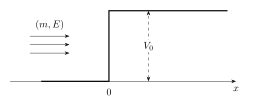
A beam of particles of mass m and energy E is incident on a step potential of height V_0 from the left as shown in the figure. Discuss the behaviour of the particle for (i) E < V_0 and (ii) E > V_0. Obtain expressions for the reflection and the transmission coefficients and sketch them as a function of the incident energy of the particle.
Generalize the results obtained in part (a) to obtain the allowed energy states and the corresponding eigenfunctions of a particle in a three dimensional isotropic box of dimension L. What is the degeneracy of the first two excited states of the particle ?
Describe the differences in the behaviour of a quantum harmonic oscillator with the corresponding classical oscillator.
Use the uncertainty principle to estimate the binding energy of the hydrogen atom in the ground state in terms of m_\text{e}, e, \hbar and c. Estimate the answer in eV.
An electron is described by the following wave function : \begin{aligned} \psi(x) &= 0 && \text{for } x < 0 \\ &= C e^{-x}(1 - e^{-x}) && \text{for } x \ge 0 \end{aligned} where C is a constant. Find out the average position of the electron.
A particle of mass m is confined in a one dimensional box on the x-axis between x = 0 and x = L. Obtain the allowed energy states of the particle and the corresponding eigenfunctions. What will be the energy pattern in the limit of L \to \infty ?
Show that
(i) \hat{L} \times \hat{L} = i \hbar \hat{L}
(ii) [\hat{L}_+, \hat{L}_-] = 2\hbar \hat{L}_z
(iii) \hat{\sigma}_x \hat{\sigma}_y \hat{\sigma}_z = -i
Prove the thermodynamic relation : \left( \frac{\partial S}{\partial V} \right)_T = \left( \frac{\partial P}{\partial T} \right)_V and hence show that \frac{\mathrm{d}P}{\mathrm{d}T} = \frac{L}{T (V_2 - V_1)} ; all the terms have their usual meanings.
Explain Bose-Einstein distribution and obtain the same from the grand canonical ensemble.
Write and explain the Maxwell-Boltzmann distribution. Using this distribution, find the expressions for the most probable speed, mean speed and root-mean-square speed.
A reversible engine converts 1/6 of the heat input into work. When the temperature of the sink is reduced by 62\ {}^{\circ}\mathrm{C}, its efficiency is doubled. Find the temperatures of source and sink.