
Determine the values of emitter current and the collector current of the transistor having \alpha = 0\cdot98 and collector to base leakage current I_\text{CBO} = 4\ \mu\text{A}. The base current is 50\ \mu\text{A}.
ifos-2017-subject-08-003
Determine the values of emitter current and the collector current of the transistor having \alpha = 0\cdot98 and collector to base leakage current I_\text{CBO} = 4\ \mu\text{A}. The base current is 50\ \mu\text{A}.
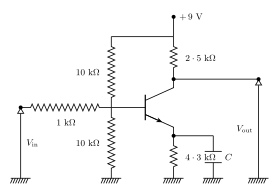
An amplifier in common-emitter configuration is shown in the above figure. If the current gain \beta=100 and the a.c. emitter resistance =25.0\,\Omega, determine the input impedance and the voltage gain of the amplifier:
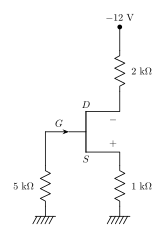
Given above is a circuit of self biased p-channel JFET. If the pinch off voltage is 5.0\ \mathrm{V} and V_{\mathrm{DS}} = 6.0\ \mathrm{V}, calculate the saturation current I_{\mathrm{DSS}}.
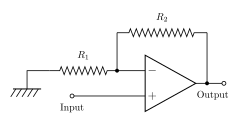
Consider the operational amplifier circuit given above: Given, R_1=10\,\mathrm{k}\Omega, R_2=150\,\mathrm{k}\Omega and the product of the open loop gain of the amplifier and its bandwidth =10^6\,\mathrm{Hz}. Determine the closed loop bandwidth of the amplifier.
Obtain the expression for penetration depth using London's equation of superconductivity and explain its significance.
In a semiconductor, the effective masses of an electron and a hole are 0.07\,m_0 and 0.4\,m_0, respectively, where m_0 is the free electron mass. Assuming that the average relaxation time for the hole is half of that for the electrons, calculate the mobility of the holes when the mobility of the electrons is 0.8\,\mathrm{m^2\,volt^{-1}\,s^{-1}}.
The energy (E) and wave vector (k) for a conduction band electron in a semiconductor are related as E=\alpha\,\dfrac{\hbar^2 k^2}{m_0} where \alpha is a constant and m_0 is the free electron mass. Calculate the effective mass of the electron.
A system of paramagnetic atoms (N per unit volume) which can occupy only two energy levels in a uniform external magnetic field H is at a temperature T. If this system follows Boltzman's distribution, find the magnetisation and susceptibility of the system.
What is Meissner effect ? Explain perfect diamagnetism in reference to this.
What do you understand by spontaneous magnetization below Curie temperature ? Explain with an appropriate diagram, the occurrence of a hysteresis loop in a ferromagnetic material.
How much energy is required to separate {}_8^{16}\text{O} nucleus into its constituent nucleons ? What is the binding energy per nucleon for this nucleus ?
What are noncentral nuclear forces ? Discuss qualitatively how the presence of a small noncentral component in the nuclear force can account for the nonvanishing quadrupole moment of deuteron.
Describe the main features of the shell model of the nucleus. Explain how it can account for the magic numbers of nuclei.
Predict the spin and parity for the ground state of the following nuclei on the basis of the shell model : {}_8^{15}\text{O}, {}_8^{16}\text{O}, {}_8^{17}\text{O}, {}_8^{18}\text{O}
Write down the semiempirical mass formula for nuclei and sketch the variation of isobaric masses with atomic number for both odd and even values of A. How many stable isobars would be there in each case ?
Explain briefly SU(3) flavor symmetry and SU(2) isospin symmetry in particle physics.
Write the quark contents and the quantum numbers (B, J, s, I_3) of the following hadrons : \bar{\Sigma}^-, \Xi^\circ, \Pi^+, \bar{K}^\circ
Write the semi-empirical mass formula pointing out the role of volume term, surface energy term, coulomb and symmetry energy correction terms.
State the three characteristic properties of strong, weak and electromagnetic forces distinguishing one from the other.
Point out the interactions in which the following conservation laws are obeyed or violated
(i) Isotopic spin
(ii) Hyper charge
(iii) Lepton number
(iv) Charge conjugation