
Explain the physical significance of group velocity from the concept of phase velocity with relevant expressions.
cse-2011-subject-02-002
Explain the physical significance of group velocity from the concept of phase velocity with relevant expressions.
Show with proper mathematical analysis that the ratio of Einstein's A and B coefficients depends upon the energy separation between the two energy levels participating in the optical transitions. What is the physical significance of A coefficient? \text{(5 marks)} Justify the statement, ``It is very difficult to develop an X-ray laser''. \text{(5 marks)}
Write down the one-dimensional harmonic oscillator differential equation under damping and its solution for the lightly damped condition, with the meanings of symbols. Determine the dependent energy in the lightly damped condition.
Prove that the group velocity V_g of electromagnetic waves in a dispersive medium with refractive index n(\lambda_0) at wavelength \lambda_0 is given by V_g=\frac{c}{n(\lambda_0)-\lambda_0\dfrac{dn(\lambda_0)}{d\lambda_0}} where c is the free space velocity of light. Find the time taken for the electromagnetic pulse to travel a distance D.
For calcite, the refractive indices of ordinary and extraordinary rays are 1.65836 and 1.48641 at \lambda_0=5893\,\mathring{\mathrm{A}} respectively. A left circularly polarized beam of this wavelength is incident normally on such crystal of thickness 0.005141\,\mathrm{mm} having its optic axis cut parallel to the surface. What will be the state of polarization of the emergent beam?
Determine the number of degrees of freedom for a rigid body-
(i) moving freely in space of three dimensions;
(ii) having one point fixed;
(iii) having two points fixed.
On the basis of three principal moments of inertia I_A, I_B and I_C each about X, Y and Z axes respectively, how can you classify molecules?
Imagine that a rigid body is rotating about a fixed point with angular velocity \vec{\omega}. Assuming that the coordinate axes coincide with the principal axes, if T stands for kinetic energy and G for external torque acting on the body, show that \frac{dT}{dt}=\vec{G}\cdot\vec{\omega}
With an appropriate diagram, deduce the velocity profile for streamline flow of a liquid through a capillary of circular cross-section. Deduce also the fraction of liquid which flows through the section up to a distance a/2 from the axis, where a is the radius of the capillary.
With an appropriate diagram, show that in the Rutherford scattering, the orbit of the particle is a hyperbola. Obtain an expression for impact parameter.
With an appropriate diagram, show that in the Rutherford scattering, the orbit of the particle is a hyperbola. Obtain an expression for impact parameter.
Prove that the time taken by the earth to travel over half of its orbit separated by the minor axis remote from the sun is two days more than half a year. Given, the period of the earth is 365 days and eccentricity of the orbit =1/60.
A spaceship measures 50 m in length on ground and it measured a length of 49.7 m in space as observed from the ground. Find out the speed of the spaceship.
Distinguish between classical and quantum theory of paramagnetism. Explain the paramagnetism of free electrons on the basis of F.D. distribution.
What is Josephson tunnelling? Distinguish between a.c. and d.c. Josephson effects.
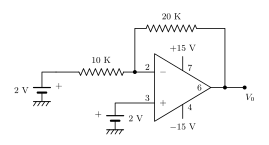
Identify the above op-amp circuit. Estimate the net output voltage V_0.
Distinguish between Einstein and Debye models of specific heats of solids. Obtain an expression for the specific heat of a solid on the basis of Debye model. Discuss the results for low and high temperature ranges.
Draw a two stage RC coupled transistor amplifier. Plot the frequency response and indicate the lower and upper cut off frequencies and the bandwidth.
Explain the reduced zone scheme of plotting the energy bands in solids. On the basis of E vs k curve distinguish between conductors, semiconductors and insulators.
What is nearly free electron approximation? On the basis of this approximation explain the formation of energy bands in solids.