
Employing NAND gates, design a half adder circuit which can add two bits A and B and provide a sum S and a carry C as its output.
ifos-2010-subject-08-007
Employing NAND gates, design a half adder circuit which can add two bits A and B and provide a sum S and a carry C as its output.
Predict from the single particle shell model, the shell configuration, ground state spin and parity for the following nuclei : {}^7_3\text{Li}, \quad {}^{13}_7\text{N}, \quad {}^{17}_8\text{O}, \quad {}^{27}_{13}\text{Al}
What are magic numbers ? Discuss the shell structure of a nucleus. How is this model able to explain various properties of nuclei ? Discuss the limitations of this model.
A star converts all its hydrogen into helium, achieving 100\% helium. It then converts the helium into carbon via the reaction {}^4_2\text{He} + ^4_2\text{He} + ^4_2\text{He} \xrightarrow{\quad} ^{12}_6\text{C} + 7.27\text{ MeV} The mass of the star is 5.0 \times 10^{32}\text{ kg} and it generates energy at the rate of 5 \times 10^{30}\text{ W}. How long will it take to convert all helium to carbon at this rate ?
Calculate the binding energy per nucleus for {}^{87}_{38}\text{Sr}.
Write the quark composition of the following :
(i) Neutron
(ii) Proton
(iii) \Lambda
(iv) \text{K}^-
(v) \pi^+
What is Raman effect ? Discuss its application to molecular structure.
Derive the combined vibration–rotation spectrum of a diatomic molecule. What are P and R branches ?
Consider a diatomic molecule as a rigid rotator. Obtain its rotational energy levels and hence the rotational spectra.
Describe Stern–Gerlach experiment. In performing this experiment, beams of neutral atoms are used. Why are electrons or ion beams not used ? Explain how it demonstrates the discrete nature of the magnetic moment of an atom.
State and explain the Heisenberg's uncertainty principle. Show that the natural line width of a spectral line follows from this principle. The lifetime of an excited state of an atom is 10^{-8}\text{ s}. Calculate the energy width of such a state.
Set up a time-independent Schrödinger equation for a linear harmonic oscillator and obtain the energy eigen values. Explain the significance of zero point energy.
A stream of particles of mass M and energy E is directed from left to a one-dimensional potential well, as shown below :
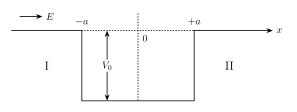
The potential is -V_0 in the region a \ge x \ge -a and zero elsewhere. Set up a time-independent Schrödinger equation and obtain an expression for the transmission ratio from region I to II. Discuss the result. Show that there is a finite reflection from such a potential well, which is a result of the wave nature of matter.
Estimate the number of states lying in an energy interval of 0.03\text{ eV} above the Fermi level in a potassium crystal of unit volume. (E_F = 2.12\text{ eV} for potassium)
The electron spin operator \hat{s} can be expressed in matrix form in terms of the Pauli spin operator, \hat{\sigma} as \hat{\sigma} = 2\hat{s} where \sigma_x = \begin{pmatrix} 0 & 1 \\ 1 & 0 \end{pmatrix}, \quad \sigma_y = \begin{pmatrix} 0 & -i \\ +i & 0 \end{pmatrix}, \quad \sigma_z = \begin{pmatrix} 1 & 0 \\ 0 & -1 \end{pmatrix} Show that \sigma_x^2 = \sigma_y^2 = \sigma_z^2 = 1 \quad \text{and} \sigma_x \sigma_y = -\sigma_y \sigma_x = i \sigma_z \sigma_y \sigma_z = -\sigma_z \sigma_y = i \sigma_x \sigma_z \sigma_x = -\sigma_x \sigma_z = i \sigma_y
Set up the time-independent Schrödinger equation for an electron moving in a Coulomb field, V(r) = \frac{-ze^2}{4\pi\varepsilon_0 r}, in polar coordinates. Solve the radial equation to get the energy eigen values.
(ii) -\left(\dfrac{\partial f}{\partial E}\right) is symmetric about the Fermi level.
N particles are distributed among three states having energies E = 0, E = kT and E = 2kT. If the total equilibrium energy of the system is 1000 kT, what is the value of N?
Let f be the Fermi-Dirac distribution function, then show that— (i) -\left(\dfrac{\partial f}{\partial E}\right) is a maximum at the Fermi level;
Explain why the distribution of speeds of molecules emerging through a small hole in an effusive molecular beam source is not a Maxwellian distribution.