
For a uniform wire of length L and radius a having a potential difference V between the ends and a current I along it, calculate the energy per unit time delivered to the wire by Poynting vector.
cse-2013-subject-03-009
For a uniform wire of length L and radius a having a potential difference V between the ends and a current I along it, calculate the energy per unit time delivered to the wire by Poynting vector.
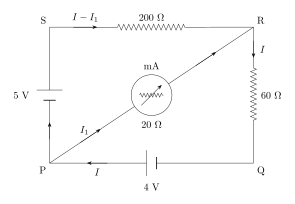
In the circuit diagram shown below, calculate the current passing through the milliammeter.
Consider the following coupled inductor - capacitor circuit:
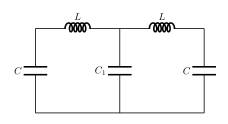
Calculate the ratio of the frequencies of the anti-symmetric and symmetric modes \omega_a/\omega_s. \left(\text{Given } k=\frac{1}{LC},\ k'=\frac{1}{LC_1}\right)
Consider the equation for a series RLC circuit and compare this to the parallel resonant circuit shown below:
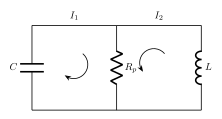
Calculate the value of R_p if a series RLC circuit and the parallel RLC circuit are to have same equations for the potential of capacitance while they both have the same L, C and Q with Q being the total charge.
ABCD is a rectangle in which charges of +10^{-11}\,\mathrm{C}, -2\times10^{-11}\,\mathrm{C} and 10^{-11}\,\mathrm{C} are placed at corners B, C and D, respectively.
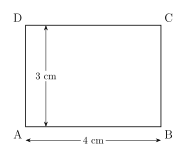
Calculate the potential at the corner A and the work done in carrying a charge of 2 coulombs to A.
A series LCR circuit has resonant frequency \omega_0 and a large quality factor Q. Write down in terms of R, \omega, \omega_0 and Q, its (i) impedance at resonance, (ii) impedance at half-power points and (iii) the approximate forms of its impedance at low and high frequencies.
Using the fundamental concepts of electromagnetism, determine the electric field of an electric dipole \vec{p} at a distance \vec{r} and its energy in an electric field \vec{E}.
(i) Considering an isotropic, linear, non-conducting, non-magnetic and inhomogeneous dielectric medium with \vec{D}=\epsilon\vec{E}=\epsilon_0n^2(x,y,z)\vec{E}, show that the electromagnetic wave equation for the field \vec{E} is given by \nabla^2\vec{E}+\vec{\nabla}\left(\frac{1}{n^2}\vec{\nabla}n^2\cdot\vec{E}\right)-\mu_0\varepsilon_0n^2\frac{\partial^2\vec{E}}{\partial t^2}=0.
(ii) Write down the scalar equation for E_x from the above equation.
(iii) Interpret physically the situation if we move from homogeneous to an inhomogeneous medium.
(iv) Obtain the similar vector equation for the magnetic field \vec{H} in inhomogeneous medium.
The dispersion relation for deep water waves is given by \omega^2 = gk + ak^3 where g and a are constants. Obtain expressions for phase velocity and group velocity in terms of the wavelength \lambda. \omega and k represent the angular frequency and wave number, respectively.
The displacement associated with a three-dimensional plane wave is given by \Psi(x,y,z,t) = a\cos\left[\frac{\sqrt{3}}{2}kx + \frac{1}{2}ky - \omega t\right]. Calculate the angles made by the propagating wave with the x, y and z-axes.
In a tungsten filament lamp, thermionic emission takes place at 1.2\times10^3\ \mathrm{K}. Calculate the ratio of spontaneous emission to stimulated emission for non-degenerate energy levels. Interpret your result physically. Take \lambda=550\ \mathrm{nm}, k_B=1.38\times10^{-2}\ \mathrm{J\,K^{-1}}, h=6.67\times10^{-34}\ \mathrm{J\,s} and c=3\times10^8\ \mathrm{m\,s^{-1}}.
During an earthquake, a horizontal shelf moves vertically. If its motion can be regarded simple harmonic, calculate the maximum value of amplitude of oscillation so that the books resting on it stay in contact with it always. Take g=9.8\ \mathrm{m\,s^{-2}} and T=0.5\ \mathrm{s}.
A parallel beam of light from a He–Ne laser (\lambda=630 nm) is made to fall on a narrow slit of width 0.2\times10^{-3} m. The Fraunhofer diffraction pattern is observed on a screen placed in the focal plane of a convex lens of focal length 0.3 m. Calculate the distance between the
(i) first two minima and
(ii) first two maxima on the screen.
Explain the physical significance of resolving power of a grating with relevant mathematical expression.
Explain why information carrying capacity of an optical fibre can be enhanced by reducing the pulse dispersion. How does one minimize pulse dispersion using a graded index optical fibre?
Show that the operator \left(\nabla^2-\frac{1}{c^2}\frac{\partial^2}{\partial t^2}\right) is invariant under Lorentz transformations.
Show that a particle of rest mass m_0, total energy E and linear momentum \vec{p} satisfies the relation E^2=c^2p^2+m_0^2c^4 where c is the velocity of light in free space.
Derive the relativistic length contraction using Lorentz transformation.
A particle describes a circular orbit under the influence of an attractive central force directed towards a point on the circle. Show that the force varies as the inverse fifth power of distance.
Calculate the horizontal component of the Coriolis force acting on a body of mass 0.1\ \mathrm{kg} moving northward with a horizontal velocity of 100\ \mathrm{ms^{-1}} at 30^{\circ}\mathrm{N} latitude on the Earth.