
State the characteristics of an ideal Op-Amp. Explain the use of an Op-Amp as a summing amplifier and a differentiator.
ifos-2024-subject-08-005
State the characteristics of an ideal Op-Amp. Explain the use of an Op-Amp as a summing amplifier and a differentiator.
(i) Prove that \overline{AB + \bar{A} + AB} = 0.
The density of a liquid monovalent metal near absolute zero temperature is given to be 0\cdot 081\text{ g cm}^{-3}. Calculate the Fermi energy \varepsilon_F, the electron velocity v_F at the Fermi surface and the Fermi temperature T_F.
(ii) Recalculate the intrinsic carrier concentration at T = 450\text{ K} by assuming that the effective electron and hole masses in the respective bands decrease by 0\cdot 5\%.
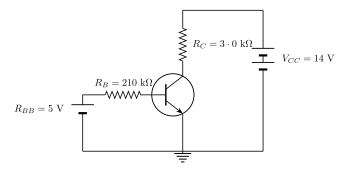
The n\text{-}p\text{-}n transistor given below has \beta = 100, I_{CO} = 12\text{ nA} and V_{BE} = 0\cdot 8\text{ V}. Determine the transistor currents and the region of operation of the transistor. What happens if R_C is indefinitely increased?
What were the difficulties faced by the initial theory of \beta-decay? How did Pauli eliminate the difficulties? What were the expected properties of the new particle proposed by Pauli?
A sample contains 4\text{ mg} of {}^{210}\text{Bi}. If the half-life of radioactive {}^{210}\text{Bi} is 5\text{ days} and the average energy of the \beta-particles emitted is 0\cdot 34\text{ MeV}, then at what rate does the sample emit energy?
In the case of deuterons, answer the following : (i) What percentage of the time do the nucleons of a deuteron spend within the range of the nuclear forces?
Apply the meson theory of nuclear forces to write the interaction between protons, neutrons, proton to neutron and neutron to proton.
Assume that the range of the interaction of nuclear force and of meson is 2 \times 10^{-15}\text{ m}. Estimate the mass of the meson.
(ii) From a study of the radial part of the Schrödinger equation of a deuteron for any angular momentum l, what do we conclude?
A radionuclide (N_1) decays to a radioactive daughter (N_2) that subsequently decays to a third daughter (N_3). If at t = 0, the initial concentrations of N_1, N_2 and N_3 are N_1^0, 0 and 0 respectively, and the decay constants are \lambda_1 (from N_1 \rightarrow N_2) and \lambda_2 (from N_2 \rightarrow N_3), then derive the expression for N_2 at time t. Given that the daughter N_3 is stable.
Write the decay reactions of the neutral pions (\pi^0) and the charged pions (\pi^+, \pi^-).
The force constant of the bond in CO molecule is 1900\text{ N m}^{-1}. Calculate the energy of the lowest vibrational level. The reduced mass of CO molecule is 1\cdot 14 \times 10^{-26}\text{ kg}. Given h = 6\cdot 63 \times 10^{-34}\text{ J s} and 1\text{ eV} = 1\cdot 6 \times 10^{-19}\text{ J}.
A beam of hydrogen atoms in a Stern-Gerlach experiment obtained from an oven heated to a temperature of 400\text{ K} passes through a magnetic field of length 1\text{ m} and having a gradient of 10\text{ T/m} perpendicular to the beam. Calculate the transverse deflection of an atom of the beam at a point where the beam leaves the field. The value of Bohr magneton \mu_B is 9\cdot 27 \times 10^{-24}\text{ A m}^2 and the Boltzmann constant k is 1\cdot 38 \times 10^{-23}\text{ J/K}.
Discuss the rotational fine structure of electronic bands of molecule.
In the vibrational Raman spectrum of HF, the Raman lines are observed at wavelengths 2670\text{ \AA} and 3430\text{ \AA}. Find the fundamental vibrational frequency of the molecule.
Describe in brief the Raman effect.
Calculate the possible angles between \vec{L} and \vec{S} for a d-electron in one-electron atom.
Explain the formation of molecular hydrogen in the interstellar medium.