
What is the de Broglie wavelength of an electron whose kinetic energy is 100\text{ eV} ?
ifos-2014-subject-05-001
What is the de Broglie wavelength of an electron whose kinetic energy is 100\text{ eV} ?
Show that the elemental quantity of heat dQ is not a total differential.
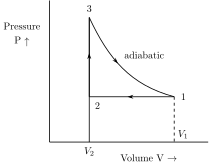
The figure below represents an imaginary ideal gas cycle. Assuming constant heat capacities, show that the thermal efficiency is : \eta = 1 - Y \frac{(V_1/V_2) - 1}{(P_3/P_2) - 1}
Derive an expression for the Fermi energy for a free electron gas at T = 0. Compute the Fermi temperature of Cu assuming the density 9\text{ gms/cm}^3 and one conduction electron per atom.
For a degenerate Fermi-Dirac gas, the concentration of nucleons in nuclear matter is N = 1.1 \times 10^{38}\text{ cm}^{-3}. Calculate the Fermi energy and Fermi temperature.
An inductance L, capacitance C and resistance R are connected in series to form a circuit with AC source driving with E_{\text{rms}} = 120\text{ V} at f = 60\text{ Hz}. Compute the power factor and average power dissipated in the resistance if R = 200\ \Omega, X_L = 80\ \Omega and X_C = 150\ \Omega.
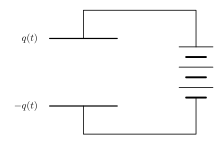
A parallel plate capacitor is connected to a battery. What is the electric current while the capacitor is being charged ? What is the displacement current between the plates of the capacitor ? Show that the rate of increase of the electric energy is equal to the surface integral of the Poynting vector over the surface enclosing the volume between the plates of the capacitor.
(i) Write Maxwell's equations in the absence of a medium. (ii) Explain the gauge transformation and gauge invariance. Show that the relation \text{div } \bar{A} + \frac{1}{c} \frac{\partial \phi}{\partial t} is Lorentz-covariant, where \bar{A} and \phi are the vector potential and the scalar potential respectively. (iii) Obtain Maxwell's wave equations satisfied by the scalar and vector potentials in the absence of charge and current.
A plane electromagnetic wave of frequency w_1 travelling in z-direction and polarized in x-direction is incident on a dielectric medium separated by a plane boundary in the x-z plane. Show that the transmission and reflection coefficient are given by : R = \frac{(n_1 - n_2)^2}{(n_1 + n_2)^2} , \quad T = \frac{4 n_1 n_2}{(n_1 + n_2)^2} , where n_1 and n_2 are the refractive indices of the first and the second medium.
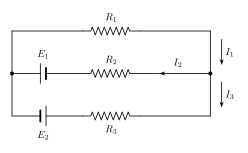
Explain Kirchoff's circuit laws. Using Kirchoff's laws find currents I_1, I_2 and I_3 in the circuit shown below for R_1 = 100\ \Omega, R_2 = 200\ \Omega, R_3 = 300\ \Omega, E_1 = 3\text{ V}, E_2 = 4\text{ V}.
A sphere of homogeneous linear dielectric material is placed in an otherwise uniform electric field \bar{E}_o. Find the electric field inside the sphere.
Compute the electrostatic energy of a conducting solid sphere of radius R and having total charge Q using the expression for the electrostatic energy in terms of the electric field \bar{E} of the above sphere.
Suppose a cavity of volume V contains blackbody radiation in equilibrium with the walls of the cavity at a temperature T. For a reversible adiabatic change of volume show that : VT^3 = \text{constant}. If the initial temperature is 2000^\circ\text{K} and the volume is increased from 10\text{ cm}^3 to 1250\text{ cm}^3, reversibly and adiabatically, what would be the final temperature of the radiation ?
Prove Stefan's law of radiation from thermodynamic considerations.
How does the population inversion in an active medium lead to the amplification of light in a laser ? Explain in details.
A left circularly polarized beam (\lambda = 5893^\circ\text{A}) is incident normally on a calcite crystal (with its optic axis cut parallel to the surface) of thickness 0.005141\text{ mm}. What will be the state of polarization of the emergent beam ? Justify your answer. Here the refractive indices for the ordinary and the extraordinary rays are 1.65836 and 1.48641 respectively.
Write down the mathematical representation of Fermat's principle and explain all the notations used. With the help of a neat diagram, show that this principle can be used to obtain the law of refraction : n_1 \sin \theta_1 = n_2 \sin \theta_2 , where n_1 and n_2 are the refractive indices of the two media while \theta_1 and \theta_2 are the angles of incidence and refraction of the light beam.
Explain how you can construct a zone plate from Fresnel's half period zone. Show that a zone plate has multiple foci.
If the system matrix for a thin lens of focal length f is given by : S = \begin{bmatrix} 1 & -1/f \\ 0 & 1 \end{bmatrix} , show that the system matrix for a combination of two thin lenses of focal lengths f_1 and f_2 separated by a distance d can be obtained as S_{12} = \begin{bmatrix} 1 - d/f_2 & -(1/f_1 + 1/f_2 - d/f_1 f_2) \\ d & 1 - d/f_1 \end{bmatrix}
What are the step index and graded index optical fibers ? What are the conventional optical windows for light propagation through optical fibers ?