
Using uncertainty principle, calculate the size and energy of the ground state hydrogen atom.
cse-2016-subject-05-004
Using uncertainty principle, calculate the size and energy of the ground state hydrogen atom.
Solve the Schrodinger equation for a step potential and calculate the transmission and reflection coefficient for the case when the kinetic energy of the particle E_0 is greater than the potential energy V (i.e., E_0>V).
An electron is confined to move between two rigid walls separated by 10^{-9}\,\mathrm{m}. Compute the de Broglie wavelengths representing the first three allowed energy states of the electron and the corresponding energies.
Write down the matrix representation of the three Pauli matrices \sigma_x, \sigma_y and \sigma_z. Prove that these matrices satisfy the following identities:
(i) [\sigma_x,\sigma_y]=2i\sigma_z
(ii) [\sigma^2\cdot\sigma_x]=0
(iii) (\vec{\sigma}\cdot\vec{A})(\vec{\sigma}\cdot\vec{B})=\vec{A}\cdot\vec{B}+i\vec{\sigma}\cdot(\vec{A}\times\vec{B}) if \vec{A} and \vec{B} commute with Pauli matrices.
Calculate the density of states for an electron moving freely inside a metal with the help of quantum mechanical Schrodinger's equation for free particle in a box.
The molecules of a gas obeying Maxwell-Boltzmann distribution move with an average speed of 450\ \mathrm{m\ s^{-1}}. If the coefficient of viscosity of the gas \eta is 16.6\times10^{-6}\ \mathrm{N\,s\,m^{-2}}, density of the gas \rho is 1.25\ \mathrm{kg\ m^{-3}} and number density is 2.7\times10^{25}\ \mathrm{m^{-3}}, calculate the mean free path and diameter of the gas molecules.
Consider a system of N particles and a phase space consisting of only two states with energies 0 and \varepsilon(>0). Obtain the expressions for the partition function and the internal energy of the system, if it obeys M-B statistics.
The viscosity in a liquid arises due to friction between adjacent layers. What causes viscosity in a gas? Explain.
Write down the salient features of the Einstein's theory of lattice heat capacity. Further write down the expression for specific heat in Einstein's theory and explain its high and low temperature limits.
The molecules of a gas obey Maxwell-Boltzmann distribution. Calculate the fraction of molecules of the gas within 1\% of the most probable speed at STP. Interpret your result.
m gram of water at temperature T_1 is isobarically and adiabatically mixed with an equal mass of water at temperature T_2. Show that the change in entropy is given by \Delta S=2mC_p\ln\left(\dfrac{T_{\mathrm{av}}}{T_{\mathrm{geo}}}\right), where T_{\mathrm{av}}=\dfrac{T_1+T_2}{2} and T_{\mathrm{geo}}=\sqrt{T_1T_2}.
Write down van der Waals' equation of state for n moles of a gas and calculate the temperature at which 5 moles of the gas at 5\ \mathrm{atm} pressure will occupy a volume of 20 litres. Given, R=8.31\times10^7\ \mathrm{erg\,mol^{-1}\,K^{-1}}, a=1.34\times10^{12}\ \mathrm{dyne\,cm^4\,mol^{-2}}, b=31.2\ \mathrm{cm^3\,mol^{-1}} and 1\ \mathrm{atm}=1.013\times10^6\ \mathrm{dyne\,cm^{-2}}.
What do you understand by the term 'phase transition'? Using Clausius-Clapeyron equation, show that for first-order phase transitions, vapour pressure decreases exponentially with temperature. You can assume that the vapour behaves like an ideal gas and latent heat remains constant with temperature.
The spectral energy curve of the moon shows maxima at 470\,\mathrm{nm} and 14\,\mu\mathrm{m}. What inference can you draw from this data? Also calculate the energy density and radiation pressure in both cases. Given, Wien's constant b = 2.892 \times 10^{-3}\,\mathrm{m\,K}, Stefan's constant \sigma = 5.67 \times 10^{-8}\,\mathrm{J\,m^{-2}\,s^{-1}\,K^{-4}} and speed of light c = 3 \times 10^{8}\,\mathrm{m\,s^{-1}}.
Briefly explain Planck's law of blackbody radiation. Show that Planck's law reduces to Wien's law and Rayleigh-Jeans law at lower and higher wavelength limits respectively.
Show that the displacement current between the plates of a parallel-plate capacitor is equal to the conduction current across the conductor.
With the help of a neat diagram, show that the potential due to a dipole at a point is given by V=\frac{1}{4\pi\epsilon_0}\,\frac{p\cos\theta}{r^2}, where p is the dipole moment of the charge distribution, \theta is the angle between the line joining the centre of the dipole to the point of interest and the axis of the dipole.
An alternating current varying sinusoidally with a frequency of 50 Hz has an r.m.s. value of 40 A. Find the instantaneous value of the current at 0.00125 second after passing through maximum positive value.
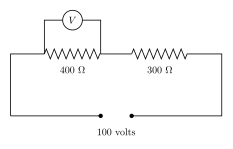
In the circuit diagram shown below, the voltmeter reads 50 volts when it is connected across the 400\Omega resistance. Calculate what the same voltmeter will read when connected across the 300\Omega resistance.
In free space, the electric field of electromagnetic wave is given as \vec{E}(x,t)=120\cos(\omega t-kx)\hat{y}\,\mathrm{V/m}. Find the average power crossing a circular area of radius one metre in the yz-plane.