A stream of electrons, each of energy E = 3\text{ eV}, is incident on a potential barrier of height V = 4\text{ eV}. The width of the barrier is 20\text{ \AA}. Calculate the percentage transmission of the beam through the barrier.
Use WKB method to estimate the energy levels of a one-dimensional harmonic oscillator.
Prove that [J^2, J_y] = 0.
Find the eigenvalues and eigenstates of the spin operator \vec{S} of an electron in the direction of unit vector \vec{n}. Assume that \vec{n} lies in the xz-plane using spin matrices.
Using Pauli spin matrices prove that,
(i) \sigma_x\sigma_y+\sigma_y\sigma_x=0;\ \sigma_y\sigma_z+\sigma_z\sigma_y=0;\ \sigma_x\sigma_z+\sigma_z\sigma_x=0
(ii) \sigma_+\sigma_-=2(1+\sigma_z)
(iii) \sigma_\alpha+\sigma_\beta=i\sigma_\gamma where \alpha\ne\beta\ne\gamma
Describe normal and anomalous Zeeman effect. Explain how it lifts the degeneracy in hydrogen atom.
Normalised wave function of hydrogen atom for 1s state is \psi_{100}=\frac{1}{\sqrt{\pi a_0^3}}e^{-r/a_0},\text{ where }a_0=\frac{\hbar^2}{me^2} being the Bohr radius. Calculate the expectation value of potential energy in this state.
Calculate the Larmor precessional frequency for a magnetic induction field of 0.5\,\mathrm{T}. Hence calculate the splitting in wave numbers of a spectral line due to normal Zeeman effect for the same field.
Find the uncertainty in the momentum of a particle when its position is determined within 0.02 cm. Find also the uncertainty in the velocity of an electron and \alpha-particle respectively when they are located within 15 \times 10^{-8}\,cm.
A particle is moving in a one-dimensional box of width 50\,\mathring{\mathrm{A}} and infinite height. Calculate the probability of finding the particle within an interval of 15\,\mathring{\mathrm{A}} at the centres of the box when it is in its state of least energy.
A beam of 12\,\mathrm{eV} electron is incident on a potential barrier of height 25\,\mathrm{eV} and width 0.05\,\mathrm{nm}. Calculate the transmission coefficient.
A particle of rest mass m_0 has a kinetic energy K, show that its de Broglie wavelength is given by \lambda=\frac{hc}{\sqrt{\left[K\left(K+2m_0c^2\right)\right]}}. Hence calculate the wavelength of an electron of kinetic energy 2\mathrm{MeV}. What will be the value of \lambda if K << m_0c^2?
Find the minimum magnetic field needed for the Zeeman effect to be observed in a spectral line of 400\,\mathrm{nm} wavelength when a spectrometer whose resolution is 0.010\,\mathrm{nm} is used. Write the answer in the nearest high integer.
Calculate the probability of finding a simple harmonic oscillator within the classical limits if the oscillator is in its normal state. Also show that if the oscillator is in its normal state, then the probability of finding the particle outside the classical limits is approximately 16\%.
Write a brief note on Chandrasekhar Limit.
How many nitrogen molecules must strike a 1\text{ cm}^2 surface each second to exert a pressure of 1\text{ atmosphere} ? (Assume the molecules are all moving at same speed, corresponding to a temperature of 300\text{ K}, and at an angle of 45^\circ to the wall). [Molecular mass of \text{N}_2 is 28\text{ u}]
A gas of N spinless Bose particles of mass m is enclosed in a volume V at a temperature T.
(i) Find an expression for the density of single-particle state D(\varepsilon) as a function of the single-particle energy \varepsilon. Sketch the result.
(ii) Write down an integral expression which implicitly determines \mu(T). Referring to your sketch in (i), determine in which direction \mu(T) moves as T is lowered.
Find the pressure at which water would boil at 150^\circ\text{C} if the change in specific volume when one gm of water is converted into steam is 1676\text{ c.c.} Given J = 4\cdot 2 \times 10^7\text{ ergs/cal}, one atmosphere = 10^6\text{ dyne/cm}^2 and latent heat of vapourisation of steam = 540\text{ cal/gm}.
Calculate the work done in expanding one mole of an ideal gas at 127^\circ\text{C} to double its initial volume.
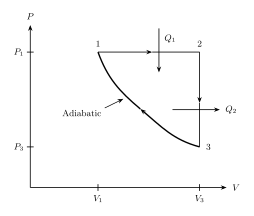
A hypothetical engine, with an ideal gas as the working substance, operates in the cycle shown below. Show that the efficiency of the engine is \eta = 1 - \frac{1}{\gamma} \left( \frac{1 - \dfrac{P_3}{P_1}}{1 - \dfrac{V_1}{V_3}} \right) .