Comment Done
Navigation
HomePYQs Question BankCSE Physics OptionalIFoS Physics OptionalBlog & InsightsCourses & ProgrammesMy Courses (Candidate Portal)
Account
/
20 questions visible on this page

A certain linear, homogeneous, isotropic, dielectric material has a relative permittivity, \varepsilon_{\text{r}} = 1\cdot 8. If potential \text{V} = -4000\text{y} volts in the material, then find :

(i) The electric flux density \text{D}, and

(ii) The polarisation \text{P}. Take vacuum permittivity \varepsilon_0 = 8\cdot 85 \times 10^{-12}\text{ farad/m}.

IFoS 2025Paper I8 marksifos-2025-subject-03-002

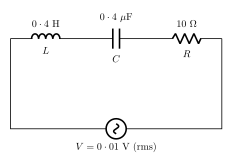
For the following series LCR circuit,

Physics Diagram ifos-q-3-064-fig-1

Calculate :

(i) The resonant frequency of the circuit.

(ii) The maximum current in the circuit.

(iii) The voltage across \text{C} at resonance.

(iv) The power absorbed by the circuit at resonance.

IFoS 2025Paper I15 marksifos-2025-subject-03-005

Describe the interference by a plane parallel thin film when illuminated normally and obliquely by a plane wave. Also list some important practical applications of the thin film interference phenomenon.

IFoS 2025Paper I8+2=10 marksifos-2025-subject-02-004

A particle of mass \text{m} is suspended from a spring which has mass \text{m} and force constant \text{k}. Show that the oscillation frequency is given by \omega = \frac{\sqrt{3}}{2}\omega_0, where \omega_0 is frequency of oscillation when spring is considered massless.

IFoS 2025Paper I15 marksifos-2025-subject-02-002

A parallel beam of sodium light of wavelength 5893\text{ \AA} is incident on a diffraction grating. The angle between the first order spectra on either side of the normal is 27^{\circ} 42'. Find :

(i) The number of rulings/mm on the grating.

(ii) The greatest number of bright images obtained.

IFoS 2025Paper I4+4=8 marksifos-2025-subject-02-005

Determine the position of focal points, principal points and nodal points for a spherical lens of radius 20\text{ cm}. The refractive index of the material of the lens is 3/2. Indicate the positions of all the points in a diagram.

IFoS 2025Paper I8 marksifos-2025-subject-02-003

Within the framework of the Cornu's spiral, describe the intensity distribution at an arbitrary point \text{P} when a plane wave is incident normally on a long narrow slit of width \text{b}. For this case, under what condition will the diffraction pattern be of Fraunhofer type?

IFoS 2025Paper I8+2=10 marksifos-2025-subject-02-006

Explain the construction and working of a quarter-wave plate. How is it used to produce circularly and elliptically polarized light?

IFoS 2025Paper I8+2=10 marksifos-2025-subject-02-007

A 15\cdot 0\text{ cm} violin string, fixed at both the ends, is vibrating with the largest wavelength. The speed of the wave in this string is 250\text{ m/s}, and the speed of sound in air is 350\text{ m/s}. What is the frequency and wavelength of the emitted sound wave?

IFoS 2025Paper I8 marksifos-2025-subject-02-001

What do you understand by pulse dispersion in multimode optical fibres? Deduce an expression for intermodal pulse dispersion in a step-index fibre. Also compare the pulse dispersions of the step-index fibres with the parabolic-index fibres.

IFoS 2025Paper I10+5=15 marksifos-2025-subject-02-008

A particle of mass \text{m} moves under the attractive central force \text{F} = -\frac{\text{C}}{\text{r}^{\text{n}+1}}. Find the condition for which the particle will have stable circular orbit. (\text{C} > 0, a constant).

IFoS 2025Paper I15 marksifos-2025-subject-01-002

Calculate the effective gravitational acceleration at the equator due to the Earth's rotation. [\text{R}_{\text{earth}} = 6400\text{ km}]

IFoS 2025Paper I8 marksifos-2025-subject-01-003

Write down the Euler equations for torque-free motion of a rigid body. Solve these equations to find precessing motion for a symmetric top.

IFoS 2025Paper I15 marksifos-2025-subject-01-004

Consider two inertial frames \text{S} and \text{S}'. \text{S}' is moving along \text{y}-direction with a constant speed \text{v}_0. Find how the first order partial derivatives with respect to \text{x}, \text{y}, \text{z} and \text{ct} are connected in these two inertial frames. Show that the D'Alembertian, \nabla^2 - \frac{1}{\text{c}^2}\frac{\partial^2}{\partial \text{t}^2} is invariant under the Lorentz transformation.

IFoS 2025Paper I15 marksifos-2025-subject-01-006

Two particles each of rest mass 1\text{ gm} collide head-on with the speed 0\cdot 8\text{c} to stick together at rest. Find the mass of the final composite.

IFoS 2025Paper I8 marksifos-2025-subject-01-005

(i) Define cyclic coordinates and find their connections with the symmetries of the system.

(ii) A system with two degrees of freedom is described by the Lagrangian \text{L} = \frac{1}{2}\text{m}_1 \dot{\text{q}}_1^2 + \frac{1}{2}\text{m}_2 \text{q}_1^2 \dot{\text{q}}_2^2 - \frac{\alpha}{\text{q}_1}, \alpha is constant. Find the cyclic coordinates, conserved quantities and symmetries for this system, if any.

IFoS 2025Paper I10+5=15 marksifos-2025-subject-01-001

State the Barkhausen criterion for sustained oscillations of a feedback circuit. Explain the operation of a Hartley oscillator using proper circuit diagram.

IFoS 2024Paper II15 marksifos-2024-subject-08-009

Given that for intrinsic Si at T = 300\text{ K}, the band gap is 1\cdot 1\text{ eV} and the intrinsic carrier concentration is n_i = 1\cdot 5 \times 10^{10}\text{ cm}^{-3}. (i) Calculate the intrinsic carrier concentration at T = 450\text{ K}. Assume that the band gap at T = 450\text{ K} is 1\cdot 08\text{ eV}.

IFoS 2024Paper II6 marksifos-2024-subject-08-002

(ii) Recalculate the intrinsic carrier concentration at T = 450\text{ K} by assuming that the effective electron and hole masses in the respective bands decrease by 0\cdot 5\%.

IFoS 2024Paper II4 marksifos-2024-subject-08-003

Consider the planes with indices (1\ 0\ 0) and (0\ 0\ 1); the lattice is f.c.c., and the indices refer to the conventional cubic cell. What are the indices of these planes when referred to the primitive axes : \vec{a}_1 = \frac{a}{2}(\hat{x}+\hat{y}), \vec{a}_2 = \frac{a}{2}(\hat{y}+\hat{z}) and \vec{a}_3 = \frac{a}{2}(\hat{z}+\hat{x})?

IFoS 2024Paper II8 marksifos-2024-subject-08-001

Document & Diagram Scanner

Clean whiteboard & high-contrast scan with automatic image enhancement

Filter:
-- × -- pxCompressed: -- KB--% saved