
Obtain the solution of one-dimensional free particle Schrödinger equation. Show that it corresponds to plane monochromatic (constant angular frequency) wave.
ifos-2016-subject-05-005
Obtain the solution of one-dimensional free particle Schrödinger equation. Show that it corresponds to plane monochromatic (constant angular frequency) wave.
A system of non-interacting fermions enclosed in a volume, V, is at T = 0^\circ\text{K}. Find an expression for the internal energy, U, of the system.
Derive the expression for the specific heat of a solid based on Einstein's theory. Obtain the limiting form of the specific heat at very low temperature.
Write down the expression for the Bose-Einstein distribution function and explain the meaning of the symbols used.
The mean speed of the molecules of an ideal monatomic gas when it contracts (or expands) adiabatically depends on the pressure according to the law v = K p^n, where K is a constant. Find n.
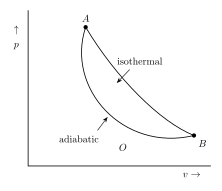
A quasistatic isothermal and quasistatic adiabatic intersect in a p-v diagram at more than one point as shown in diagram. Does it imply violation of 2nd law of thermodynamics ? Give reasons for your answer.
An inductor L = 0.1\text{ H} in series with a resistor R = 20\ \Omega is connected across 230\text{ V}, 50\text{ Hz} a.c. voltage. Determine the following : (i) inductive reactance (ii) impedance of the circuit (iii) current in the circuit (iv) voltage across R (v) voltage across L (vi) phase angle between the current and voltage (vii) power factor (viii) power consumed in the circuit
(i) Derive Planck's law of Black body radiation. (ii) Obtain its limiting forms for (i) very low frequency and (ii) very high frequency.
Show that Maxwell's equations of electrodynamics are invariant under Lorentz transformations.
Show that for any electromagnetic wave propagating in free space, the total average energy per unit volume is \frac{1}{2}\epsilon_0 E_{\text{max}}^2; where E_{\text{max}} is the amplitude of the electric field associated with the electromagnetic wave.
A point charge of q is held above a grounded conducting plane located at z = 0. If the position of the charge is (0, 0, d), obtain an expression for the induced charge density on the plane as a function of the coordinates x and y.
If the magnetic field \vec{B}, at a point with position vector \vec{r} is uniform, show that the corresponding vector potential \vec{A}(\vec{r}) is given by \vec{A}(\vec{r}) = -\frac{1}{2} \left[ \vec{r} \times \vec{B} \right]
What is the volume density of charge in a region of space where electrostatic potential is given by V = a - b(x^2 + y^2) - c\log(x^2 + y^2), where a, b, c are constants.
(i) Show that the work done per unit volume of a ferromagnetic substance per one complete cycle of hysteresis is given by W = \oint \vec{H} \cdot d\vec{B} (ii) Further, show that the value of W is equal to the area of B-H loop. Which material is preferred for the core of a transformer and why ?
Discuss the principles of Fresnel's half period zone and explain how these are used in the construction of a zone plate. Show how the zone plate has several foci.
A diffraction grating has 5000\text{ lines per cm}. For illumination at normal incidence, determine the dispersive power of the grating in the second order spectrum in the range of wavelengths around 500\text{ n.m.}
State Huygen's principle. Using this principle and suitable diagram, show that this principle could lead to Snell's law of refraction.
The vibrations of a string fixed at both ends is represented by the equation y = 2\sin\frac{\pi x}{3}\cos 50\pi t\ (m) If the above stationary wave is produced due to the superposition of two component waves of the same frequency, velocity and amplitude travelling in opposite directions, find (i) the exact equations of the displacements associated with the vibrations of the component waves and (ii) the distance between two consecutive nodes of the stationary wave.
Prove that the group velocity V_g of electromagnetic waves in a dispersive medium is given by V_g = \frac{c}{n + \omega\ dn/d\omega} where c is the velocity of light in vacuum and n is the refractive index of the medium for the angular frequency \omega of the waves.
Plane polarized light of wavelength 6000\text{ \AA} is incident on a thin quartz plate cut with faces parallel to the optic axis. Given, \mu_0 = 1.544 and \mu_e = 1.553, calculate the following quantities : (i) The ratio of the intensities of the ordinary and the extraordinary light if the planes of vibration of two incident lights make an angle of 30^\circ with the optic axis. (ii) The minimum thickness of the plate for which ordinary and the extraordinary waves will combine to produce plane polarized light.