Comment Done
Navigation
HomePYQs Question BankCSE Physics OptionalIFoS Physics OptionalBlog & InsightsCourses & ProgrammesMy Courses (Candidate Portal)
Account
/
20 questions visible on this page

What is the main inference drawn from the Stern Gerlach experiment ? What would be the change in the result in the following cases :

(i) electron spin is \frac{3}{2}\hbar instead of \frac{\hbar}{2}.

(ii) a beam of neutral atoms is passed through a homogeneous magnetic field.

IFoS 2017Paper II8 marksifos-2017-subject-06-005

Describe the differences in the behaviour of a quantum harmonic oscillator with the corresponding classical oscillator.

IFoS 2017Paper II8 marksifos-2017-subject-05-003

An electron is described by the following wave function : \begin{aligned} \psi(x) &= 0 && \text{for } x < 0 \\ &= C e^{-x}(1 - e^{-x}) && \text{for } x \ge 0 \end{aligned} where C is a constant. Find out the average position of the electron.

IFoS 2017Paper II8 marksifos-2017-subject-05-002

Use the uncertainty principle to estimate the binding energy of the hydrogen atom in the ground state in terms of m_\text{e}, e, \hbar and c. Estimate the answer in eV.

IFoS 2017Paper II8 marksifos-2017-subject-05-001

A particle of mass m is confined in a one dimensional box on the x-axis between x = 0 and x = L. Obtain the allowed energy states of the particle and the corresponding eigenfunctions. What will be the energy pattern in the limit of L \to \infty ?

IFoS 2017Paper II15 marksifos-2017-subject-05-004

Show that

(i) \hat{L} \times \hat{L} = i \hbar \hat{L}

(ii) [\hat{L}_+, \hat{L}_-] = 2\hbar \hat{L}_z

(iii) \hat{\sigma}_x \hat{\sigma}_y \hat{\sigma}_z = -i

IFoS 2017Paper II15 marksifos-2017-subject-05-008
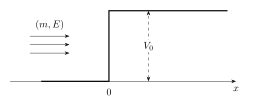
Physics Diagram ifos-q-5-049-fig-1

A beam of particles of mass m and energy E is incident on a step potential of height V_0 from the left as shown in the figure. Discuss the behaviour of the particle for (i) E < V_0 and (ii) E > V_0. Obtain expressions for the reflection and the transmission coefficients and sketch them as a function of the incident energy of the particle.

IFoS 2017Paper II15 marksifos-2017-subject-05-007

Estimate the probability of finding the particle between x = 0 and x = \frac{L}{3} in the lowest energy state.

IFoS 2017Paper II5 marksifos-2017-subject-05-005

Generalize the results obtained in part (a) to obtain the allowed energy states and the corresponding eigenfunctions of a particle in a three dimensional isotropic box of dimension L. What is the degeneracy of the first two excited states of the particle ?

IFoS 2017Paper II20 marksifos-2017-subject-05-006

State Maxwell's distribution law of molecular speeds. Draw and explain a curve between n(c) and c in a gas at a given temperature T, where n(c) dc is the number of molecules having speed between c and c + dc. Discuss the effect of T and mass m of the molecule on the nature of the curve.

IFoS 2017Paper I15 marksifos-2017-subject-04-003

Describe neutron star on the basis of Fermi-Dirac statistics and obtain the condition of critical mass for a neutron star.

IFoS 2017Paper I8 marksifos-2017-subject-04-002

Derive the mathematical expression for the total energy of a degenerate Fermi gas at a temperature T and calculate the specific heat of the Fermi gas at this temperature.

IFoS 2017Paper I15 marksifos-2017-subject-04-004

Prove the thermodynamic relation : \left( \frac{\partial S}{\partial V} \right)_T = \left( \frac{\partial P}{\partial T} \right)_V and hence show that \frac{\mathrm{d}P}{\mathrm{d}T} = \frac{L}{T (V_2 - V_1)} ; all the terms have their usual meanings.

IFoS 2017Paper I8 marksifos-2017-subject-04-001

Use the method of electric images to find the electric field on the surface of a grounded conducting sphere.

IFoS 2017Paper I10 marksifos-2017-subject-03-003

How does one explain the observed spectrum of black-body radiation using Planck's quantum hypothesis ? State and obtain Wien's displacement law. Also explain the important features of this law.

IFoS 2017Paper I15 marksifos-2017-subject-03-009

(i) Define and explain the significance of the quality factor of an electrical machine. (ii) Discuss in brief, the working principle of a transformer.

IFoS 2017Paper I5+5=10 marksifos-2017-subject-03-008

Discuss the reflection and refraction of plane electromagnetic waves at plane dielectric boundaries for normal incidence and also find the reflection and transmission coefficients.

IFoS 2017Paper I15 marksifos-2017-subject-03-007

(i) State Faraday's law of electromagnetic induction and prove that it can be expressed in the following vector form : \mathrm{Curl}~\vec{E} = -\frac{\partial \vec{B}}{\partial t} with \vec{E} and \vec{B} being the electric and magnetic fields. (ii) A coil of 10 turns has dimension 9~\text{cm} \times 7~\text{cm}. It rotates at the rate of 15\pi~\text{rad/sec} in a uniform field whose flux density is 0\cdot 6~\text{weber/m}^2. What is the maximum e.m.f. induced in the coil ?

IFoS 2017Paper I10+5=15 marksifos-2017-subject-03-005

(i) Using Maxwell's equations, obtain the relation \frac{1}{c} \frac{\partial}{\partial t} \left( \frac{E^2 + B^2}{2} \right) + \vec{\nabla} \cdot (\vec{E} \times \vec{B}) = 0 (ii) What is Poynting vector ? Deduce Poynting theorem for the flow of energy in an electromagnetic field.

IFoS 2017Paper I5+10=15 marksifos-2017-subject-03-006

Write down the four Maxwell's equations and explain the contribution of Maxwell in the development of these equations.

IFoS 2017Paper I8 marksifos-2017-subject-03-004

Document & Diagram Scanner

Clean whiteboard & high-contrast scan with automatic image enhancement

Filter:
-- × -- pxCompressed: -- KB--% saved