
Show that for pure rotational spectrum of a diatomic molecule the wave number difference between the consecutive lines \Delta \bar{\nu} = \frac{\hbar}{2\pi Ic}, where I is the moment of interia.
ifos-2018-subject-06-004
Show that for pure rotational spectrum of a diatomic molecule the wave number difference between the consecutive lines \Delta \bar{\nu} = \frac{\hbar}{2\pi Ic}, where I is the moment of interia.
How many different wavelengths may be observed in the spectrum from a hydrogen sample, if the atoms are excited to states with principle quantum number n ?
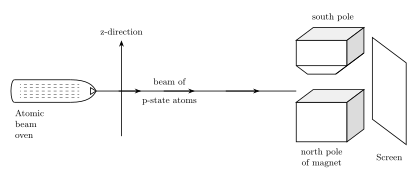
In an atomic physics experiment a beam of p-state atoms is passed through a non-uniform magnetic field. After passing through the magnetic field the atomic beam strikes at the screen and is detected as shown in the given figure. Obtain an expression of the force acting on the p-atoms beam due to gradient in the magnetic field acting along z-axis as shown. Also comment on the number of spots that are found on the screen as an outcome and explain.
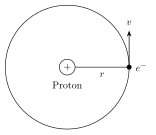
Consider an electron circulating around a proton (as shown in figure) in a circular orbit of radius, r. Assuming the motion of orbiting electron equivalent to an electrical current loop, find the expression for the ratio of magnetic moment to the angular momentum of the system and estimate the numerical value of this ratio.
Consider a particle trapped in a box of width L and its \text{n}^{\text{th}} state wave function is given by \psi_n (n) = \sqrt{\frac{2}{L}} \sin\left(\frac{n\pi x}{L}\right). Calculate the expectation value of the position <x> of the particle. How is this result different from classical consideration of finding the particle inside the box ?
The quantum theory describes the angular momentum (\vec{J}) as a linear operator with three components J_x, J_y and J_z in three dimensions. For the angular momentum operator prove that [J^2, J_i] = 0, where i = x, y, and z and comment on the measurability of J^2 and its components as operators.
The radial part of Schrödinger wave function for hydrogen atom for spherical symmetric potential V(r) = -\frac{e^2}{4\pi \varepsilon_0 r} is given as : \frac{1}{r^2}\frac{d}{dr}\left(r^2 \frac{dR}{dr}\right) + \frac{2\mu}{\hbar^2}\left[ E - V(r) - \frac{\hbar^2}{2\mu}\frac{l(l+1)}{r^2}\right] R = 0, where \mu = \frac{mM}{m+M} is reduced mass and m and M are mass of electron and proton respectively. (i) Obtain the form of the above equation for ground state electron of hydrogen atom. (ii) Also starting with a trial wave function for the radial equation, R = A e^{-r/a_0}, for the l = 0 state, find the expressions of energy E and orbital radius for the ground state of hydrogen atom.
Write down the Schrödinger wave equation for a one-dimensional harmonic oscillator in which a particle of mass m and frequency \omega is subject to a parabolic potential V(x) = m\omega^2 x^2/2. Let one of the possible energy eigen states be given by \psi(x) = Ax e^{-x^2/x_0^2}. Find the energy E corresponding to the eigen state given by \psi(x). Is it a ground state energy or one of the excited state energies ? Comment.
Given the time dependent one-dimensional Schrödinger wave equation as H\psi(t) = i\hbar \frac{\partial \psi(t)}{\partial t}, \text{ with } H = \frac{\vec{p}\cdot \vec{p}}{2m} + V(\vec{x}) as Hermitian operator for a particle of momentum \vec{p} under the influence of a potential V(\vec{x}). Find the value of \frac{d}{dt}\left(\int \psi^*(t) \psi(t) \, dx\right).
Electrons with energies of 1\cdot 0\text{ eV} and 2\cdot 0\text{ eV} are incident on a barrier 10\cdot 00\text{ eV} high and 0\cdot 50\text{ nm} (nanometer) wide. Calculate the ratio of their respective transmission probabilities across the barrier.
Consider an experiment in which a beam of electrons is directed at a plate containing two slits, labelled as A and B. Beyond the plate is a screen, where electrons hit the screen and are detected. For each of the following cases sketch the variation of the relative number of incident electrons as a function of position along the screen and also provide brief explanation about each observation : (i) Slit A open, slit B closed, (ii) Both A and B are open.
Use uncertainty principle to estimate the ground state energy of a linear harmonic oscillator.
Consider N molecules of a gas obeying van der Waals' equation of state given by \left( P + \frac{a N^2}{V^2} \right) (V - Nb) = N k_B T where a is a measure of the attractive forces between the molecules and b is another constant proportional to the size of the molecules. The other symbols have their usual meanings. Show that during an isothermal expansion from volume V_1 to volume V_2 quasi-statically and reversibly, the work done is W = -N k_B T \log \left( \frac{V_2 - Nb}{V_1 - Nb} \right) + a N^2 \left( \frac{1}{V_1} - \frac{1}{V_2} \right)
Explain Maxwell-Boltzmann formula for distribution of velocities of gas molecules at temperature T. What will be the formula for distribution of speeds? If \bar{v}, v_{\text{rms}} and v_m denote average speed, root mean square velocity and most probable speed, show that \bar{v} : v_{\text{rms}} : v_m = \sqrt{\frac{8}{\pi}} : \sqrt{3} : \sqrt{2}
Write Bose-Einstein distribution function explaining every symbol. Derive Einstein's result on specific heat of solids explaining the assumptions made in the model. Discuss the low and high temperature limits of the predicted specific heat. In which limit, the Einstein formula fails to explain the experimental data?
Show that the probability of occupation for an electron state at the Fermi energy is equal to 0\cdot 5 for all finite temperatures.
Define Fermi energy and show that for an electron gas at absolute zero temperature, the Fermi energy is given by E_F = \left( \frac{h^2}{2m} \right) \left( \frac{3}{8\pi} \frac{N}{V} \right)^{2/3} where the symbols have their usual meanings. Estimate the numerical value of Fermi energy for copper taking number of electrons per unit volume as 8\cdot 4 \times 10^{22}\text{ electrons/cm}^3 and find Fermi temperature T_F.
Starting from the first law of thermodynamics, show that C_p - C_v = \left[ P + \left( \frac{\partial U}{\partial V} \right)_T \right] \left( \frac{\partial V}{\partial T} \right)_P
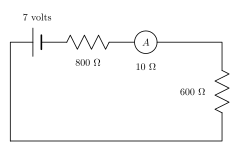
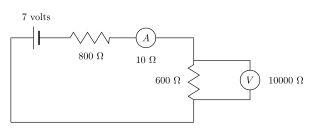
Two resistors of 600~\Omega and 800~\Omega are connected in series with a 7\text{ volts} battery. An ammeter of 10~\Omega resistance is used to measure current.
(i) What will be the reading in the ammeter?
(ii) Similarly if a voltmeter of 10000~\Omega resistance is used to measure the potential difference across the 600~\Omega resistor, what will be the reading in the voltmeter?
Construct the Hamiltonian of a charged particle with charge q and mass m moving with the velocity \vec{v} in the external electromagnetic field, \vec{E}=E_0 \hat{i}, \vec{B}=B_0 \hat{k}, where E_0 and B_0 are constants.