Write Maxwell's equations in free space in both differential and integral forms. Obtain wave equations and show that electromagnetic waves can travel in free space with a speed of light. Can one get the wave equations from the integral form of the Maxwell's equations?
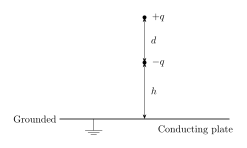
A vertically oriented electric dipole having dipole moment \vec{p} is kept at height h above an infinitely large horizontal conducting plate, which is grounded as shown in the diagram. Calculate the force between the electric dipole and the conducting plate by using method of images.
Using the two-fluid model of a conductor (normal and superconducting) and the Maxwell's equations, derive the two London equations of superconductivity.
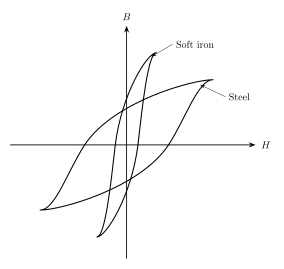
Based on the hysteresis loops for soft iron and steel as shown in the diagram, which material would you prefer to utilise for making transformer cores and why?
Describe the oscillations of electric and magnetic fields in an ideal LC circuit. The applied voltage phasor in a circuit is (4+3i) volt and resulting current phasor is (3+4i) ampere. Draw the phasor diagram. Determine the impedance of the circuit and indicate whether it is inductive or capacitive in nature. Also find the power dissipation in the circuit.
A 10\Omega resistor is connected in series with a capacitor of 1.0\mu\mathrm{F} and a battery with emf 12.0 V. Before the switch is closed at time t=0, the capacitor is uncharged. Calculate the following:
(i) The time constant.
(ii) What fraction of the final charge is on the plates at the time t=46 seconds?
(iii) What fraction of the initial current remains at the time t=46 seconds? Consider that the internal resistance of the battery is zero and neglect the resistance of all the connecting wires.
Write expressions for divergence and curl of an electrostatic field. From these, obtain Poisson and Laplace equations. Two concentric conducting spherical shells having radii r_1 and r_2 (r_1<r_2) are charged to potentials V_1 and V_2, respectively. What are the electric potential and hence electric field in the space between the shells? Also find the charge on the inner shell.
Discuss the conditions for interference. Describe Young's double-slit experiment and derive an expression for the estimation of fringe width. Discuss its dependency on various parameters. Green light of wavelength 5100\,\mathring{\mathrm{A}} from a narrow slit is incident on a double-slit. If the overall separation of 10 fringes on a screen 200\,\text{cm} away is 2\,\text{cm}, find the slit separation.
State and explain Fermat's principle of extremum path. Discuss the cases of rectilinear propagation of light and reversibility of light rays in context of Fermat's principle. Using Fermat's principle, deduce the thin lens formula.
Briefly discuss the postulates of Einstein to explain stimulated emission. Derive an expression for Einstein's A and B coefficients and show that the ratio of coefficients of spontaneous versus stimulated emission is proportional to the third power of frequency of radiation. Why is it difficult to achieve laser action in higher frequency ranges such as X-rays? Can there be a temperature at which the rates of spontaneous and stimulated emission are equal? Illustrate with wavelength \lambda = 5000\,\mathring{\mathrm{A}}.
For free space show that electromagnetic (EM) wave is transverse in nature. Show that for free space, the total outward flux of EM energy through surface S bounding volume V is equal to the rate of loss of EM energy from the volume V. A laser beam of 2\ \mathrm{mm} diameter has average power of 20\ \mathrm{GW}. Calculate the peak values of electric and magnetic fields in the laser beam.
The equation for displacement (X) of a point on a damped oscillator is given by x = 5e^{-0.25t}\sin\left(\frac{\pi}{2}\right)t\ \text{metres}. Find the velocity of oscillating point at t = \frac{T}{4} and T, where T is the time period of the oscillator. What is the direction of velocity in each case?
What are Newton's rings? How are they formed by two curved surfaces?
Explain the phenomenon of double refraction in calcite crystal. Considering birefringent crystal as non-conducting material, explain double refraction using electromagnetic theory. Calculate the thickness of a double refracting plate which produces a path difference of \frac{\lambda}{4} between extraordinary and ordinary waves. Given: \lambda = 5890\,\mathring{\mathrm{A}},\quad \mu_0 = 1.53,\quad \mu_e = 1.54
What is a zone plate? Give its theoretical description. Show that a zone plate has multiple foci. Differentiate a zone plate from a convex lens. Calculate the radius of the first half period zone in a zone plate behaving like a convex lens of focal length 60\,\mathrm{cm} for light of wavelength 6000\,\mathring{\mathrm{A}}.
A rocket starts vertically upwards with speed v_0. Then define its speed v at a height h in terms of v_0, h, R (radius of Earth) and g (acceleration due to gravity on Earth's surface). Also calculate the maximum height attained by a rocket fired with a speed of 90% of the escape velocity.
What do you understand by length contraction? Calculate the percentage length contraction of a rod moving with a velocity 0.8c in a direction at 60^\circ with respect to its own length.
Derive the relativistic expression for kinetic energy by considering mass variation with velocity. Hence, establish the relation between momentum (p) and energy (E) for a relativistic particle; \frac{dE}{dp}=v.
Determine the location of the centre of mass of a uniform solid hemisphere of radius R and mass M from the centre of its base.
Obtain expressions for the moment of inertia of a solid cone about its
(i) Vertical axis and
(ii) axis passing through the vertex and parallel to its base.