
Derive Maxwell's thermodynamic relations using concepts of internal energy, Helmholtz function, Gibbs' function and enthalpy.
ifos-2019-subject-04-005
Derive Maxwell's thermodynamic relations using concepts of internal energy, Helmholtz function, Gibbs' function and enthalpy.
Derive an expression for the entropy change in the expansion of a gas from volume \text{V}_i to volume \text{V}_f. Use a statistical definition of entropy for derivation.
The equation of state of a dilute gas at very high temperature is described by \frac{\text{PV}}{\text{kT}} = 1 + \frac{\text{B(T)}}{\text{V}}, where V is the volume per particle and B(T) is a negative quantity. One can conclude that this is a property of a Van der Waal's gas. Explain why it is a property of Van der Waal's gas.
State and prove Stefan – Boltzmann law for ideal gases in thermodynamics.
Write down the formula for Planck's radiation law. Show that it reduces to Wien displacement law for shorter wavelengths and to Rayleigh – Jeans law for longer wavelengths.
If we consider the Earth as a black body in thermal equilibrium, estimate the global temperature of our planet in terms of the temperature of the Sun, \text{T}_{\text{sun}}, its radius, \text{R}_{\text{sun}}, and distance D between the Earth and the Sun.
A charge of -3\cdot 30\ \mu\text{C} is fixed in place. From a horizontal distance of 0\cdot 0455\text{ m}, a particle of mass 7\cdot 35 \times 10^{-3}\text{ kg} and charge -7\cdot 45\ \mu\text{C} is fired with an initial speed of 62\cdot 5\text{ m/s} directly towards the fixed charge. How far does the particle travel before it comes to rest ?
A uniformly charged sphere of radius R carries a total charge Q. Find the net force that the southern hemisphere exerts on the northern hemisphere. Express your answer in terms of the radius R and total charge Q.
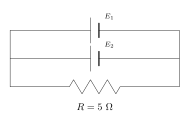
Two cells \text{E}_1 of E.M.F. 2\text{ volts} and internal resistance 1\cdot 5\text{ ohms} and \text{E}_2 of E.M.F. 1\cdot 5\text{ volts} and internal resistance 1\text{ ohm}, are joined in parallel with like poles together (see the figure below). Calculate the current that would pass through a 5\text{-ohm} resistance joined in parallel with the cells.
(i) Using the laws of transformation of the electric field, \vec{\text{E}}, and the magnetic field, \vec{\text{B}}, show that (\text{E}^2 - \text{C}^2 \text{B}^2) is relativistically invariant. (ii) Suppose that in one inertial frame \vec{\text{B}} = 0 but \vec{\text{E}} \neq 0 (at some point P). Is it possible to find another inertial frame in which the electric field is zero at P ?
Consider electromagnetic fields in a medium with permittivity \varepsilon and permeability \mu. The fields are space and time dependent. Write down the full system of Maxwell's equations along with the constitutive equations. Then, derive the continuity equation from them. Using this continuity equation, show that the total charge of the universe is conserved.
How can the refractive index of a liquid be determined using a method of Newton's rings ? Obtain an appropriate expression for calculating the refractive index.
Explain Huygens' theory of double refraction in a uniaxial crystal. Discuss the formation of ordinary and extraordinary rays for oblique incidence when an optic axis is in the plane of incidence and when it is perpendicular to the plane of incidence.
Two Fabry – Pérot interferometers have same plate separation but the coefficients of intensity reflection are 0\cdot 7 and 0\cdot 9. Deduce the relative width of the maxima in the above two cases.
With a neat ray diagram, describe Fraunhofer diffraction at a circular aperture.
In an \text{He}-\text{Ne} laser system, the two energy levels of \text{Ne} involved in lasing action have energy values of 20\cdot 66\text{ eV} and 18\cdot 70\text{ eV} respectively. Population inversion occurs between these two energy levels. What will be the wavelength of the laser beam produced ? What will be the population in the metastable energy level with respect to the upper excited level at room temperature (27^\circ\text{C}) ?
It is required that a real image twice the size of the object be formed by a thin plano-convex lens. If the lens has a radius of curvature of 50\text{ cm} and a refractive index of \mu = 1\cdot 5, determine the locations of the object and image with respect to the lens.
The quality factor Q in a damped harmonic motion is defined as Q = \frac{2\pi \times \text{Average energy stored per cycle}}{\text{Average energy dissipated per cycle}} Show that Q = \frac{\omega}{2b} (where the symbols have usual meaning).
A High Frequency (HF) radio receiver receives simultaneously two signals from a transmitter 400\text{ km} away, one by a path along the surface of the Earth, and the other by reflection from a portion of the ionospheric layer situated at a height of 200\text{ km}. We assume that the Earth is flat and the ionospheric layer acts as a perfect horizontal reflector, which is moving slowly in the vertical direction. When the frequency of the transmitted wave is 10\text{ MHz}, it is observed that the combined signal strength varies from maximum to minimum and back to maximum 6 times per minute. With what slow vertical speed is the ionospheric layer moving ?
A particle moves in an elliptical orbit in an inverse-square-law central force field. If the ratio of the maximum angular velocity to the minimum angular velocity of the particle in the orbit is n, then show that the eccentricity of the orbit is \varepsilon = \frac{\sqrt{n} - 1}{\sqrt{n} + 1}.