
Write the electronic configurations for carbon (C), nitrogen (N) and oxygen (O) atoms, and then derive their ground states.
ifos-2025-subject-06-002
Write the electronic configurations for carbon (C), nitrogen (N) and oxygen (O) atoms, and then derive their ground states.
Why were silver atoms used in Stern-Gerlach experiment? Also, write the importance of this experiment.
A particle is described by the wave function \psi(x, t) = e^{i(kx-\omega t)}. (i) Is this wave function an eigenfunction corresponding to any dynamical variable or variables? If so, name the variable(s). (ii) Does this represent a ground state?
The raising (J_+) and lowering (J_-) operators are defined by J_+ = J_x + i J_y and J_- = J_x - i J_y. Show that– (i) [J_z, J_\pm] = \pm \hbar J_\pm (ii) J_+ J_- = J^2 - J_z^2 + \hbar J_z
Explain the phenomenon of penetration of a particle through a barrier whose height exceeds the total energy of the particle with necessary diagram.
An alpha particle is trapped in a nucleus of radius 1\cdot 4\text{ fm}. What is the probability that it will escape from the nucleus if its energy is 2\text{ MeV}? The potential barrier at the surface of the nucleus is 4\text{ MeV}. [Given : The mass of the alpha particle is 6\cdot 64 \times 10^{-27}\text{ kg}]
A bullet of mass 0\cdot 025\text{ kg} is moving with a velocity of 600\text{ m/s}. The speed is measured with an accuracy of 0\cdot 02\%. Find out the uncertainty in x. Also, comment on the result.
(i) Derive an expression for density of states for a free electron gas in one dimension. Hence, show its variation with energy for a one-dimensional metallic crystal. (ii) Where do you find the applications of free electron gas model?
Consider \text{N} non-interacting ideal spinless particles (Bose gas) are occupying a volume \text{V}. Find out the temperature '\text{T}' below which B-E condensation takes place.
One gram of water (1\text{ cm}^3) becomes 1671\text{ cm}^3 of steam when boiled at constant pressure of 1\text{ atm} (1\cdot 013 \times 10^5\text{ Pa}). The heat of vapourisation at this pressure is \text{L} = 2\cdot 256 \times 10^6\text{ J/kg}. Calculate :
(i) The work done by the water when it vapourizes, and
(ii) Increase in its internal energy.
Assuming the Maxwell's velocity distribution formula, find out the value of :
(A) Mean velocity (\bar{\text{v}}),
(B) The most probable velocity (\text{v}_{\text{mp}}), and
(C) Root mean square speed (\text{v}_{\text{rms}}) in terms of the Boltzmann constant (\text{k}_{\text{B}}) and show that : \text{v}_{\text{rms}} > \bar{\text{v}} > \text{v}_{\text{mp}}. If nitrogen molecules are kept at 27^{\circ}\text{C}, find out the value of \text{v}_{\text{rms}}, \bar{\text{v}} and \text{v}_{\text{mp}}. Given : Molecular mass of nitrogen \text{M} = 28 \times 10^{-3}\text{ kg/mol} and gas constant \text{R} = 8\cdot 314\text{ J.mol}^{-1}\text{K}^{-1}.
Consider that an ideal non-interacting Fermi gas with internal energy '\text{U}' at temperature \text{T} is kept in a cubical box of volume \text{V}. Find the pressure for the gas in terms of \text{U} and \text{V}.
For silver, the specific heat at constant pressure in the range of 50\text{ K} to 100\text{ K} is given by : \text{C}_{\text{p}} = 0\cdot 076\text{ T} - 0\cdot 00026\text{ T}^2 - 0\cdot 15\text{ cal mol}^{-1}\text{deg}^{-1} If 2 moles of silver are heated from 50\text{ K} to 100\text{ K}, calculate the change in entropy.
After highlighting the importance of the Biot-Savart law, show that the magnetic field of a current carrying long wire, at a point near it, is inversely proportional to the distance of the point from the wire.
Deduce Fresnel's law for the propagation of plane electromagnetic waves through an anisotropic dielectric medium.
For the following series LCR circuit,
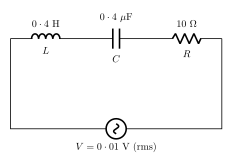
Calculate :
(i) The resonant frequency of the circuit.
(ii) The maximum current in the circuit.
(iii) The voltage across \text{C} at resonance.
(iv) The power absorbed by the circuit at resonance.
Assume the Sun to be a black body at temperature 5800\text{ K}. Use Stefan's law to calculate :
(i) The total energy emitted by the Sun per second, and
(ii) The energy reaching the top of the Earth's atmosphere. Given : \sigma = 5\cdot 672 \times 10^{-8}\text{ SI units}, Radius of the Sun = 7 \times 10^8\text{ m}, The distance of the Earth's atmosphere from the Sun = 1\cdot 5 \times 10^{11}\text{ m}.
A certain linear, homogeneous, isotropic, dielectric material has a relative permittivity, \varepsilon_{\text{r}} = 1\cdot 8. If potential \text{V} = -4000\text{y} volts in the material, then find :
(i) The electric flux density \text{D}, and
(ii) The polarisation \text{P}. Take vacuum permittivity \varepsilon_0 = 8\cdot 85 \times 10^{-12}\text{ farad/m}.
If volume charge density in free space varies as \rho_{\text{v}} = \frac{100\varepsilon_0}{\text{r}^{2/5}}, then using Poisson's equation, find potential \text{V}(\text{r}). It is assumed that \text{r}^2 \text{E}_{\text{r}} \rightarrow 0 when \text{r} \rightarrow 0, while \text{V} \rightarrow 0 at \text{r} \rightarrow \infty.
For a plane electromagnetic wave given by : \text{E}_{\text{z}} = \text{a}\cos \omega\text{x} \cos \omega\text{ct} \text{H}_{\text{y}} = -\text{a}\sin \omega\text{x} \sin \omega\text{ct} Find the value of the Poynting vector.