Comment Done
Navigation
HomePYQs Question BankCSE Physics OptionalIFoS Physics OptionalBlog & InsightsCourses & ProgrammesMy Courses (Candidate Portal)
Account
/
20 questions visible on this page

Calculate the zero point energy for a particle in an infinite potential well for the following cases : (i) a 100\text{ g} ball confined on a 5\text{ m} long line. (ii) an oxygen atom confined to a 2 \times 10^{-10}\text{ m} lattice. (iii) an electron confined to a 10^{-10}\text{ m} atom. Why zero point energy is not important for macroscopic objects ? Comment.

CSE 2023Paper II10 markscse-2023-subject-05-001

A particle constrained to move along x-axis in the domain 0 \le x \le L has a wave function \psi(x) = \sin \left( \frac{n \pi x}{L} \right), where n is an integer. Normalize the wave function and evaluate the expectation value of momentum of the particle.

CSE 2023Paper II15 markscse-2023-subject-05-006

A particle of mass m is in a spherically symmetric attractive potential of radius a. Find the minimum depth of the potential needed to have two bound states of zero angular momentum.

CSE 2023Paper II10 markscse-2023-subject-05-003

The raising (J_+) and lowering (J_-) operators of total angular momentum are defined by J_+ = J_x + iJ_y and J_- = J_x - iJ_y. Find the values of the following : (i) [J_x, J_+] (ii) [J_y, J_+] (iii) J_- J_+

IFoS 2023Paper II15 marksifos-2023-subject-05-007

The components of arbitrary vectors \vec{A} and \vec{B} commute with those of \vec{\sigma}. Show that (\vec{\sigma} \cdot \vec{A})(\vec{\sigma} \cdot \vec{B}) = \vec{A} \cdot \vec{B} + i\vec{\sigma} \cdot (\vec{A} \times \vec{B}).

IFoS 2023Paper II8 marksifos-2023-subject-05-006

The time independent wave function of a system is \psi(x) = A \exp(ikx), where k is a constant. (i) Is this wave function normalizable in the domain -\infty < x < \infty? (ii) Calculate the probability current density for this function.

IFoS 2023Paper II8 marksifos-2023-subject-05-005

(i) Derive an expression for the period of Bloch oscillation for a one-dimensional crystal having lattice period a and electric field \varepsilon. (ii) Consider an electron in a perfectly periodic lattice, wherein the energy-wavenumber relationship in the first Brillouin zone is expressed as E = \frac{\hbar^2 k^2}{5\mathrm{m}_e} where \mathrm{m}_e is the mass of an electron in free space. Find the effective mass of the electron and hence write down the time-independent Schrodinger equation for the electron. Also determine the velocity of the electron. Ignore all interactions except between the electron and the lattice.

IFoS 2023Paper II10+10=20 marksifos-2023-subject-05-001

Find the condition at which de Broglie wavelength equals the Compton wavelength for a particle.

IFoS 2023Paper II8 marksifos-2023-subject-05-002

Evaluate the commutator \left[\frac{\partial^2}{\partial x^2}, x\right] and hence show that [p^2, x] = -2 i\hbar p.

IFoS 2023Paper II10 marksifos-2023-subject-05-003

An operator P describing the interaction of two spin \frac{1}{2} particles is P = a + b \vec{\sigma}_1 \cdot \vec{\sigma}_2, where a and b are constants, and \vec{\sigma}_1 and \vec{\sigma}_2 are Pauli matrices of the two spins. The total spin angular momentum \vec{S} = \vec{S}_1 + \vec{S}_2 = \frac{1}{2} \hbar (\vec{\sigma}_1 + \vec{\sigma}_2). Show that P, S^2 and S_z can be measured simultaneously.

CSE 2023Paper II15 markscse-2023-subject-05-004

Consider the potential V(x) = \begin{cases} 0, & 0 < x < a \\ \infty, & \text{elsewhere} \end{cases} (a) Estimate the energies of the ground state as well as those of the first and the second excited states for (i) an electron enclosed in a box of size a = 10^{-10}\text{ m}. (ii) a 1\text{ g} metallic sphere which is moving in a box of size a = 10\text{ cm}. (b) Discuss the importance of the Quantum effects for both of these systems. (c) Estimate the velocities of the electron and the metallic sphere using uncertainty principle.

CSE 2023Paper II20 markscse-2023-subject-05-005

For the n^{\text{th}} state of linear harmonic oscillator, evaluate the uncertainty product (\Delta x) \cdot (\Delta p).

IFoS 2023Paper II15 marksifos-2023-subject-05-004

Use the Maxwell-Boltzmann distribution to find the number of oxygen molecules whose velocities lie between 195\text{ m/s} and 205\text{ m/s} at 0^\circ\text{C}. The given mass of oxygen gas is 0\cdot1\text{ kg}. (Assume mass of proton to be 1\cdot66 \times 10^{-27}\text{ kg})

CSE 2023Paper I15 markscse-2023-subject-04-005

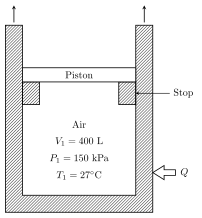
A piston-cylinder device initially contains air at 150\text{ kPa} and 27^\circ\text{C}. At this state, the piston is resting on a pair of stops, as shown in the figure, and the enclosed volume is 400\text{ L}. The mass of the piston is such that a 350\text{ kPa} pressure is required to move it. The air is now heated until the volume is doubled. Determine : (i) the final temperature, (ii) the work done by the air, and (iii) the total heat transferred to air. Given : U_{300\text{ K}} = 214\text{ kJ/kg} and U_{\text{final}} = 1113\text{ kJ/kg} Gas constant of air, R = 0\cdot287\text{ kPa.m}^3/\text{kg.K}

Physics Diagram cse-q-4-083-fig-2
CSE 2023Paper I20 markscse-2023-subject-04-004

Write down the expressions for the Fermi-Dirac distribution and the Bose-Einstein distribution. Plot the distributions as a function of the energy.

CSE 2023Paper I10 markscse-2023-subject-04-002

What is the concept of negative temperature in statistical mechanics? Explain in brief.

IFoS 2023Paper I8 marksifos-2023-subject-04-004

Explain how the state of ionization of any particular element in a star changes with varying temperatures and pressures.

IFoS 2023Paper I15 marksifos-2023-subject-04-001

Explain how we can produce refrigeration without using a compressor.

IFoS 2023Paper I10 marksifos-2023-subject-04-003

Distinguish between a perfect gas and a real gas. Derive van der Waals' equation of state and use it to obtain the expressions for the critical constants in terms of the constants of the van der Waals' equation.

IFoS 2023Paper I15 marksifos-2023-subject-04-002

(i) Define Joule-Kelvin coefficient. Write it in its mathematical form. (ii) Determine the Joule-Kelvin coefficient for a van der Waals gas. Hence, obtain an expression for temperature of inversion. Discuss the conditions under which heating or cooling is produced.

CSE 2023Paper I15 markscse-2023-subject-04-003

Document & Diagram Scanner

Clean whiteboard & high-contrast scan with automatic image enhancement

Filter:
-- × -- pxCompressed: -- KB--% saved