A rod of length L_0 moves with speed v along the horizontal direction. The rod makes an angle \theta_0 with respect to the x'-axis. (i) Determine the length of the rod as measured by a stationary observer. (ii) Determine the angle \theta the rod makes with the x-axis. (v is comparable to c)
Describe Michelson-Morley experiment with the help of a diagram. Discuss why it is considered as the 'most famous failed experiment'.
The moment of inertia of the CO molecule is 1\cdot 46 \times 10^{-46}\text{ kg-m}^2. Calculate the energy (in eV), and the angular velocity in the lowest rotational energy level of the CO molecule.
Two spaceships approach each other, each moving with the same speed as measured by a stationary observer on the Earth. Their relative speed is 0{\cdot}7c. Determine the velocity of each spaceship as measured by the stationary observer on the Earth.
Explain the rotation of a free rigid body and show that a rigid body rotating in any manner about a fixed point has two constants of motion, L^2 and T. Here \vec{L} is angular momentum and T is kinetic energy.
Suppose the position of a particle of mass m on the xy-plane is \bar{r} = (x, y, z) = (r \cos\phi, r \sin\phi, 0) Here r and \phi are functions of time t. Find l_z, the z-component of \vec{l}, where \vec{l} is the angular momentum of the particle. Further, show that the areal velocity is equal to the angular momentum divided by 2m. Is areal velocity constant?
A rocket of mass m_1 + m_2 is launched with a velocity whose horizontal and vertical components are u_x and u_y. At the highest point in its path, the rocket explodes into two parts of masses m_1 and m_2 that separate in a horizontal direction in the original plane of motion. Show that the fragments strike the ground at a distance apart given by D = \frac{u_y}{g} \sqrt{\frac{2(m_1 + m_2)K}{m_1 m_2}} where K is the kinetic energy produced by the explosion. (Neglect air resistance, the mass of explosive, any spinning motion of the fragments and assume that g is constant)
Derive Euler-Lagrange equations of motion from Hamilton's principle for any bilateral holonomic system having no non-potential forces and n degree of freedom. Can it be applied to non-holonomic systems?
(i) Explain Coriolis force. Compare the qualitative effects of the Coriolis forces in the two geographical hemispheres of the Earth for rivers flowing east. (ii) With schematic, explain Foucault's pendulum.
Describe briefly the construction of an enhancement type MOSFET using a p-type silicon bar. Point out the structural difference between enhancement and depletion forms of the MOSFET.
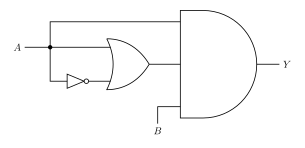
Obtain the Boolean expression for the output Y in the given logic circuit :
Simplify the expression and show that the circuit is equivalent to an AND gate with inputs A and B.
A transistor having \alpha = 0\cdot 975 and a reverse saturation current I_{\text{CO}} = 10~\mu\text{A} is operated in CE configuration. What is \beta for this configuration? If the base current is 250~\mu\text{A}, calculate the emitter current and the collector current.
Explain the Meissner effect in superconductivity. Obtain an expression for London penetration depth of magnetic field for a superconductor.
An n-channel silicon JFET has donor concentration of 2 \times 10^{21}/\text{m}^3 and a channel width of 4~\mu\text{m}. If the dielectric constant of silicon is 12, find the pinch-off voltage. If the FET operates with a gate-source voltage of -2~\text{V}, what is the saturation voltage V_{\text{Dsat}}?
Explain the use of an op-amp as a differentiator and an integrator using proper circuit diagram. Write the condition to work as good differentiator and integrator.
A superconducting material has a critical temperature of 3\cdot 7~\text{K} and a magnetic field of 0\cdot 0306~\text{tesla} at 0~\text{K}. Find the critical field at 2~\text{K}.
Explain the salient features of nuclear shell model. What are the magic numbers? Write the experimental facts in support of shell model of nuclei.
What are the properties of the particles made up of the following quarks? Also write the names of particles :
(i) u\bar{d}
(ii) \bar{u}d
(iii) dds
(iv) uss
By applying the conservation laws, state about the following decay equations, whether they are allowed or not allowed :
(i) \Sigma^+ \rightarrow p + \pi^0
(ii) \Sigma^0 \rightarrow \Lambda^0 + \gamma
(iii) \Lambda^0 \rightarrow n + \pi^0
Calculate the decay rate of {}^{14}\text{C} per gram of carbon in a living organism, assuming the ratio {}^{14}\text{C} / ^{12}\text{C} = 1\cdot 35 \times 10^{-12}. The half-life of {}^{14}\text{C} is 5730 years.