
With the help of a schematic diagram, describe the structure of n-depletion MOSFET. Draw and describe its drain and transfer characteristics.
ifos-2023-subject-08-004
With the help of a schematic diagram, describe the structure of n-depletion MOSFET. Draw and describe its drain and transfer characteristics.
Consider an n-channel JFET which has \text{I}_{\text{DSS}} = 15\text{ mA} and pinch-off voltage \text{V}_\text{p} = -5\text{ V}. If \text{V}_{\text{GS}} = -1\cdot 5\text{ V}, how much will the drain current \text{I}_\text{D} be? What will be the minimum value of \text{V}_{\text{DS}} for pinch-off to occur at \text{V}_{\text{GS}} = -1\cdot 5\text{ V}?
(i) Using the logic gates, draw the circuit diagram representing the Boolean expression \text{AB} + \text{A}(\text{B} + \text{C}) + \text{B}(\text{B} + \text{C}). (ii) Simplify the following Boolean expression : [\text{AB}(\text{C} + \overline{\text{BD}}) + \overline{\text{AB}}]\ \text{CD}
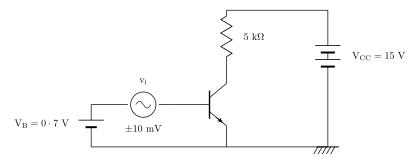
Consider the BJT amplifier circuit given below with the following parameters : d.c. current gain \beta_{\text{dc}} = a.c. current gain \beta_{\text{ac}} = 100 \text{I}_\text{B} = 20\ \mu\text{A} for \text{V}_\text{B} = 0\cdot 7\text{ V}, and \text{i}_\text{b} = \pm 2\ \mu\text{A} for \text{v}_\text{i} = \pm 10\text{ mV}. Determine the values of \text{V}_{\text{CE}}, input impedance and voltage gain \text{A}_\text{v}.
Draw the crystal structure of \text{CaF}_2 indicating the positions of cations and anions. What are their respective coordination numbers?
Show that the Fermi level shifts upward, closer to the conduction band in an n-type semiconductor and shifts downward, closer to the valence band in a p-type semiconductor.
Derive diffraction conditions using reciprocal lattice concept. What are these conditions known as ?
Explain classical theory of diamagnetism. Show that the susceptibility of diamagnetic substances is directly proportional to the atomic number. Why all the electrons in an atom contribute to diamagnetism ?
What will be the frequency of Josephson current, if a d.c. voltage of 4\cdot 0\ \mu\text{V} is applied across a Josephson junction?
What do you understand by nuclear forces ? Explain meson theory of exchange forces.
Establish the Rutherford's scattering cross section formula for \alpha-particle by considering the standard assumptions and symbols.
What is the age of a fossil that contains 6\text{ g} of carbon {}^{14}\text{C} and has a decay rate of 27\text{ decays per minute} ? Given : Ratio \frac{{}^{14}\text{C}}{{}^{12}\text{C}} = 1\cdot 3 \times 10^{-13}, Half life (T_{1/2}) of {}^{14}\text{C} = 5730\text{ yrs}.
(i) K^+ \longrightarrow \Pi^+ + \Pi^+ + \Pi^- (ii) \Pi^+ + p \longrightarrow \Pi^+ + \Pi^+ + n (iii) \Pi^+ + p \longrightarrow \Delta^{++} \longrightarrow \Pi^+ + p (iv) \Sigma^\circ \longrightarrow \lambda^\circ + \gamma (v) \Sigma^+ \longrightarrow \lambda^\circ + e^+ + u_e (vi) K^- + p \longrightarrow K^+ + K^\circ + \Omega^- (vii) \Pi^\circ \longrightarrow \gamma + e^+ + e^- (viii) \Sigma^- \longrightarrow n + e^- + \bar{\nu}_e (ix) \lambda^\circ \longrightarrow p + e^- + \bar{\nu}_e (x) e^+ + e^- \longrightarrow \gamma + \gamma Name the interactions via which the above nuclear decays occur :
What do you understand by the critical size of a reactor ? Explain the main features of nuclear reactors.
Why does a neutron star have a magnetic field if it is composed of neutrons?
The nature of curves of binding energy and packing fraction are complementary to each other. Explain.
What do you understand by the critical size of a nuclear reactor? Write down the common features of nuclear reactors used for the production of electricity.
Justify the fact that the electrons are emitted from nuclei in \beta-decay but they cannot be contained inside the nuclei.
On the basis of conservation laws, explain whether the following reactions are allowed or forbidden : (i) \pi^- + \text{p} \longrightarrow \Sigma^+ + \text{K}^- (ii) \text{K}^- + \text{p} \longrightarrow \Omega^- + \text{K}^+ + \text{K}^0 (iii) \Omega^- \longrightarrow \Xi^0 + \pi^- (iv) \pi^+ + \text{p} \longrightarrow \text{p} + \text{p} + \bar{\text{n}} (v) \Sigma^+ \longrightarrow \Lambda^0 + \text{K}^+
Derive an expression for \alpha-disintegration energy for a nucleus in a radioactive decay process.