
Set up the Schrodinger's wave equation for one dimensional potential barrier and obtain the probability of tunnelling.
cse-2022-subject-05-006
Set up the Schrodinger's wave equation for one dimensional potential barrier and obtain the probability of tunnelling.
An electron in a one-dimensional infinite potential well, defined by V(x)=0 for -a\leq x\leq a and V(x)=\infty otherwise, goes from n=4 to n=2 level and emits photon of frequency 3.43\times10^{14}\,\mathrm{Hz}. Calculate the width of the well. (Assume Plank's constant h=6.626\times10^{-34}\,\mathrm{J.S.} and mass of electron m=9.11\times10^{-31}\,\mathrm{kg})
What is de Broglie concept of matter wave? Evaluate de Broglie wavelength of Helium that is accelerated through 300\mathrm{V}. (Given mass of proton = mass of neutron = 1.67\times10^{-27}\,kg)
Show that E_n=\langle V\rangle in the stationary states of the hydrogen atom.
One mole of gas obeys van der Waals equation of state. If its molar internal energy is given by u=cT-a/V (in which V is the molar volume, a is one of the constants in the equation of state and c is a constant), calculate the molar heat capacities C_v and C_p.
A gas of interacting atoms has an equation of state and heat capacity at constant volume given by the expressions p(T,V)=aT^{1/2}+bT^3+cV^{-2} C_v(T,V)=dT^{1/2}+eT^2V+fT^{1/2} where a through f are constants which are independent of T and V. Find the differential of the internal energy dU(T,V) in terms of dT and dV.
What do you understand by negative temperature? Write and explain various restrictions on a system for the concept of negative temperature to be meaningful.
A body of constant heat capacity C_p and a temperature T_i is put into contact with a reservoir at temperature T_f. Equilibrium between the body and the reservoir is established at constant pressure. Determine the total entropy change and prove that it is positive for either sign of \left[(T_f-T_i)/T_f\right]. Consider \left|\frac{T_f-T_i}{T_f}\right|<1.
Assume that the Earth's atmosphere is pure nitrogen in thermodynamic equilibrium at a temperature of 300\ \mathrm{K}. Calculate the height above sea level at which the density of the atmosphere is one-half its sea level value. (Molecular weight of \mathrm{N}_2 is 28\mathrm{gm/mole})
A compressor designed to compress air is used instead to compress helium. It is found that the compressor overheats. Explain this effect, assuming that the compression is approximately adiabatic and the starting pressure is same for both the gases. \left[\gamma_{\mathrm{He}}=\frac{5}{3},\gamma_{\mathrm{Air}}=\frac{7}{5}\right]
A thermally insulated cylinder, closed at both ends, is fitted with a frictionless heat-conducting piston which divides the cylinder in two parts. Initially, the piston is clamped in the centre, with one litre of air at 200\ \mathrm{K} and 2\ \mathrm{atm} pressure on one side and one litre of air at 300\ \mathrm{K} and 1\ \mathrm{atm} pressure on the other side. The piston is released and the system reaches equilibrium in pressure and temperature, with the piston at a new position. Compute the final pressure and temperature.
A current sheet having \vec{K} = 9.0a_y\,\mathrm{A\,m^{-1}} is located at z = 0. The interface is between the region 1, z < 0, \mu_{r1} = 4, and region 2, z > 0, \mu_{r2} = 3. Given that \vec{H}_2 = 14.5a_x + 8.0a_z\,\mathrm{A\,m^{-1}}. Find \vec{H}_1 and \vec{B}_1.
A metal guitar string with a length of 70\,\mathrm{cm} vibrates at its fundamental frequency of 246.94\,\mathrm{Hz} in a uniform magnetic field of 10\,\mathrm{T} oriented perpendicular to the plane of vibration of the string. Assume a sinusoidal form for the amplitude of the vibrational mode, and a maximum displacement of 3\,\mathrm{mm} at the centre of the string. What is the maximum e.m.f. generated across the length of the guitar string, and at what point in time in the string's motion does that occur? What would be the e.m.f. if the same guitar string vibrates at its second harmonic frequency? Briefly explain.
A cell of internal resistance 1\,\text{ohm}, 1.5 volt e.m.f. and another cell of internal resistance 2\,\text{ohm}, 2 volt e.m.f. are connected in parallel across the ends of an external resistance of 5\,\text{ohm}. Find the current in each branch of the circuit.
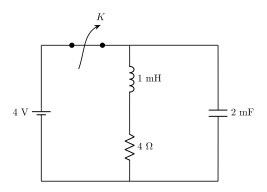
Consider the R-L-C circuit shown here. Calculate the Q-factor of the circuit. Does the circuit have a resonant frequency? Justify your answer:
In a partially conducting medium, \varepsilon_r = 18.5, \mu_r = 800 and \sigma = 1\ \mathrm{S\,m^{-1}}. Find \alpha, \beta, \eta and the velocity u, for a frequency of 10^9\ \mathrm{Hz}. Determine \vec{H}(z,t). Given, \vec{E}(z,t) = 50e^{-\alpha z}\cos(\omega t - \beta a_z)a_y\ \mathrm{V\,m^{-1}}.
Consider two point particles of charge q each, separated by a distance d, and travelling at non-relativistic velocity \vec{v}. If the line joining the two charges is perpendicular to \vec{v}, then write an expression for the magnetic force between the two particles, and illustrate the direction of the force on each particle.
Write down Maxwell's equations in a non-conducting medium with constant permeability and susceptibility (\rho = j = 0). Show that \vec{E} and \vec{B} each satisfies the wave equation, and find an expression for the wave velocity. Write down the plane wave solutions for \vec{E} and \vec{B}, and show how \vec{E} and \vec{B} are related.
Starting from the Laplace's equation in a cylindrical polar coordinate system and using the method of separation of variables, obtain the differential equations for the solutions of r, \phi and z components of the potential.
In He-Ne laser, what is the function of He gas? Explain the answer with the help of energy level diagram for He – Ne laser.