Consider one gm of ice at a temperature T_1\text{ K}. Show that when this ice changes into steam at a temperature T_2\text{ K}, the total gain in entropy is \Delta S = \frac{L_i}{T_1} + C \log_e \left( \frac{T_2}{T_1} \right) + \frac{L_s}{T_2} where L_i is latent heat of ice, C is specific heat of water, L_s is latent heat of steam. T_1 = 273\text{ K}.
Calculate the work done in expanding one mole of an ideal gas at 127^\circ\text{C} to double its initial volume.
How many nitrogen molecules must strike a 1\text{ cm}^2 surface each second to exert a pressure of 1\text{ atmosphere} ? (Assume the molecules are all moving at same speed, corresponding to a temperature of 300\text{ K}, and at an angle of 45^\circ to the wall). [Molecular mass of \text{N}_2 is 28\text{ u}]
A gas of N spinless Bose particles of mass m is enclosed in a volume V at a temperature T.
(i) Find an expression for the density of single-particle state D(\varepsilon) as a function of the single-particle energy \varepsilon. Sketch the result.
(ii) Write down an integral expression which implicitly determines \mu(T). Referring to your sketch in (i), determine in which direction \mu(T) moves as T is lowered.
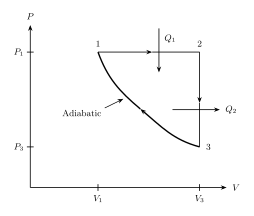
A hypothetical engine, with an ideal gas as the working substance, operates in the cycle shown below. Show that the efficiency of the engine is \eta = 1 - \frac{1}{\gamma} \left( \frac{1 - \dfrac{P_3}{P_1}}{1 - \dfrac{V_1}{V_3}} \right) .
Find the pressure at which water would boil at 150^\circ\text{C} if the change in specific volume when one gm of water is converted into steam is 1676\text{ c.c.} Given J = 4\cdot 2 \times 10^7\text{ ergs/cal}, one atmosphere = 10^6\text{ dyne/cm}^2 and latent heat of vapourisation of steam = 540\text{ cal/gm}.
Write a brief note on Chandrasekhar Limit.
Define gauge transformation. Under what condition can the gauge transformation be regarded as restricted gauge transformation ? Further, generate the symmetrical forms of Maxwell's equations in terms of scalar and vector potentials under Lorentz gauge.
What are geomagnetic storms and why are they potentially disruptive to power grids ?
Write the Laplace's equation in Cartesian, spherical polar and cylindrical coordinates in one-dimensional space. Using a suitable Laplace's equation out of these three, find the capacitance of parallel plate capacitor.
Justify the importance of method of images. Using this method, evaluate induced charge density on the surface of a grounded conducting sphere when a point charge is placed near it.
Define a black body and evaluate Planck's radiation law. Show that at high temperature, this law resembles Rayleigh – Jeans law.
Show that in an A.C. circuit with inductor only, current lags behind emf in phase by \dfrac{\pi}{2}. If the current through 0\cdot 5\text{ Henry} inductor varies sinusoidally with an amplitude of 10\text{ amp} and a frequency 50\text{ Hz}, calculate the potential difference across the terminals of the inductor.
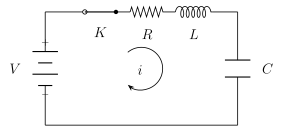
In the circuit as shown in figure :
where V = 10\text{ V}, R = 10\ \Omega, L = 1\text{ H}, C = 10\ \mu\text{F}, and v_c(0) = 0, find i(0+), \dfrac{di}{dt}(0+) and \dfrac{d^2i}{dt^2}(0+).
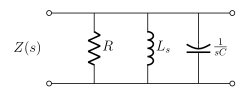
The impedance function of a parallel R, L and C circuit has poles loaded at - 3 \pm 4j\text{ radians/second}. If the value of \text{L} = 1\text{ Henry}, determine the following :
(i) The value of R and C.
(ii) What is the quality factor of this circuit ? Derive an expression for series and parallel circuit.
Write Maxwell's equations in differential and algebraic forms. Give the physical significance of each. Show that the equation of continuity is contained in Maxwell's equations.
What is the principle of propagation in optical fibers ? Explain with the help of neat diagram, the ray propagation in Step index and Parabolic index optical fibers. How can pulse dispersion be minimized using Parabolic index optical fibers ?
What is the Resolving power of a grating ? Obtain an expression for the Resolving power of a grating, based on Rayleigh's criterion of resolution.
What is holography ? Briefly discuss the applications of holography.
What are beats ? A tuning fork gives 6 beats per second with 25\cdot 4\text{ cm} length of stretched sonameter wire. The same 6 beats are heard per second when the length of the same wire is reduced to 24\cdot 6\text{ cm}. Calculate the frequency of the tuning fork.