
What is Meissner effect? Superconducting tin has a critical temperature of 3.7 K in zero magnetic field and critical field at 0 K is 306 gauss. Determine the critical field at 2K.
cse-1999-subject-08-001
What is Meissner effect? Superconducting tin has a critical temperature of 3.7 K in zero magnetic field and critical field at 0 K is 306 gauss. Determine the critical field at 2K.
The following reaction do not take place : (i) n \rightarrow p + e^- + \nu (ii) p \rightarrow \pi^0 + e^+ + \nu Explain the reasons in terms of conservation laws.
The specific activity of a sample containing radioactive \text{Co}^{58} and non-radioactive \text{Co}^{59} was observed to be 2.2 \times 10^{12} disintegrations per second per gm. Half-life of \text{Co}^{58} is 71.3 days. Find the percentage of mass of radioactive element in the sample.
Give Weiszacker formula for the binding energy of a nucleus. Explain the significance of each term. Derive an expression for the atomic number Z of the most stable nucleus for a given mass number A. Determine the atomic number Z of the stable nucleus having A = 64.
Find the de Broglie wavelength associated with an electron of energy (i) 10 eV and (ii) 10 MeV
Using the uncertainty principle \Delta x . \Delta p \sim h/2, estimate the minimum energy of a particle in a simple harmonic potential U = 1/2 k x^2.
What are Compton effect and Compton wavelength ? Determine Compton shift. Show that maximum Compton shift is twice the Compton wavelength.
What is spin-orbit coupling? Considering the sodium doublet (5890\text{ \AA} and 5896\text{ \AA}), calculate the effective magnetic field experienced by the electron in the 3p state.
For a particle confined in a one dimensional potential well of length L the wave-function is \psi(x) = c \sin (\pi x/L), 0 < x < L and \psi(x) = 0. \text{ outside} Calculate the expectation values of x and p.
Write a short note on Carnot cycle.
The RMS speed of oxygen molecules at 0^\circ\text{ C} is 460\text{ ms}^{-1}. What would be the RMS speed of Argon molecules (Mol. wt. = 40 gm/mole) at 40^\circ\text{ C} and at what temperature this speed would be double than at N.T.P.?
At the N.T.P., the mass of one litre of Hydrogen is 0.09 gm. Calculate the (i) RMS (ii) Mean and (iii) Most Probable Speed at 27^\circ\text{ C}.
Mention the assumptions made & by Einstein in explaining the variation of specific heat of solids with temperature. Show how these assumptions were used to derive the formula for the specific heat of solids. How and why Einstein's theory fails at very low temperatures.
Explain how very low temperatures can be produced by adiabatic demagnetisation.
The specific heat of a substance is found to vary with temperature in the following way c(T) = aT + bT^2 where c(T) is the specific heat at the temperature T and 'a' and 'b' are constants. Compare the average specific heat of the substance in the temperature range 0-T to the specific heat at the mid-temperature T/2.
Explain the concept of internal energy of a system. Formulate mathematically the first law of thermodynamics. Calculate the work done in an isothermal compression of a gas.
Write a short note on Thermodynamic potentials.
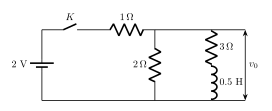
In the given circuit the output voltage v_0 at time t second after closing the key K is 1 volt. Calculate the rate of change of current in the inductance coil at this moment.
Two inductance coils hang inductances L_1 and L_2 and negligible resistances are connected in parallel. The coils have a mutual inductance M. Obtain an expression for the effective inductance of the combination.
The electric field vector of a plane electromagnetic wave is given by: \vec{E} = E_0 \cos(kz - \omega t + \delta)\hat{x} Write the magnetic field vector. Calculate the average energy per unit volume stored in electromagnetic field and the average energy flux density.