
The mean speed of the molecules of an ideal monatomic gas when it contracts (or expands) adiabatically depends on the pressure according to the law v = K p^n, where K is a constant. Find n.
ifos-2016-subject-04-002
The mean speed of the molecules of an ideal monatomic gas when it contracts (or expands) adiabatically depends on the pressure according to the law v = K p^n, where K is a constant. Find n.
A Van der Waals gas undergoes Joule-Kelvin expansion with a pressure drop of 50\ \mathrm{atm}. If its initial temperature is 300^{\circ}\mathrm{K}, determine its final temperature. (Given Van der Waals constant a=0.136\ \mathrm{Pa\,m^6\,mol^{-1}}, b=36.5\times10^{-6}\ \mathrm{m^3\,mol^{-1}}, C_p=30\ \mathrm{J\,K^{-1}\,mol^{-1}}, R=8.3\ \mathrm{J\,K^{-1}\,mol^{-1}}.)
Start from the equation T dS = C_p dT - T \left( \frac{\partial V}{\partial T} \right)_P dP and get the relation \left( \frac{\partial C_p}{\partial P} \right)_T = -T \left( \frac{\partial^2 V}{\partial T^2} \right)_P Hence, show that the third law of thermodynamics requires for the coefficient of thermal expansion of any substance to vanish at T = 0.
Plot the Fermi distribution function versus energy at temperatures T = 0 and T > 0. Explain the nature of the former curve on the basis of the Pauli principle.
For a Van der Waals gas, write down the equation of state. Determine the coefficient of critical expansion \beta.
Discuss the consequence following from Joule's free expansion experiments in the context of the internal energy of an ideal gas.
Derive an expression for the total number of particles N in an ideal Bose gas at any temperature T. Hence, obtain the relation N_0 = N \left[ 1 - \left( \frac{T}{T_0} \right)^{\frac{3}{2}} \right] for the number of particles N_0 in the ground state at T < T_0, the Bose-Einstein condensation temperature, and draw N_0 versus T curve.
The vapour pressure of an organic substance is 50\times10^3\ \mathrm{Pa} at 40^{\circ}\mathrm{C}. Its normal boiling point is 80^{\circ}\mathrm{C}. If the substance in vapour phase can be treated like an ideal gas, find the latent heat of vaporization of the substance.
Show that the elemental quantity of heat dQ is not a total differential.
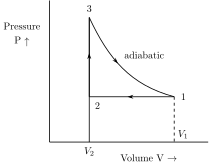
The figure below represents an imaginary ideal gas cycle. Assuming constant heat capacities, show that the thermal efficiency is : \eta = 1 - Y \frac{(V_1/V_2) - 1}{(P_3/P_2) - 1}
For a degenerate Fermi-Dirac gas, the concentration of nucleons in nuclear matter is N = 1.1 \times 10^{38}\text{ cm}^{-3}. Calculate the Fermi energy and Fermi temperature.
Consider a system of free gas particles having f degrees of freedom. Use equipartition theorem to establish the relation f=\frac{2}{\left(\dfrac{C_p}{C_V}-1\right)}, where C_p and C_V are molar specific heats at constant pressure and constant volume respectively. Obtain the values of \dfrac{C_p}{C_V} for diatomic and triatomic gases.
Explain the four thermodynamic relations of Maxwell. Using the same, obtain the Clausius-Clapeyron equation \frac{\mathrm{d}P}{\mathrm{d}T}=\frac{L}{T(V_2-V_1)}.
Show that both Fermi-Dirac and Bose-Einstein distribution functions at an energy E are given by: f(E) \simeq \exp\left[\frac{\mu-E}{k_{\mathrm B}T}\right], where f(E) is much smaller than unity, \mu and k_{\mathrm B}T are the chemical potential and thermal energy of the atom.
Define Enthalpy and show that it remains constant in a throttling process.
One kg of water at 20^\circ\mathrm{C} is converted into ice at -10^\circ\mathrm{C} at constant pressure. Heat capacity of water is 4{,}200\ \mathrm{J\,kg^{-1}\,K^{-1}} and that of ice is 2{,}100\ \mathrm{J\,kg^{-1}\,K^{-1}}. Heat of fusion of ice at 0^\circ\mathrm{C} is 335\times10^3\ \mathrm{J\,kg^{-1}}. Calculate the total change in entropy of the system.
Derive an expression for the Fermi energy for a free electron gas at T = 0. Compute the Fermi temperature of Cu assuming the density 9\text{ gms/cm}^3 and one conduction electron per atom.
What is transport phenomenon ? Obtain the expression for the coefficient of viscosity. Discuss its temperature dependence.
State Dulong-Petit's law and discuss its limitations in explaining heat capacities of solids. How were these efficiencies overcome by Debye ?
Calculate the net change in entropy when 10\text{ g} water at 60^\circ\text{C} is mixed with 30\text{ g} water at 20^\circ\text{C}.