Comment Done
Navigation
HomePYQs Question BankCSE Physics OptionalIFoS Physics OptionalBlog & InsightsCourses & ProgrammesMy Courses (Candidate Portal)
Account
/
20 questions visible on this page

Write Bose-Einstein distribution function explaining every symbol. Derive Einstein's result on specific heat of solids explaining the assumptions made in the model. Discuss the low and high temperature limits of the predicted specific heat. In which limit, the Einstein formula fails to explain the experimental data?

IFoS 2018Paper I10 marksifos-2018-subject-04-004

Explain Maxwell-Boltzmann formula for distribution of velocities of gas molecules at temperature T. What will be the formula for distribution of speeds? If \bar{v}, v_{\text{rms}} and v_m denote average speed, root mean square velocity and most probable speed, show that \bar{v} : v_{\text{rms}} : v_m = \sqrt{\frac{8}{\pi}} : \sqrt{3} : \sqrt{2}

IFoS 2018Paper I15 marksifos-2018-subject-04-005

Derive the mathematical expression for the total energy of a degenerate Fermi gas at a temperature T and calculate the specific heat of the Fermi gas at this temperature.

IFoS 2017Paper I15 marksifos-2017-subject-04-004

State Maxwell's distribution law of molecular speeds. Draw and explain a curve between n(c) and c in a gas at a given temperature T, where n(c) dc is the number of molecules having speed between c and c + dc. Discuss the effect of T and mass m of the molecule on the nature of the curve.

IFoS 2017Paper I15 marksifos-2017-subject-04-003

Describe neutron star on the basis of Fermi-Dirac statistics and obtain the condition of critical mass for a neutron star.

IFoS 2017Paper I8 marksifos-2017-subject-04-002

Prove the thermodynamic relation : \left( \frac{\partial S}{\partial V} \right)_T = \left( \frac{\partial P}{\partial T} \right)_V and hence show that \frac{\mathrm{d}P}{\mathrm{d}T} = \frac{L}{T (V_2 - V_1)} ; all the terms have their usual meanings.

IFoS 2017Paper I8 marksifos-2017-subject-04-001

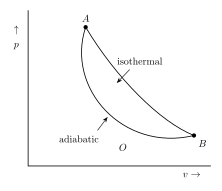
A quasistatic isothermal and quasistatic adiabatic intersect in a p-v diagram at more than one point as shown in diagram. Does it imply violation of 2nd law of thermodynamics ? Give reasons for your answer.

Physics Diagram ifos-q-4-018-fig-1
IFoS 2016Paper I1+9=10 marksifos-2016-subject-04-001

The mean speed of the molecules of an ideal monatomic gas when it contracts (or expands) adiabatically depends on the pressure according to the law v = K p^n, where K is a constant. Find n.

IFoS 2016Paper I10 marksifos-2016-subject-04-002

Write down the expression for the Bose-Einstein distribution function and explain the meaning of the symbols used.

IFoS 2016Paper I10 marksifos-2016-subject-04-005

A system of non-interacting fermions enclosed in a volume, V, is at T = 0^\circ\text{K}. Find an expression for the internal energy, U, of the system.

IFoS 2016Paper I8 marksifos-2016-subject-04-004

Derive the expression for the specific heat of a solid based on Einstein's theory. Obtain the limiting form of the specific heat at very low temperature.

IFoS 2016Paper I10 marksifos-2016-subject-04-003

Start from the equation T dS = C_p dT - T \left( \frac{\partial V}{\partial T} \right)_P dP and get the relation \left( \frac{\partial C_p}{\partial P} \right)_T = -T \left( \frac{\partial^2 V}{\partial T^2} \right)_P Hence, show that the third law of thermodynamics requires for the coefficient of thermal expansion of any substance to vanish at T = 0.

IFoS 2015Paper I5+15=20 marksifos-2015-subject-04-002

Derive an expression for the total number of particles N in an ideal Bose gas at any temperature T. Hence, obtain the relation N_0 = N \left[ 1 - \left( \frac{T}{T_0} \right)^{\frac{3}{2}} \right] for the number of particles N_0 in the ground state at T < T_0, the Bose-Einstein condensation temperature, and draw N_0 versus T curve.

IFoS 2015Paper I10+10=20 marksifos-2015-subject-04-004

Plot the Fermi distribution function versus energy at temperatures T = 0 and T > 0. Explain the nature of the former curve on the basis of the Pauli principle.

IFoS 2015Paper Iifos-2015-subject-04-003

Discuss the consequence following from Joule's free expansion experiments in the context of the internal energy of an ideal gas.

IFoS 2015Paper Iifos-2015-subject-04-001

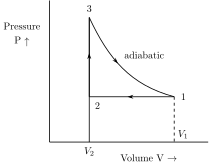
The figure below represents an imaginary ideal gas cycle. Assuming constant heat capacities, show that the thermal efficiency is : \eta = 1 - Y \frac{(V_1/V_2) - 1}{(P_3/P_2) - 1}

Physics Diagram ifos-q-4-014-fig-1
IFoS 2014Paper I15 marksifos-2014-subject-04-002

Derive an expression for the Fermi energy for a free electron gas at T = 0. Compute the Fermi temperature of Cu assuming the density 9\text{ gms/cm}^3 and one conduction electron per atom.

IFoS 2014Paper I5 marksifos-2014-subject-04-004

For a degenerate Fermi-Dirac gas, the concentration of nucleons in nuclear matter is N = 1.1 \times 10^{38}\text{ cm}^{-3}. Calculate the Fermi energy and Fermi temperature.

IFoS 2014Paper I8 marksifos-2014-subject-04-003

Show that the elemental quantity of heat dQ is not a total differential.

IFoS 2014Paper I8 marksifos-2014-subject-04-001

Calculate the net change in entropy when 10\text{ g} water at 60^\circ\text{C} is mixed with 30\text{ g} water at 20^\circ\text{C}.

IFoS 2013Paper I8 marksifos-2013-subject-04-002

Document & Diagram Scanner

Clean whiteboard & high-contrast scan with automatic image enhancement

Filter:
-- × -- pxCompressed: -- KB--% saved