Comment Done
Navigation
HomePYQs Question BankCSE Physics OptionalIFoS Physics OptionalBlog & InsightsCourses & ProgrammesMy Courses (Candidate Portal)
Account
/
20 questions visible on this page

How many nitrogen molecules must strike a 1\text{ cm}^2 surface each second to exert a pressure of 1\text{ atmosphere} ? (Assume the molecules are all moving at same speed, corresponding to a temperature of 300\text{ K}, and at an angle of 45^\circ to the wall). [Molecular mass of \text{N}_2 is 28\text{ u}]

IFoS 2021Paper I8 marksifos-2021-subject-04-006

Write a brief note on Chandrasekhar Limit.

IFoS 2021Paper I8 marksifos-2021-subject-04-005

Find the pressure at which water would boil at 150^\circ\text{C} if the change in specific volume when one gm of water is converted into steam is 1676\text{ c.c.} Given J = 4\cdot 2 \times 10^7\text{ ergs/cal}, one atmosphere = 10^6\text{ dyne/cm}^2 and latent heat of vapourisation of steam = 540\text{ cal/gm}.

IFoS 2021Paper I10 marksifos-2021-subject-04-003

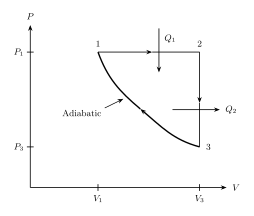
A hypothetical engine, with an ideal gas as the working substance, operates in the cycle shown below. Show that the efficiency of the engine is \eta = 1 - \frac{1}{\gamma} \left( \frac{1 - \dfrac{P_3}{P_1}}{1 - \dfrac{V_1}{V_3}} \right) .

Physics Diagram ifos-q-4-036-fig-1
IFoS 2021Paper I15 marksifos-2021-subject-04-004

Calculate the work done in expanding one mole of an ideal gas at 127^\circ\text{C} to double its initial volume.

IFoS 2021Paper I5 marksifos-2021-subject-04-002

Deduce Clausius-Clapeyron equations based on reversible cycle. Show that the specific heat of steam is negative. What is the significance of negative specific heat?

IFoS 2020Paper I15 marksifos-2020-subject-04-002

There are g cells of energy \varepsilon. Show that the number n of bosons of energy \varepsilon distributed among these cells is given by n = \frac{g}{e^{(\varepsilon - \mu)/kT} - 1} What is \mu and how will you find it?

IFoS 2020Paper I15 marksifos-2020-subject-04-005

Write down the distribution law obeyed by electron gas and apply the same to derive Richardson-Dushman equation.

IFoS 2020Paper I8 marksifos-2020-subject-04-004

Calculate (i) the internal energy of the electron gas per unit volume and (ii) the molar specific heat at constant volume for sodium at 100\text{ K} containing one free electron per atom. Given that the density of sodium = 0{\cdot}97 \times 10^3\text{ kg m}^{-3} and the atomic weight of sodium = 23.

IFoS 2020Paper I10 marksifos-2020-subject-04-003

10\text{ g} of water at 60\text{ }^\circ\text{C} is mixed with 30\text{ g} of water at 20\text{ }^\circ\text{C}. Will the entropy of the system increase or decrease? Calculate the change.

IFoS 2020Paper I8 marksifos-2020-subject-04-001

Derive Maxwell's thermodynamic relations using concepts of internal energy, Helmholtz function, Gibbs' function and enthalpy.

IFoS 2019Paper I10 marksifos-2019-subject-04-005

Consider a quantum – mechanical gas of non-interacting spin zero bosons, each of mass m which are free to move within volume V. (i) Find the energy and heat capacity in the very low temperature region. Discuss why it is appropriate at low temperatures to put chemical potential equal to zero. (ii) Show how the calculation is modified for a photon (mass = 0) gas. Prove that the energy is proportional to \text{T}^4.

IFoS 2019Paper I5+10=15 marksifos-2019-subject-04-006

Obtain an expression for the specific heat capacity of a solid on the basis of Einstein's theory. How far do the results from this theory agree with experimental data ?

IFoS 2019Paper I15 marksifos-2019-subject-04-004

The equation of state of a dilute gas at very high temperature is described by \frac{\text{PV}}{\text{kT}} = 1 + \frac{\text{B(T)}}{\text{V}}, where V is the volume per particle and B(T) is a negative quantity. One can conclude that this is a property of a Van der Waal's gas. Explain why it is a property of Van der Waal's gas.

IFoS 2019Paper I10 marksifos-2019-subject-04-003

Derive an expression for the entropy change in the expansion of a gas from volume \text{V}_i to volume \text{V}_f. Use a statistical definition of entropy for derivation.

IFoS 2019Paper I20 marksifos-2019-subject-04-002

Obtain Clausius – Clapeyron equation which applies to any first-order change of phase or any transition that occurs at constant temperature and pressure. Use Maxwell's thermodynamic relation for deriving the equation.

IFoS 2019Paper I8 marksifos-2019-subject-04-001

Show that the probability of occupation for an electron state at the Fermi energy is equal to 0\cdot 5 for all finite temperatures.

IFoS 2018Paper I8 marksifos-2018-subject-04-006

Consider N molecules of a gas obeying van der Waals' equation of state given by \left( P + \frac{a N^2}{V^2} \right) (V - Nb) = N k_B T where a is a measure of the attractive forces between the molecules and b is another constant proportional to the size of the molecules. The other symbols have their usual meanings. Show that during an isothermal expansion from volume V_1 to volume V_2 quasi-statically and reversibly, the work done is W = -N k_B T \log \left( \frac{V_2 - Nb}{V_1 - Nb} \right) + a N^2 \left( \frac{1}{V_1} - \frac{1}{V_2} \right)

IFoS 2018Paper I8 marksifos-2018-subject-04-001

Starting from the first law of thermodynamics, show that C_p - C_v = \left[ P + \left( \frac{\partial U}{\partial V} \right)_T \right] \left( \frac{\partial V}{\partial T} \right)_P

IFoS 2018Paper I8 marksifos-2018-subject-04-002

Define Fermi energy and show that for an electron gas at absolute zero temperature, the Fermi energy is given by E_F = \left( \frac{h^2}{2m} \right) \left( \frac{3}{8\pi} \frac{N}{V} \right)^{2/3} where the symbols have their usual meanings. Estimate the numerical value of Fermi energy for copper taking number of electrons per unit volume as 8\cdot 4 \times 10^{22}\text{ electrons/cm}^3 and find Fermi temperature T_F.

IFoS 2018Paper I10 marksifos-2018-subject-04-003

Document & Diagram Scanner

Clean whiteboard & high-contrast scan with automatic image enhancement

Filter:
-- × -- pxCompressed: -- KB--% saved