
What are type I and type II superconductors? Give examples. Discuss and compare Meissner effect and perfect diamagnetic behaviour for type I and type II superconductors.
cse-2018-subject-08-004
What are type I and type II superconductors? Give examples. Discuss and compare Meissner effect and perfect diamagnetic behaviour for type I and type II superconductors.
Describe the working of a microprocessor system in block diagram. How is its performance affected in a pipelined processor?
Explain drift velocity, mobility and conductivity of an intrinsic semiconductor.
Calculate the total conductivity in an intrinsic semiconductor. How does this conductivity change with temperature ?
Derive the expression for electron concentration in the conduction band of an intrinsic semiconductor.
Derive an expression for lattice specific heat in Debye model. Find its low temperature limit (Debye T^3 law).
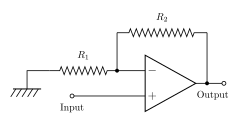
Consider the operational amplifier circuit given above: Given, R_1=10\,\mathrm{k}\Omega, R_2=150\,\mathrm{k}\Omega and the product of the open loop gain of the amplifier and its bandwidth =10^6\,\mathrm{Hz}. Determine the closed loop bandwidth of the amplifier.
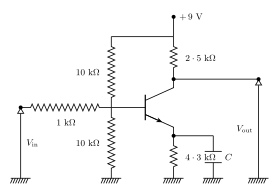
An amplifier in common-emitter configuration is shown in the above figure. If the current gain \beta=100 and the a.c. emitter resistance =25.0\,\Omega, determine the input impedance and the voltage gain of the amplifier:
What is Meissner effect ? Explain perfect diamagnetism in reference to this.
In a semiconductor, the effective masses of an electron and a hole are 0.07\,m_0 and 0.4\,m_0, respectively, where m_0 is the free electron mass. Assuming that the average relaxation time for the hole is half of that for the electrons, calculate the mobility of the holes when the mobility of the electrons is 0.8\,\mathrm{m^2\,volt^{-1}\,s^{-1}}.
What do you understand by spontaneous magnetization below Curie temperature ? Explain with an appropriate diagram, the occurrence of a hysteresis loop in a ferromagnetic material.
A system of paramagnetic atoms (N per unit volume) which can occupy only two energy levels in a uniform external magnetic field H is at a temperature T. If this system follows Boltzman's distribution, find the magnetisation and susceptibility of the system.
The energy (E) and wave vector (k) for a conduction band electron in a semiconductor are related as E=\alpha\,\dfrac{\hbar^2 k^2}{m_0} where \alpha is a constant and m_0 is the free electron mass. Calculate the effective mass of the electron.
Determine the values of emitter current and the collector current of the transistor having \alpha = 0\cdot98 and collector to base leakage current I_\text{CBO} = 4\ \mu\text{A}. The base current is 50\ \mu\text{A}.
Obtain the expression for penetration depth using London's equation of superconductivity and explain its significance.
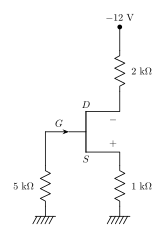
Given above is a circuit of self biased p-channel JFET. If the pinch off voltage is 5.0\ \mathrm{V} and V_{\mathrm{DS}} = 6.0\ \mathrm{V}, calculate the saturation current I_{\mathrm{DSS}}.
Define the terms critical magnetic field and critical temperature in a superconductor. Find the magnetic field strength necessary to destroy the superconductivity in a sample of lead at 4\cdot2\text{ K}. The critical magnetic field at 0\text{ K} is 0\cdot80\text{ Tesla} and the critical temperature is 7\cdot2\text{ K}.
Explain with the help of a neat diagram the working of an RC coupled common emitter amplifier.
Why does the resistance of a semiconductor decrease with increase in temperature ?
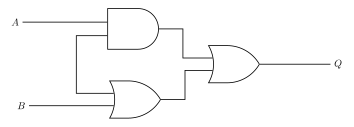
Find the Boolean algebra expression for the above system.