
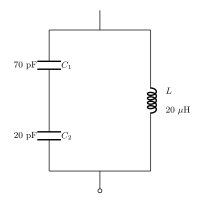
Explain how the circuit shown above can be a source of oscillations. Use this circuit to construct a transistor oscillator and explain its working. What is the frequency of oscillations of this circuit?
cse-2013-subject-08-006
Explain how the circuit shown above can be a source of oscillations. Use this circuit to construct a transistor oscillator and explain its working. What is the frequency of oscillations of this circuit?
Explain the variation of Magnetisation of Type I and Type II superconductors as a function of applied magnetic field.
What are the rules followed in biasing a bipolar junction transistor when it is used as an amplifier? Show how n-p-n and p-n-p transistors to be used as an amplifier are biased and the direction of flow of base, collector and emitter currents.
Classify diamagnetic, paramagnetic and ferromagnetic materials in terms of their magnetic susceptibility \psi. Plot and explain the variation of \frac{1}{\psi} with temperature for the three materials.
Construct an operational amplifier based analog computer to solve the differential equation \frac{d^2v}{dt^2}-\frac{dv}{dt}+2v=0.
Starting from an expression for the group velocity, arrive at an expression for the effective mass of an electron in a semiconductor. Explain the significance of sign of the effective mass.
Explain the race problem encountered in an RS latch and how it can be avoided. Build a Mod-10 counter using JK flip-flops and explain its working.
Metallic iron undergoes a structural phase transition from bcc to fcc at 910^\circ\mathrm{C}. At this temperature, the atomic radii of iron atoms in the bcc and fcc structures are 0.126 \times 10^{-9}\,\mathrm{m} and 0.129 \times 10^{-9}\,\mathrm{m} respectively. Calculate the volume change in percentage during this structural change.
Derive Bragg diffraction condition in vectorial form using incident and diffracted wave vectors and reciprocal lattice vector.
Draw the common-base amplifier circuit, using an n-p-n transistor and briefly discuss its working.
Simplify the logical expression AB + \bar{A}\bar{B} + ABC using a Karnaugh map.
Describe the characteristic properties of a superconductor. Derive London equation for a superconductor and hence explain Meissner effect.
Distinguish between intrinsic and extrinsic semiconductors. Show that in a semiconductor, the product of concentrations of the two types of charge carriers is constant at a given temperature.
Simplify the logical expression \overline{(A+B)}B(A+\bar{C}) and draw the logical circuit to implement it.
Explain the origin of energy band formation in solids. Show that in nearly free electron approximation, the energy band gap is 2|V_G|, where V_G is Fourier transform of periodic potential seen by the valence electrons.
Find an expression for lattice specific heat of solids, and its low and high temperature limits. What is Debye temperature?
An electron beam of 4 Kev is diffracted through a Bragg angle of 16^\circ for the first maxima. If the energy is increased to 16 keV, find the corresponding Bragg angle for diffraction.
Draw a two stage RC coupled transistor amplifier. Plot the frequency response and indicate the lower and upper cut off frequencies and the bandwidth.
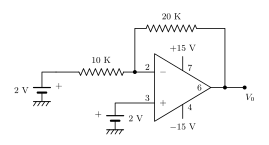
Identify the above op-amp circuit. Estimate the net output voltage V_0.
What is Josephson tunnelling? Distinguish between a.c. and d.c. Josephson effects.