
What are intrinsic and extrinsic semiconductors? Show that in the intrinsic semiconductors, Fermi level lies exactly in the middle of bottom of conduction band and top of valence band.
cse-2018-subject-08-005
What are intrinsic and extrinsic semiconductors? Show that in the intrinsic semiconductors, Fermi level lies exactly in the middle of bottom of conduction band and top of valence band.
What are operational amplifiers? How can it be used as an inductor? Prove it mathematically.
What are type I and type II superconductors? Give examples. Discuss and compare Meissner effect and perfect diamagnetic behaviour for type I and type II superconductors.
Describe the working of a microprocessor system in block diagram. How is its performance affected in a pipelined processor?
Derive Bragg diffraction law for X-ray diffraction. Compare Laue and Debye-Scherrer methods for crystal structure determination.
Calculate Atomic Packing Fraction (APF) for FCC and HCP structures, and show that these are the most closely packed structures.
Derive an expression for lattice specific heat in Debye model. Find its low temperature limit (Debye T^3 law).
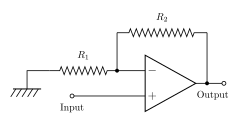
Consider the operational amplifier circuit given above: Given, R_1=10\,\mathrm{k}\Omega, R_2=150\,\mathrm{k}\Omega and the product of the open loop gain of the amplifier and its bandwidth =10^6\,\mathrm{Hz}. Determine the closed loop bandwidth of the amplifier.
A system of paramagnetic atoms (N per unit volume) which can occupy only two energy levels in a uniform external magnetic field H is at a temperature T. If this system follows Boltzman's distribution, find the magnetisation and susceptibility of the system.
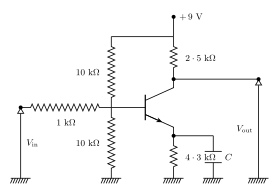
An amplifier in common-emitter configuration is shown in the above figure. If the current gain \beta=100 and the a.c. emitter resistance =25.0\,\Omega, determine the input impedance and the voltage gain of the amplifier:
The energy (E) and wave vector (k) for a conduction band electron in a semiconductor are related as E=\alpha\,\dfrac{\hbar^2 k^2}{m_0} where \alpha is a constant and m_0 is the free electron mass. Calculate the effective mass of the electron.
Obtain the expression for penetration depth using London's equation of superconductivity and explain its significance.
In a semiconductor, the effective masses of an electron and a hole are 0.07\,m_0 and 0.4\,m_0, respectively, where m_0 is the free electron mass. Assuming that the average relaxation time for the hole is half of that for the electrons, calculate the mobility of the holes when the mobility of the electrons is 0.8\,\mathrm{m^2\,volt^{-1}\,s^{-1}}.
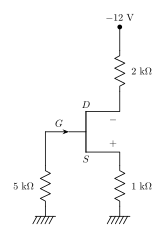
Given above is a circuit of self biased p-channel JFET. If the pinch off voltage is 5.0\ \mathrm{V} and V_{\mathrm{DS}} = 6.0\ \mathrm{V}, calculate the saturation current I_{\mathrm{DSS}}.
Obtain Laue's equations for X-ray diffraction by crystals. Show that these are consistent with the Bragg's law.
With the help of a schematic diagram, show how entropy and specific heat vary with temperature for a superconductor.
What is the difference between direct and indirect band gap semiconductors? Which one is suitable for use in solar cells?
The primitive translation vectors of a two-dimensional lattice are \hat{a}=2\hat{i}+\hat{j},\quad \hat{b}=2\hat{j}. Determine the primitive translation vectors of its reciprocal lattice.
Distinguish between a superconductor and perfect conductor. Explain what is a Cooper pair.
Draw the device structure of a p-n junction solar cell and explain how light energy is converted into electrical energy. Draw and explain its I-V characteristics.